

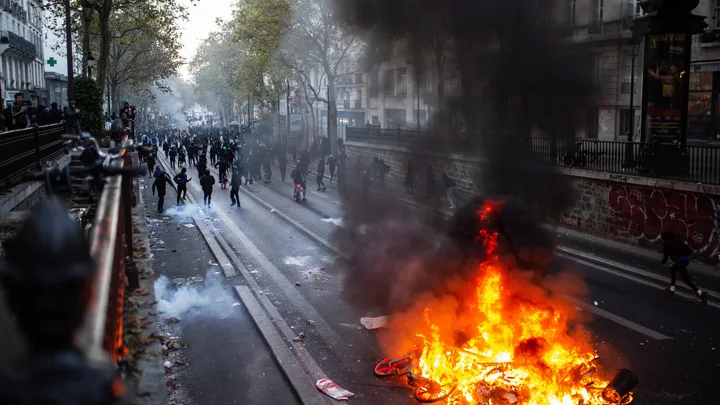
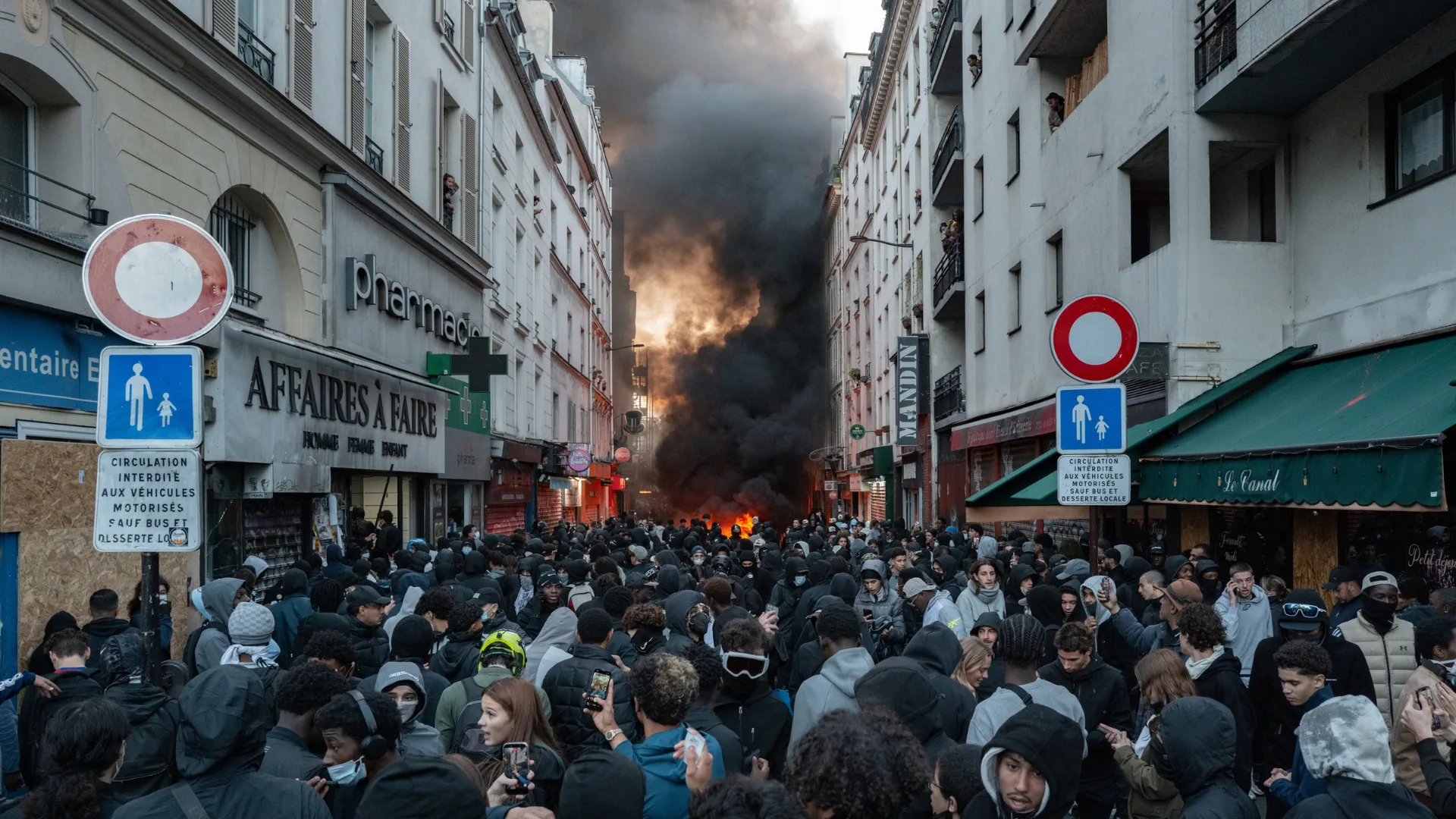
Whole streets in Paris have “been devastated”, according to the city’s mayor Emmanuel Gregoire, and more than 1,800 people (some publications report 2,000) have been arrested in the protests so far, reports The Guardian. The protests originally were about education and schooling conditions in France but have since broadened to wider cost of living issues, including rising fuel prices.
On Saturday, October 17, roughly 550,000 to 800,000 protested peacefully in street marches around France, but fringe groups instead opted for violence, targeting public buildings, looting luxury boutiques and supermarkets and attacking police officers and cars, according to the ABC.
“We will all stand united against the sowers of chaos, who only seek to undermine our institutions and prevent those who peacefully express their demands from doing so,” President Emmanuel Macron wrote on X.
In Paris, rioters attempted to break into The Galeries Lafayette department store, ransacked a Lacoste store and looted an SFR mobile phone shop. At least one restaurant was gutted by fire.
“Riot police were seen charging at one crowd in central Paris and hitting several people with batons,” reports the BBC.
In Limoges, a French city four-hour drive south of Paris, the City Hall was set on fire, while in Marseille, on the southern coastline, black-clad protesters broke into its City Hall, using a metal fence as a battering ram, and defaced the building with anarchic graffiti. The BBC reports that in Lille, a 2.5-hour drive north of Paris, police said a McDonald’s was set on fire, and an Apple store in the city was broken into and looted.
Violent incidents have also been recorded in French towns and cities Rennes, Toulouse and Angers, reports the UK’s The Independent.
More than 500 police officers, gendarmes and firefighters were injured over the weekend, reports The Guardian. The cost of damage to shops across the country will run to hundreds of millions of euros, according to a trade body president.
“I find it unacceptable – absolutely unacceptable,” a Parisian local for more than 70 years, known simply as ‘Rabah’, told Al Jazeera. “Back in the day, we also demonstrated, but peacefully.”
The protests have also spread to Spain, Italy and Portugal. “The Portuguese social class that pays taxes, that which keeps this country going, is under attack and is losing its rights, notably its right to housing,” Elena Costa, a 46-year-old social assistant, told The Guardian over the weekend. “So we are all here together to try to explain that we are suffocating.”
Why Did The France Protests Start?
The protests stemmed from anger over disparities in school quality, university admissions decisions, and latent racial discrimination and a sense among young people that those in power were not listening to them, reports Time. Students said they’re also concerned with the government not giving them enough opportunities.
On the other side, workers, including school staff, were concerned with wages and resources available to deliver public services, reports Al Jazeera.

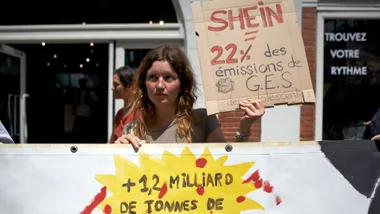
The school protests combined with a nationwide public sector strike against the government’s budget plans has resulted in what one professor called “the worst possible outcome for the French government”. The professor of contemporary history at the University of Edinburgh, Emile Chabal, added to Al Jazeera that the demonstrations were “the logical outcome of a series of protests”.
When Did The France Protests Start?
This current wave of protests started in late September, a week after the start of the school year, according to The Guardian. Specifically, the first protest happened at a high school in Creteil, a Parisian suburb, on September 17 over a lack of teachers, poor facilities and long declining quality of education, according to Time.
High school students called class strikes and blockades over teacher shortages, overcrowded classrooms and dilapidated school facilities, reports Al Jazeera. At the time, some of the school blockades had turned violent with protesters burning rubbish bins and throwing bottles at officers.
When Will France Protests End?
French president Emmanuel Macron will address his country on TV on Sunday, October 18 at 8pm (Monday, October 19 at 5pm AEDST) after crisis meetings with ministers. Though there’s no indication of when this unrest will end, the president’s speech should shed more light on the situation and the government’s plans moving forward. France is holding its presidential elections in April 2027.
Is France Safe To Visit Now With The Protests?
The current advice for Australian travellers considering heading to France is to “Exercise a high degree of caution due to the threat of terrorism”. The official Smart Traveller website has ranked it a level 2 out of 4.

