

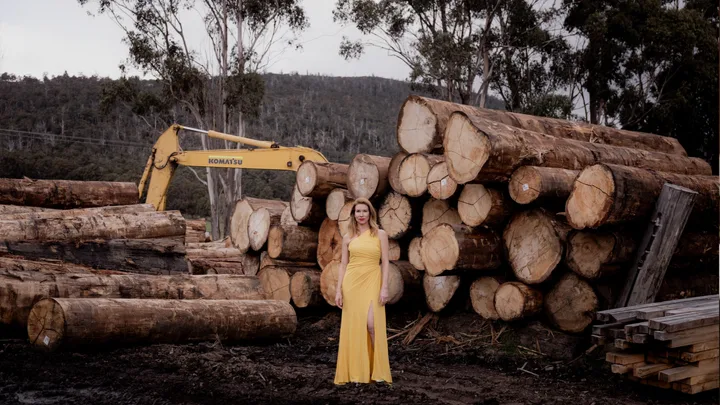
Kirsha Kaechele is standing beside a towering pile of enormous, felled trees in an asymmetric yellow ballgown. The sawn ends of the trunks are circular, smooth and so wide each tree must have been 100 years old when it was brought to the ground. Stacked together, they dwarf the strawberry-blonde Kaechele, who – in her trademark red lipstick and high heels – is on her way to drafting a landmark, Palawa-led agreement to end old-growth logging in Tasmania.
Although the dress is almost an exact colour match to the crane behind her, the outfit is decidedly out of place in the remnants of the forest. But for Kaechele – the art curator and artist who is married to Mona founder David Walsh – a ballgown is a weapon and when you’re stepping inside a decades-long war, like the one engulfing Tasmanian forestry, you need all the firepower you can muster. Also in her arsenal: lavish dinners, performance art, nudity, champagne, live music, dancing, karaoke, bonfires, saunas and ocean swims.
In many ways, this is diplomacy amid the heady pulses of a wild and otherworldly witches’ sabbat. “Feminine power, sex appeal, sexual power is a healing force,” Kaechele says. “The industry is almost all men and they respond to it. They can’t help it.” In the architecture of her schemes, nothing is an accident. She is equal parts self-aware, emotionally intelligent, playfully seductive and disarming. She continues: “Everybody loves the goddess. She melts tension, she melts fear, she melts pain, and that energy really healed a lot of the hurt and bridged the differences in the room.”
The Forest Congress has met intermittently since 2023. Historical enemies – the greenies and the loggers, who would normally only encounter each other on opposite sides of a picket line – were invited to talk (and play), face-to-face, in the same room. They were propelled by Kaechele’s belief that in the right circumstances, surrounded by beauty, charmed by creativity and plied with tequila, their differences would shrink, common values would be unearthed and agreement about how to protect Tasmanian forests and the communities they employ might be reached. It was the first time the Palawa – the Indigenous people of Lutruwita (Tasmania) – had been invited to participate in a conference about forestry. Their leadership proved critical to the project’s success and a Shared Vision Statement was signed by more than 30 participants in July of this year.
“Every time the energy in the room was on the verge of eruption, someone from the Palawa mob would just bring it back down and remind people that it’s not about you, it’s about something bigger,” Kaechele says.
The Palawa have a sacred connection to the Tasmanian landscape and, for them, the stakes could not have been higher. “We stand on the edge of those logging coupes and witness the slaughter of our kin out there in those forests,” says Ruth Langford, also known as Tipruthanna, a Tasmanian-born Yorta Yorta/Dja Dja Wurrung woman and activist. “The amount of immense grief that I hold in my body and the immense rage that [felling] continues. Every single time we stepped into the room at Forest Congress, we had to call forth on this depth of generosity.”
The tension that would arise during a confrontation between two legacy adversaries – like foresters tearing down native ecosystems that are critical to water catchments and biodiversity, meeting greenies determined to destroy their industry and therefore their livelihoods – was something Kaechele anticipated. She diffused it by having punk rock bands blast music at odd moments, sex performers who pulled things out of their vaginas or encouraging tequila-fuelled karaoke sessions (John Farnham’s “You’re the Voice” was a universal favourite). “Those timed intrusions were really helpful because it just broke the ice and everyone kind of laugh or brought the tension outside of themselves,” Kaechele says. “So, they’re just putting their hand on the person next to them and saying, ‘Oh my gosh,’ and then looking, ‘Oh my gosh, you’re an environmentalist. Oh my gosh, you’re a logger.’ ”
Langford recalls a time when she was in a sauna at an event and honey made by bees from one of the threatened forests was being passed around. “We took that honey in our hand and smeared it over our bodies. It was so sensual; we were sweating and here I am sitting next to a logger,” she says. “It blew my mind. It was surreal. It took me beyond my normal comfort levels, but it enabled us to open up and speak about things. We got to see each other beyond just our positions.” (Langford is a particularly fierce adversary and has been arrested for protesting inside logging coupes.)
Steve Pearce, the creative director of The Tree Projects (a greenie), describes experiencing a similar moment of unexpected comradeship. He was sitting next to the forest manager for Sustainable Timber Tasmania, watching a man recite poetry with his penis out. “We shared one of those little side-eye glances like, ‘Ooh, this is interesting.’ But we had a wicked chat after that, had a glass of wine, a bit of a meal. And he was like, ‘Steve, mate, I know you’ve been looking at this place. We’re not going to log it.’ Just like that.”
One reason an agreement had been so far out of reach until now is that concepts within forestry are convoluted. At opposite ends of the spectrum, the definitions are settled: ancient or old-growth forests have never been touched; plantations are monocultures of trees that require chemicals to grow. But in between, there are biodiverse native forests with functioning ecosystems that have undergone selective harvesting or have regrown after clear cutting decades ago – when and if it is OK to continue logging in these areas is debated.
What’s also highly contentious is what areas “should” be available for industry. Some loggers see all forests – including old-growth – as renewable resources there for the taking. Some greenies believe selective, time-managed harvesting in native forests is preferable to plantations. Hardline greenies see plantations as the only viable option and insist all native logging must be ended. The loggers are worried about what will happen to their families and rural communities – which are already struggling – if the forestry industry is shackled or outlawed. The greenies and the Palawa are worried about the future of the planet because forests are carbon sinks, home to much of the world’s biodiversity, provide bushfire breaks, and ensure the climate is regulated and that we have clean air to breathe and clean water to drink.
Kaechele’s position on the debate between logging in native forests versus plantations is clear: “As someone who studied permaculture, I find [the idea of plantations being the only permissible landscape in forestry] ecologically depressing. Isn’t a diverse native ecosystem preferable to a single-species monoculture for growing wood?”
Naturally, some of the Forest Congress experiences were designed to support this. “There was one incredible bit of art,” recalls Michael Schofield, the resource and sustainability manager for Midway Tasmania (a forester). “We got off the bus, and we were handed a bow and arrows. I’m looking around thinking it’s like something out of The Hunger Games. And then we start firing these proper bow and arrows – they’re about a metre high – up the rows of pine plantations. And it was just a moment in time when some of the environmentalists realised
that the plantations are a monoculture.”


The biggest breakthrough, the one that led to the formal agreement, arrived messily, as most breakthroughs do. With each glass of champagne, fireside performance or blurry morning watching the stars give way to sunrise, each side surrendered a little pride, confessed to their fears and openly declared their love of the forest and a desire to do forestry better. No-one, it seems, wants to be cutting down ancient forests, and loggers want to be doing best practice forestry rather than just relying on plantations, which are ecologically simplified, don’t provide suitable habitats for wildlife and are vulnerable to bushfires and pests.
And so, after three years of discussion, a three-tiered agreement was drafted. Signatories pledged to end oldgrowth logging; limit forestry to regrowth native forests under the age of 80 years; and that going forward, logging would be determined by a collaborative, whole-of-landscape assessment informed by Indigenous knowledge, ecological values, practical experience and the latest science.
Some conservationists are critical of the proposal, including the Bob Brown Foundation, which has dismissed it as Kaechele’s performance art while overlooking the leadership of the Palawa people. They insist the focus on old-growth forests does not go far enough and that logging in all native forests needs to end.
While the principles in the statement are relatively simple, enshrining them into law is more complex. Tasmania’s native forest logging system currently sits outside federal legislation, but new national environmental standards will be applied from July. And so, for the congress – which is run by a team of women – the work is never done.
In November, a project called OnlyFerns (an adult film site) was launched to fund the next round of forest-art. While examining the ethics of using pornography to raise money to protect the forests – something that would undoubtedly horrify ecofeminists – is outside the scope of this piece, one thing is clear. In Kaechele’s world, femininity, sexuality, couture, cocktails, stilettos and pleasure are tools to dismantle the patriarchy’s dominateand- destroy mantra. They are a means to dissolve and disarm the harsh, extractive values that are bringing the climate and the economy to the edge of collapse.
“I’ve seen Kirsha in the bush trekking around in many thousands of dollars’ worth of outfits that are not really fit for purpose,” says Dwayne Kerrison, general manager of Orana Enterprises (a logger). “Would the Forest Congress have felt different if it was all organised by men? Absolutely. Would the outcome have changed? Probably. Yes, there was phenomenally out-of-place ballgowns and things, but she’s doing what she wants to do and she’s having the time of her life. She did a wicked job. Her team did a wicked job.”

