In the heart of Bukchon, Seoul’s traditional hanok neighbourhood, sits a stunningly contemporary piece of architecture: Futura Seoul. Standing at the entrance, its sharp-edged concrete facade feels like it should be out of place. And yet it’s precisely that juxtaposition that makes the space the perfect setting for L’ÉCOLE’s first Nomadic School in South Korea, where savoir-faire meets curious minds.
It’s here that the once-closed doors of the high jewellery world are opened to me — and everyone else. As Van Cleef & Arpels’ President of Asia Pacific, Julie Clody-Medina puts it, the whole mission of L’ÉCOLE is “to demystify and open the door to the jewellery world.”

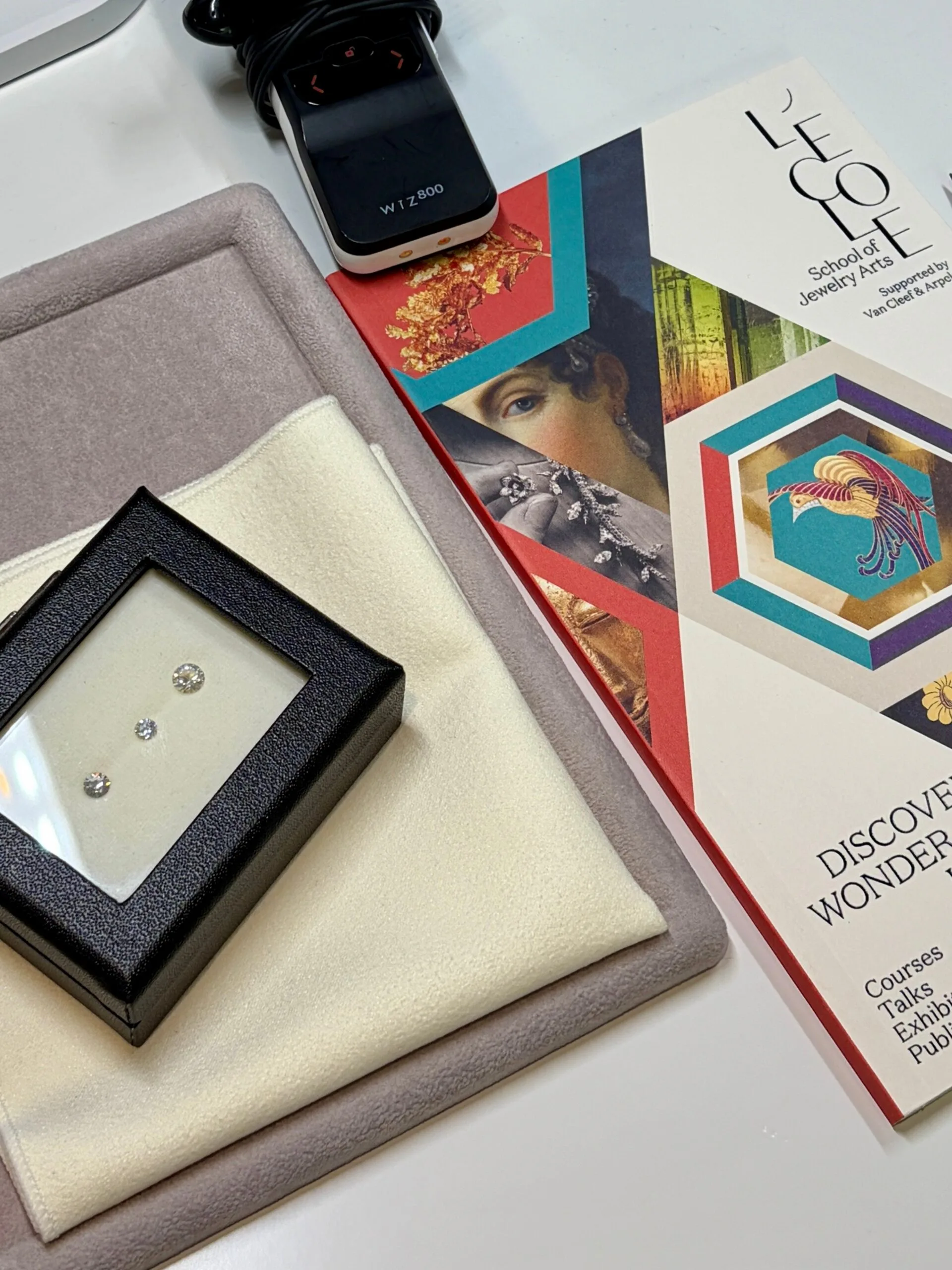
The course program is generous by any measure: 102 sessions over three weeks, including adult courses in savoir-faire, art history, and gemology, as well as youth workshops, expert talks, and the exquisite “Garden of Emeralds” exhibition. But I was there for one class in particular: “The Diamond: A Gemological Exception.”
Two gemologists walk us through the history, composition, and savoir-faire behind cutting jewellery’s most coveted stone; their knowledge and passion instantly infectious.
Beyond covering the basics of diamond composition, cut, carat, clarity, and colour comes the exceptional. The stone that anchored the session was the Lesotho Legend — a 910-carat rough diamond, the fifth-largest gem-quality diamond ever found, discovered at the Letšeng mine in Lesotho and acquired by Van Cleef & Arpels in 2018.
The real revelation isn’t the size of any single stone; it’s what I learn happens after it’s found. Cutters spent a year mapping the rough before it was cut into 67 individual diamonds, the largest being a spectacular 79.35-carat oval. It’s an impressive insight into how a single rough diamond is painstakingly analysed, mapped, and eventually cut into multiple gems of varying carat weights and cuts, each decision protecting or sacrificing size for clarity, symmetry, brilliance.
Each gem then serves as inspiration for a unique high jewellery piece to take form. On occasion, an already-imagined design has lain waiting for this moment – for the perfect stone to be cut.
The cutting process itself also proves fascinating. Diamond cutting has evolved from the earliest motorised saws to Henry Morse’s work applying scientific principles of light — the calculations of angle and proportion that eventually gave us the brilliant cut, the one most of us picture the second someone says “diamond ring.”
What stays with me long after the course ends is that rarity alone doesn’t make a diamond dazzling. That takes hands: gemologists mapping a single rough for months, and centuries of savoir-faire refined into the cut that finally makes it catch light. Sparkle, it turns out, is never just found. It’s made.


Related stories
Native ad body.

Native ad body.




Native ad body.