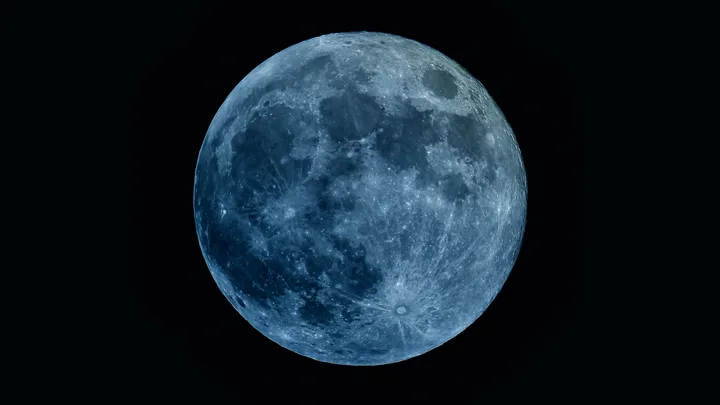
The first calendar Blue Moon since August 2023 will rise on May 31, bringing with it a rare cosmic double act. Not only is it a Blue Moon, but it is also a micromoon, making it one of the more unusual full moons of the year.
However, before you get too excited, the Moon will not actually appear blue.


A Blue Moon is simply the name given to the second full moon in a calendar month. Because the lunar cycle lasts roughly 29.5 days and does not align perfectly with our calendar months, these events occur every two to three years.
This year’s Blue Moon comes with an added distinction. It coincides with a micromoon, which occurs when a full moon falls near apogee, the point in the Moon’s orbit furthest from Earth.
As a result, it may appear slightly smaller and dimmer than a typical full moon, although the difference is subtle.
Astronomically, the event may be understated. Astrologically, however, many believe it is anything but. As the second full moon to grace May’s skies, it is often associated with manifestation, culmination and accelerated growth.
Ahead, everything to know about May’s Blue Moon.
When Can You See The Blue Moon In Australia?
Mark your calendar for Sunday, May 31, 2026. The Blue Moon will reach peak illumination at 6.45pm AEST, arriving just as the sky slips into that dreamy post-sunset shade of blue. The luminous effects will still be visible for days after, too.
The table below outlines when the Blue Moon will reach peak illumination in each Australian state and territory.
| State/Territory | Time of Peak Illumination |
|---|---|
| New South Wales | 6:45pm AEST |
| Victoria | 6:45pm AEST |
| Queensland | 6:45pm AEST |
| Australian Capital Territory | 6:45pm AEST |
| Tasmania | 6:45pm AEST |
| South Australia | 6:15pm ACST |
| Northern Territory | 6:15pm ACST |
| Western Australia | 4:45pm AWST |
What Do Blue Moons Mean Astrologically?
The first calendar Blue Moon since 2023 is not expected to return until December 2028, and astrologers believe it arrives with particularly potent energy. Symbolising culmination, clarity and release, the lunation coincides with several powerful planetary movements.
Saturn in Aries encourages bold action and renewed ambition, while Neptune in Aries and Pluto retrograde in Aquarius invite a reassessment of long-held beliefs, urging us to confront what has been overlooked or left unresolved.
The influence of the fixed star Antares is also thought to amplify confidence and opportunity, making this an auspicious moment for meaningful change.
Blue Moons are also associated with second chances. As an “extra” full moon within a calendar cycle, they are thought to offer an opportunity to revisit goals, revive abandoned projects and build on intentions that may have stalled earlier in the month.
Rather than marking a simple ending, this lunation is often viewed as a moment when lessons, insights and ambitions come full circle, creating space to move forward with greater clarity and purpose.
Fire Signs (Aries, Leo, Sagittarius)
For fire signs, this Blue Moon is all about recalibration. Aries is being called to embrace authenticity and stop compromising personal values to keep the peace. Leo may feel tested, but resilience and determination will help transform challenges into opportunities for growth. Meanwhile, Sagittarius is being encouraged to slow down, prioritise self-care and find a healthier balance between social commitments and much-needed rest.
Water Signs (Cancer, Pisces, Scorpio)
For water signs, this Blue Moon brings growth through confidence and change. Cancer is being encouraged to step beyond familiar routines and pursue experiences that reignite passion and curiosity. Scorpio may find opportunities to improve their financial situation, particularly through creative projects or calculated risks. Meanwhile, Pisces is being reminded to trust in their abilities, as a promising professional opportunity could be closer than they think.
Air Signs (Gemini, Libra, Aquarius)
For air signs, this Blue Moon shines a light on relationships and perspective. Gemini is being encouraged to let go of unrealistic expectations and embrace people for who they truly are. Libra may find their social calendar filling up fast, making boundaries and careful planning essential to avoid overcommitting. Meanwhile, Aquarius is learning that asking for support is not a weakness, with friends and loved ones ready to provide guidance when it is needed most.
Earth Signs (Taurus, Virgo, Capricorn)
For earth signs, this Blue Moon is centred on emotional growth and self-discovery. Taurus is being encouraged to honour personal boundaries and share only what feels comfortable, despite pressure from others to open up. Virgo may feel drawn back to old dreams and ambitions, using them as inspiration to cultivate greater confidence and self-belief. Meanwhile, Capricorn stands on the brink of a meaningful transformation, with intuition proving just as valuable as logic when navigating the next chapter.
Why Is It Called A Blue Moon?
Despite its name, a Blue Moon is not actually blue. The term is believed to have evolved from the centuries-old phrase “once in a blue moon”, which was used to describe something rare or unusual. By the 16th century, saying the moon was blue was a way of describing something absurd or unlikely.
The modern astronomical meaning came much later. Traditionally, a Blue Moon referred to the third full moon in a season containing four full moons rather than the usual three. Today, however, the term is most commonly used to describe the second full moon in a calendar month, a definition that gained popularity after a 1946 article mistakenly interpreted the older seasonal rule.
In short, the Moon is called “blue” not because of its colour, but because it is an uncommon addition to the lunar calendar.
What Is A Blue Micromoon?
A Blue Micromoon occurs when a Blue Moon and a micromoon happen at the same time. In May 2026, the full moon is both the second full moon of the calendar month, making it a Blue Moon, and a micromoon, meaning it occurs near apogee, the point in the Moon’s orbit furthest from Earth.
Because the Moon follows an elliptical orbit rather than a perfectly circular one, its distance from Earth changes throughout the month. When a full moon occurs near its furthest point, it can appear slightly smaller and dimmer than a typical full moon. The difference is subtle and often difficult to notice with the naked eye, but it is enough to earn the micromoon designation.
The combination of a Blue Moon and a micromoon is relatively uncommon, making May’s lunar event a particularly notable one for skywatchers.

Related stories

Native ad body.
Native ad body.


Native ad body.