

Trigger warning: This story discusses perinatal mental health, including anxiety and depression, which may be distressing for some readers. If you need help: Free, confidential support is available in Australia. Contact PANDA on 1300 726 306 for perinatal mental health support, Beyond Blue on 1300 22 4636 or via beyondblue.org.au, or Lifeline on 13 11 14 for 24/7 crisis support.
It’s been called “America’s saddest murder trial”, and whatever your opinion of Lindsay Clancy – the woman accused of strangling her three children before cutting her own wrists and throwing herself from a second-storey window – on this description, the verdict surely must be unanimous.
Five-year-old Cora, three-year-old Dawson and baby Callan – just eight months old – were found dead in the basement of the Clancy family home before a frantic 911 call from their father, Patrick, in January 2023.
For six weeks, the world watched in horror as details of the almost unfathomable tragedy unfurled in a Massachusetts courtroom, live-streamed and dissected via infinite Tik Tok breakdowns and watercooler debates.
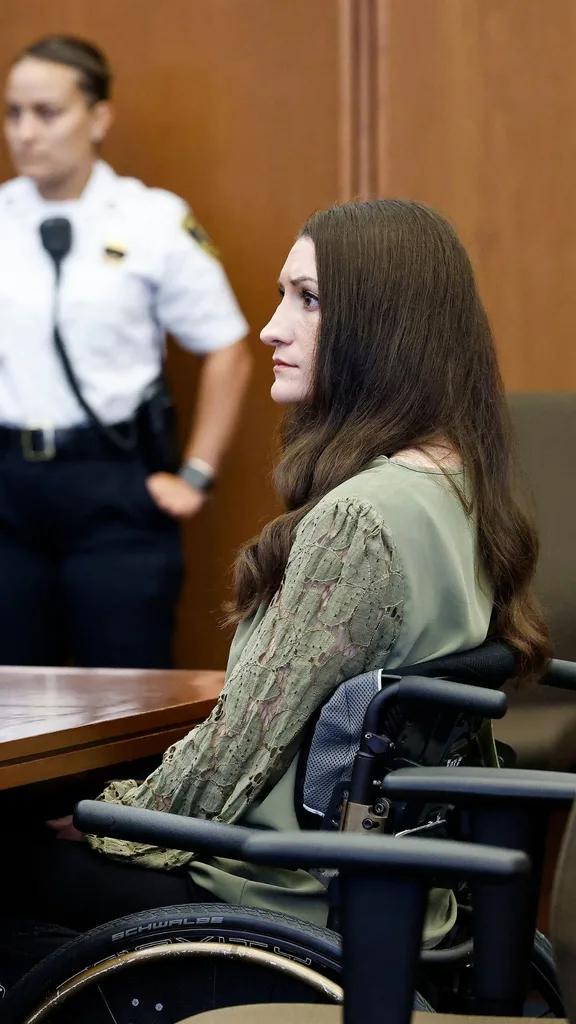
Permanently paralysed from the waist down due to her injuries, Clancy entered a plea of not guilty by reason of lack of criminal responsibility. Her defence team argued she was in a severe state of postpartum depression and psychosis, as well as overmedicated with psychiatric prescriptions, rendering her unable to understand “the wrongfulness or criminality of her conduct” at the time of the killings.
On September 4, after deliberating for 38 hours across seven days, the 12-person jury were unable to come to a unanimous decision. The judge was forced to declare a mistrial.
At the time of writing, Clancy remains in a psychiatric facility awaiting a hearing to determine whether the state will pursue a retrial or if the case will be dismissed.
But it is the conversation her trial has sparked across the world that experts say needs to continue regardless of the ultimate outcome.
What Is Postpartum Psychosis?
“Postpartum psychosis is a severe mental health condition and a medical emergency. It has a very quick onset, so it’s really important that lots of people are aware of it,” explains Dr Erin Seeto, director of clinical services at perinatal mental health support service Gidget Foundation Australia.
“It is a condition where a woman loses touch with reality post-birth. They might experience hallucinations, delusions, confusion, mania and severe mood changes. It’s often accompanied with insomnia and being unable to sleep, even when there is an opportunity to sleep.”
Postpartum psychosis impacts approximately two in every 1000 births in Australia, though experts caution those numbers may appear less significant than they really are. “It’s usually described as a rare condition,” says clinical and health psychologist Narelle Dickinson, director of Lotus Health and Psychology in Brisbane. “But actually, when you break those numbers down into real terms and think about the fact that 800 babies are born in Australia every day, that actually means that every single day we can probably expect one mum who has birthed is going to develop postpartum psychosis … I don’t think rare is an appropriate word.”
“I thought robot versions of my sons had been developed by a technology company”

Canberra mother-of-two Gen Whitlam understands the weight of every one of those statistics better than most. After giving birth to her son, Arlo, four weeks early in January 2020, she experienced a cascading series of health crises that landed her in an acute mental health emergency.
With Covid looming on the horizon, Whitlam, a former epidemiologist, was all too aware of the impact the pandemic might have – something that would play into her delusional thoughts.
“Four days after giving birth, I developed mastitis,” she recalls. “I was given antibiotics and told it wasn’t a particularly severe infection, but I was in a lot of pain.”
A few days later, during a shopping trip with her partner and their two children, the new mother experienced a sudden worsening of symptoms.
“We were in IKEA, and I became convinced there was Covid on all the surfaces, and on a bear we’d bought for our older son,” she says.
After developing a sudden fever and excruciating breast pain, Whitlam headed to the emergency department, where she was admitted with life-threatening sepsis.
“I think I was in there for close to two days while they were trying to figure out what was causing the sepsis,” she says. “But my mental health started deteriorating rapidly. I thought that the light above my bed was a camera link to ex-colleagues who were investigating Covid. I was beside myself thinking that colleagues could see me in this vulnerable state.”
Whitlam was transferred to an isolation room in the maternity ward for ongoing antibiotic treatment.
“At one stage my veins collapsed due to the IV treatment,” she explains. “I was afraid, became increasingly confused, paranoid and delusional. I lay in bed in a dark room, alone with my thoughts. I believed that my partner, Lizz, had signed me up to a clinical trial where researchers had wired me up to a medical device that was controlling all aspects of my functioning. I thought the windows were one-way mirrors, that the nurses were researchers, that the television was a recording device, and that the clock and my phone were being controlled by the researchers. I lost complete track of time and became totally withdrawn.”
Thankfully Lizz, a mental health nurse, picked up that something was very wrong, and pushed for a psychiatric review, where doctors eventually diagnosed Whitlam with postpartum psychosis.
“I was confused – my thoughts seemed so real,” she recalls. “I was able to hold down a conversation with other patients or visitors. But when left on my own, my mind took me to places that at the time made sense, but now seem so bizarre.
“I began to think that I was rich and famous. This belief led to me uncharacteristically spending more than $100 in the hospital newsagency. I thought that robot versions of my sons had been developed by a technology company, and it was these robots that were visiting me. I thought the magazines I was reading had been published specifically for me, and that music had a new, underlying meaning giving me instructions.”
Still, her perception of postpartum psychosis, based on the sensationalism she’d seen in media reports about it, left Whitlam with the overwhelming feeling of stigma and shame.
“My head went, ‘That’s not me. What are you talking about?’ Denial, shame, self-stigma – I just sort of plummeted … because I knew from the media the implications of what that meant. Or at least I thought I did.”
What We Need To Talk About When We Talk About Postpartum Psychosis
This, Dickinson explains, is why stories like Lindsay Clancy’s can be simultaneously valuable and damaging to the conversation around postpartum psychosis.
“Psychosis is not inherently dangerous or violent in that way,” she says. “It is not an automatic thing that a person in psychosis will try to harm another person. It’s actually far more likely they’re going to harm themselves. Psychosis does not mean someone is necessarily dangerous, but the very extreme outlier situations are the ones we tend to see reported on in the media.”
Seeto agrees: “A lot of the time, women might be having these thoughts but continuing to appear functional on the outside. There’s a fear that their children [will be] removed from their care. There’s a fear that something worse might happen. So that causes a level of hesitancy that will stop people seeking help early on.”
It’s why both experts, along with Whitlam, are so committed to ensuring accurate, non-sensationalist information lands in the hands of new mothers and their support networks.
A “Highly Treatable” Condition When Families Seek Help
“I really want people who have given birth to understand that this is a highly treatable condition,” says Whitlam, who, after a few weeks in a mental health unit, was able to transfer to a mother-and-baby maternal mental health centre with Arlo to continue her recovery.
“I don’t think it’s had any long-term impacts on my connection or ability to parent, which was another thing I was initially worried about. He’s now six-and-a-half, and he’s a beautiful little boy, and our connection is just as strong as with our eldest son.”
Another issue all three women agree on: women and their families require significantly more support in the postpartum period than is currently being offered.
“I’ve been working in this space for almost 30 years, and while some things have improved, I don’t think it’s any easier for women to access the level of affordable care and intervention they need than it was 30 years ago,” Dickinson says.
“It’s still just horrendous to try to get someone to see a good-quality psychiatrist, and to be able to offer them the level of psychological intervention they need, and also to get them an appropriate inpatient stay if that’s what they require, particularly in a mother-and-baby unit.”
It’s one of the issues Senator Marielle Smith, chair of the just-announced Australian Senate Select Committee on Women’s Health, would like to see improve.
“I want a national conversation about how we can better care for mothers in the postpartum period, and how we support their families,” she says of the inquiry that will focus primarily on three historically overlooked pillars: postpartum healthcare, chronic pain and medical dismissal, and assisted reproduction.
“This committee represents a powerful opportunity to elevate women’s experiences, to spark a national conversation on what needs to change and to build an evidence base that can’t be ignored,” Smith says.
“We know too many women are finding themselves suffering in the darkest of places because of challenges with their mental or physical health during this period.”

