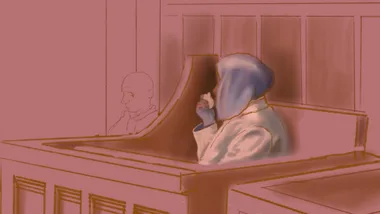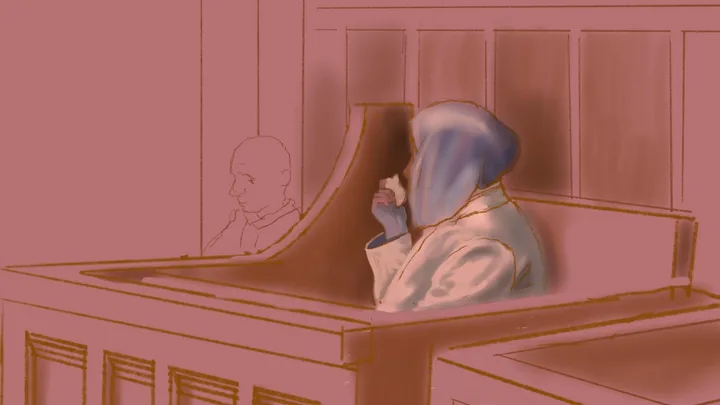
Three years after killing and dismembering her husband, Mamdouh Noufl, Nirmeen Noufl sat in the dock of the New South Wales Supreme Court on a brisk Friday morning in September, awaiting sentencing for manslaughter. She nervously clutched a creased tissue as Justice Peter Hamill raked through a ledger of evidence, describing matter-of-factly the litany of violence that permeated through her marriage. “The agreed facts state that the police were called to the home on a number of occasions but that ‘many of the incidents of domestic violence went unreported’,” he wrote in his judgement. For as long as they had been together, Nirmeen had been regularly victimised by her husband: pushed, shoved, beaten, controlled and debased, even while pregnant. As a result, she was offered a 25 per cent cut to her sentence, making her eligible for parole in less than a year.
As she returned to her cell, Nirmeen joined a tragic sorority of Australian women whose lives have been mapped and marred by domestic terrorism, and who – in response – have used fatal force in a bid to survive. In 2020, Rebecca Payne, having twice endeavoured to escape her abusive husband, crushed a lethal amount of temazepam into the icing of homemade lemon biscuits, offering him one. She then wrapped his unconscious body in a blanket and placed him in a chest freezer on her back verandah. That same year, Judith Ann Venn dissolved lorazepam tablets into a bowl of vegetable soup and served it to her abusive husband, Lance Hilton Venn, before slicing his left wrist. He died an hour or two later, but not before delivering one final beating, leaving Judith’s eyes bruised.
Eight years earlier, Jessica Silva stabbed her ex-partner, James Polkinghorne, to death with a kitchen knife after he had abused and threatened her relentlessly. In an audio recording Jessica secretly made during one of his heated outbursts, James can be heard threatening to “cave [her] fucking head in”. “Look at me, I’m fucking serious,” he spat. Jessica had fled the family home with her child and moved into her parents’ house for safety. (When police scoured James and Jessica’s home for evidence, they discovered the place in disarray, ransacked by James’ extensive outbursts: furniture had been toppled over, doors were pulled off their hinges, and a number of fist-sized holes were found in the gyprock walls.)
Each of these women, and many others like them, spent time behind bars. Their imprisonment has long ignited frustration among domestic violence experts, who argue that victim-survivors who use fatal force against their abusers should not bear the burden of undue punishment. Those who work on the frontline of domestic violence refuges are regularly besieged with a desperate number of phone calls from women across the country, terrified for their lives. Their reality is stark: kill or be killed.
In 2019, Australia’s National Research Organisation for Women’s Safety (ANROWS) conducted research examining the homicide trials of Australian women who have killed their abusive partners in self-defence. “ANROWS’ research found that our legal system relies on outdated understandings of intimate partner violence, which has a huge impact on women in this situation,” Dr Tessa Boyd-Caine, the chief executive officer of ANROWS, told marie claire.
Researchers at ANROWS based much of their analysis on the case of Dr Chamari Liyanage, who was originally charged with murder after killing her husband, Dinendra Athukorala, in June 2014. She struck him twice with a metal mallet as he lay asleep in their bed. What preceded the attack was years of sustained domestic violence. Dinendra’s abuse had chipped away at Chamari for nearly half a decade, beginning in 2009, when he insisted she stop contacting her friends. By 2011, he had uploaded her phone number to adult websites in Sri Lanka, falsely identifying her as a sex worker and pushing her to have affairs. The following year, his abuse escalated. He regularly hit Chamari, slammed her head against their bedhead and pulled her hair. He also forced her to perform sexual acts on Skype for a live audience. “I felt I’m like a trapped animal. I just had to behave the way he want me to do,” Chamari stated in her evidence. By 2013, Dinendra was forcing her to watch child sexual abuse material with him, punishing her with anal sex if she refused. By the end, Chamari had tried to escape several times and had attempted suicide.
Despite the compelling account of Chamari’s abusive marriage presented to the court, prosecutor Nick Cogin told the jury that nothing Dinendra had done warranted his eventual undoing. Chamari, he argued, had other options. She could have left her husband. This assumption weaved itself through her trial, where anachronistic ideas about what a victim-survivor looks like and how she ought to behave helped cast her actions as excessive and unreasonable. Chamari was ultimately sentenced to four years’ imprisonment for her husband’s manslaughter.
Perhaps this reasoning might have been avoided if, as Boyd-Caine argues, state legal systems had caught up with feminist scholarship and adopted a “social
entrapment framework” to better understand why women kill their abusive partners. “This framework recognises an abuser’s behaviour, the victim-survivor’s limited safety options and the broader structural barriers a woman faces that fundamentally affect her ability to resist or escape abuse,” she tells marie claire. Lobbyists and researchers have been steadily pressuring governments to reform Australia’s self-defence laws so that they align with such a rubric. They contest that victim-survivors are regularly failed by systems that rely on reductive, idealistic beliefs: namely, that a woman in danger can just up and leave her abuser if she feels unsafe. One such researcher is Professor Heather Douglas. “Entrapment refers to entrapment in the violence, not in the relationship, given that even after separating, the violence often continues,” she clarifies.
Not all of these efforts have fallen on deaf ears. Following Chamari’s sentencing, legal Professor Stella Tarrant helped drive reforms under Western Australia’s Family Violence Legislation Reform Act 2020, making it the first state to legally recognise social entrapment. More recently, in December 2025, the Queensland Law Reform Commission recommended repealing section 304B of the Criminal Code, “Killing for Preservation in an Abusive Domestic Relationship”, and replacing the existing partial defence with a complete defence for victim-survivors. If adopted, the reforms could offer a necessary corrective to a criminal justice system that has too often punished women faced with impossible odds. Other legislative efforts have proved less enduring. Victoria’s defensive homicide offence, for instance, was abolished in November 2014 amid broad concern it was being weaponised by abusive men.
“One of the problems with the law is that it purports to be gender-neutral,” says solicitor Melinda Walker, who has witnessed firsthand how sexism is baked into the criminal justice system. In 2020, she took Stacey Edwards’ case to the Court of Appeal. Stacey, an Aboriginal woman, had stabbed her abusive partner in the neck in 2016, receiving a lengthy manslaughter sentence. Walker recalls presenting to the court compelling evidence that Stacey had been beaten by him just days before the stabbing. Despite this, arguments for a reduced sentence were rejected. “It was a bit of a train wreck,” she reflects. “When are we going to start adequately responding to the amount of women being killed?”
In 1992, Walker was a young mother putting herself through law school, having herself escaped family violence. For a legal assignment, she made an early foray into researching how male perpetrators of domestic abuse could exploit the law at the time by securing retaliatory intervention orders against women. “Women would go to the police and get an intervention order, their abusers would lawyer up, and the lawyers would say to the women or their representatives, we’ll agree to the order if you agree to have one on you,” she recalls. Her research exposed the masculinist tactics used to evade accountability and “skew the statistics”. Legal officials and government bodies could then point to the data as evidence that women were just as likely as men to have intervention orders taken out against them, despite this not being the full story.
Like Walker, Elena Pappas, co-founder and CEO of the Law and Advocacy Centre for Women, understands how the criminal justice system has long been unable, or unwilling, to account for the circumstances of criminalised women. “We respond to the highly gendered nature of the criminal legal system, which has been set up in response to men’s violence and the profiles of men instead,” she tells us. “But the backgrounds and circumstances of women coming into the system are vastly different. The system itself is not good at recognising that.” The centre’s work is grounded in feminist principles and scholarship, which shows that many incarcerated women have themselves been victims of violent crime, often at the hands of family members or intimate partners. “In our experience, a very large proportion of the women who are facing criminal charges in relation to family violence are actually victim-survivors, and are not the aggressor.” Pappas points to a recent report published by the NSW Bureau of Crime Statistics and Research in August 2026, which identifies four male and four female typologies of domestic and family violence perpetrators. “For women, the highest risk factor for being identified as an offender is if they’ve been a family violence victim before. Whereas for men, it’s that they’ve previously offended,” she says.
It is unsurprising then that after killing her abusive husband and serving nearly three years in custody and prison, Chamari did not go on to accumulate a record of escalating violence. Instead, she paints. At markets and exhibitions in Geraldton, WA, Chamari sells canvases, specialising in acrylic renditions of flowers: roses, lilies, vines, orchids and dandelions. Her preoccupation with flora seems particularly apt. A flower will do all it can to survive, even if planted in arid soil. Under the right conditions, it has no choice but to bloom.