

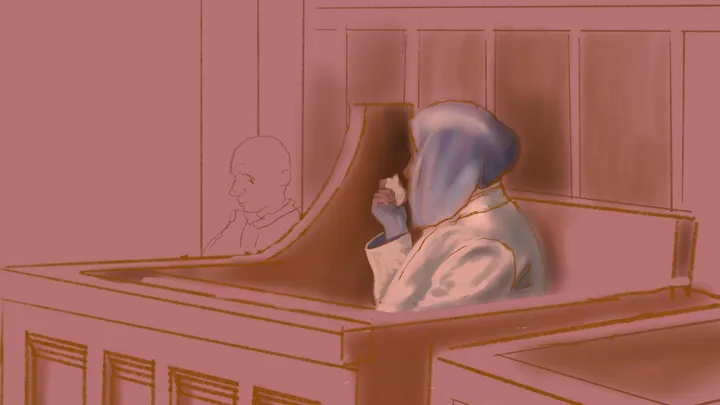
In May 2023, Sydney woman Nirmeen Noufl killed and dismembered her husband after years of alleged sustained domestic abuse. Last week, she received the minimum jail term for manslaughter and will be eligible for parole in October 2027. Her sentencing sets a landmark precedent for how domestic violence victim-survivors are tried in court, with prosecutors accepting the lesser charge on the basis that self-defence encompasses consistent and compounded danger rather than just one terrifying moment. Journalist Madison Griffiths reports for marie claire from the press pit in the New South Wales Supreme Court.
Nirmeen Noufl, 55, met Mamdouh “Emad” Noufl when she was in her late teens. It was their wedding day in Sydney. Or, as her sister alleges, the day their father sold Nirmeen to him. Nirmeen and Mamdouh’s marriage spanned three decades and was allegedly marked by a brutal carousel of ongoing domestic violence. Police reports detailing years of abuse painted a ghastly image. “I would rather see you dead than give you a divorce,” Mamdouh is alleged to have once threatened, holding up a knife. Many other incidents were left unreported. Mamdouh allegedly regularly beat his wife, threatened her life and berated her ceaselessly, even while pregnant. Testimonies from their children indicated that it was common for Nirmeen to be so injured from Mamdouh’s physical abuse that she was unable to get out of bed on some days.
Late one evening in early May 2023, Nirmeen and Mamdouh got into a physical altercation, likely spurred on by his plans to leave Sydney in the coming months to go to Egypt to marry another woman, all the while refusing to grant Nirmeen a divorce. On that particular evening, according to psychiatric reports, Mamdouh pursued Nirmeen from room to room, chasing her through their Greenacre property. He managed to pin his wife to the floor of their kitchen and allegedly proceeded to choke her. Believing her life was in danger, Nirmeen reached for a nearby tool and stabbed her husband once in the left side of the chest, killing him.
Court documents reveal that, following the struggle, Nirmeen was left with a cut on her forehead, a bleeding lip and swelling near her jaw. After his death, she is alleged to have placed plastic sheets on the floor before using various kitchen knives and a drop saw to dismember him. She placed pieces of her husband’s body in about 20 to 30 plastic rubbish bags, and disposed of them in various residential and industrial bins across the regions of Bexley and Chullora.
Nirmeen pleaded guilty after prosecutors agreed to a plea deal, dropping the murder charge for Mamdouh’s death to manslaughter. At her sentencing hearing last Friday, Justice Peter Hamill accepted that the guilty plea was appropriate: while Nirmeen believed it necessary to retaliate to Mamdouh’s violence, killing him was not a “reasonable response” to the danger as she saw it. She was subsequently sentenced to six years and nine months in prison, with a non-parole period of three years, sparking outrage from her husband’s family, a member of whom yelled out “Fuck Australia, fuck the law, she should be doing 25 to life,” on the steps of the Supreme Court.
The following day, NSW saw domestic violence deaths reach a sinister climax. Three women in three separate attacks were allegedly murdered by men known to them, bringing this year’s death toll to 52. While the court accepted that, in the case of Nirmeen Noufl, “excessive self-defence” was used, a 2023 study of 69 Australian cases of women who killed their abusive partners found that the law is regularly ill-equipped to accommodate such homicides, resulting in killings perpetrated by victim-survivors being regularly interpreted as “disproportionate” and “unreasonable.”
Last Tuesday, days prior to the state’s ghastly show of violence, dozens of protestors gathered in front of the NSW Parliament to insist on government action in response to Australia’s epidemic of femicide. For women like Nirmeen, who resort to killing their abusers, Greens MLC Abigail Boyd told NewsWire, “There’s no other way out. We have these women lashing out in a final moment of wanting to exit — and it can be physical — and then these women are often misidentified as being the primary aggressor.”
Nirmeen’s attempts to leave Mamdouh were well documented. About 18 years ago, her sister told the court, Nirmeen and her children managed to flee, finding momentary refuge in a domestic violence shelter. But given Mamdouh’s financial authority over the family, they were forced to return home. On another occasion, she escaped, hiding out in her husband’s investment property for a few days before returning to him, exhausted and hungry.
The moral responsibility of domestic abuse victim-survivors is regularly scrubbed of its context, and — according to criminologists Caitlin Nash and Rachel Dioso-Villa — abused women who kill their partners are misunderstood, “hindered by misconceptions and inaccurate understandings of the nature and dynamics” of the oppressive regimes they have been subjected to. Homicide laws, they claim, are “gender-biased operations” that have been “developed around male experiences of violence”, leaving the desperate actions of women like Nirmeen isolated from the pressure cooker they emerge from. Their research found that 83 per cent of women used a weapon, such as a knife or other sharp instrument, to stab their partner, and that excessive violence was absent, with the majority of women (79 per cent) using a knife to inflict only one or two stab wounds.
In a country with a catastrophic toll of domestic violence deaths, a woman’s attempt to save her own life can become as contested as the country’s willingness to save it.

Related stories

Native ad body.
Native ad body.


Native ad body.



Share this post