I didn’t take it well when I found my first grey hair. Outwardly, I wept bitterly about it being “all over” but internally, things were significantly worse.
In the flick of a single hand movement, I took a vibrant, headstrong woman in the prime of her life and mentally recast her as the little-known fifth member of The Golden Girls. (Fun fact: although the show was ostensibly about “mature retirees”, most characters were only in their early-to-mid fifties – the same as Carrie Bradshaw et al in And Just Like That… How times have changed.)
As it turns out, I never had a chance to take out a Millers membership: a couple of months later I was diagnosed with breast cancer. My grey hair – once so offensive on my head – now waved goodbye on pillows and as it slunk down drains, and I soon came to see ageing for what it really is: a privilege too few of us get to enjoy.
I knew then that I didn’t only want to live, I wanted to live well. Although I didn’t know it at the time, this mindset – or rather, a global societal shift – has a name, and happily you don’t need a big C diagnosis to embrace it.
Introducing the new longevity
Humans have been chasing longevity since the dawn of time; after all, who wants to leave a good party early? The “new longevity”, however, isn’t focused only on life extension, it’s also about reframing ageing – not as a slow decline to be managed, but as a longer, more dynamic life to be actively designed. It’s a shift grounded in reality. Globally, we’re living longer, healthier and more active lives, and in Australia the average life expectancy now sits at 85.1 for women and 81.1 for men, with some scientists suggesting our natural lifespan could stretch far further.
Whether or not we reach 120, the implications are clear: women approaching 50 today can reasonably expect another 40 years of life, decades that, if healthy and well-resourced, can be productive, creative and powerful. “Chronological age is no longer an accurate predictor of health, identity, capability, social role or even felt age,” explains Dr Foula Kopanidis, associate professor of marketing at RMIT University and a steering committee member of the university’s Consumer Wellbeing Research Group.
“In our research, we found a 10- to 20-year gap between how old women are chronologically and how old they feel, with this subjective age identity exerting a stronger influence over lifestyle, consumption and household decisions.”
Happily for my cohorts, Australian gen X women – on the cusp of a powerful financial and cultural shift – are leading the longevity charge. Not only are we earning more money than we ever have (albeit our average net wealth remains 40 per cent less than our male counterparts, according to finder.com.au’s State of Women’s Wealth Report 2025), we’re set to inherit more than 65 per cent of the nearly $5 trillion in intergenerational wealth transfer in the coming years (in the US, middle- aged women will be in control of some $US30 trillion by 2030).
Yep, we might still be dressing like we’re fronting Seattle garage bands, but we’re becoming Vecna-level powerful. How does this change play out in real time for Australian women? A later-life redesign looks different for everyone.
Those who’ve swapped law for art, left their decades-long marriage for a girlfriend, taken global sabbaticals, said no to traditional grandparent duties by moving to Mongolia – I’ve interviewed them all. For me it has meant walking away from situations that no longer serve me, rediscovering long-discarded teenage hobbies and planning my next career.
Yet when I try to explain the movement to my teenage daughters, I arrive at: “It ultimately comes down to letting go of the word ‘should’”.
Mass representation (and its limitations)
When model and age liberation activist Luisa Dunn looks back on her thirties, she remembers a long run of conservative mum roles.
“Over a nine-year period, I did 20 television commercials, and whether it was banking or property I was almost always cast as the mother,” she says.
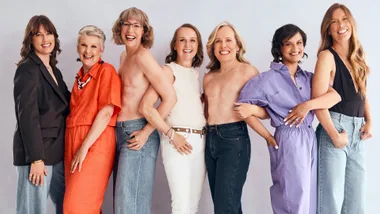
Today, the landscape is shifting. Dunn, now in her mid-50s and vocal in her refusal to front anti-ageing campaigns, has more than 1.5 million Instagram followers (@ thesilverlining_1970) and appears in swimwear, lingerie, jewellery and fashion campaigns – not a matronly one-piece in sight. “There’s a confidence that comes with growing older,” says Dunn.
“You develop your voice and you learn to use it; honestly, my age is the least interesting thing about me.” The reframing of female ageing is beginning to reshape the fashion and beauty industry. Where Isabella Rosellini once lost her Lancôme contract in her early forties for being deemed unsuitable to “sell the dream of youth”, we’re now witnessing “the dream of accurate representation”.
Paulina Porizkova, 60, has returned to Estée Lauder as a global brand ambassador, La Mer has signed Michelle Yeoh, 63, and the likes of Andie MacDowell, 67, Laura Dern, 59, and Jane Fonda, 88, walked the runway for L’Oréal at Paris Fashion Week.
Hollywood is following suit, with actors in their fifties and sixties, including Demi Moore and Pamela Anderson, enjoying a career resurgence – even if points must be deducted for how many column inches have been devoted to Anderson’s “bravery” in appearing in public without makeup. While change is afoot, only the more progressive brands are reading the room, concedes Grant Davidson, head of brand growth at Principals, one of the country’s leading branding agencies.
“You have to remember that the world of advertising was traditionally male-dominated, and I think there’s still this hangover mindset of ‘this is how women were portrayed and this is how we’re going to continue portraying them’.”
Both Davidson and Dunn point to the continued use of ageist language in advertising as being particularly problematic. “There’s this real disconnect between how women in their fifties are now feeling about growing older, bolder and stronger, and the messaging which remains all about how to hide the signs of ageing,” explains Davidson.
As a consumer, that disconnect is glaring. It’s hard not to notice when you’re being courted for your spending power while being quietly erased from the story. Brands ignore this shift at their peril. Women aged 50-plus control an estimated $2.38 trillion in aggregate net worth in Australia and make up more than 22 per cent of the population.
We spend not just on ourselves but on partners, children and extended social circles (shout out to all the dads who look forward to seeing what they’ve “bought” their children for Christmas each year).
Interestingly, we’re also the only demographic continuing to grow on social media, with more than 159 million users aged 55 and over among TikTok’s 1.5 billion global audience. Despite these figures, less than 5 per cent of advertising targets the 35 to 64 market.
“Positive identity reconstruction drives consumption behaviour: as women redefine themselves, they reassess what brands, services and environments reflect the self they are becoming, rather than the one assigned to them,” explains Kopanidis. “For marketers, acknowledging this shift is no longer optional but a brand growth imperative.”
Planning for longevity
It’s impossible to talk about the promise of longevity without acknowledging its limitations. For some, the shifting goalposts feel like being asked to run a marathon after training for a sprint. The superannuation gap remains a concern, particularly for women without access to inheritance. Health, too, requires a longer, more deliberate view.
No surprises then that data-driven health optimisation clinics focused on extending healthspan through advanced diagnostics and personalised plans are gaining traction. Dr Adam Brown, founder and principal physician of The Longevity Medicine Institute (longevitymedicineinstitute. com), says the mindset shift he’s witnessing in his Double Bay clinic in Sydney is significant.
“The conversation has shifted from retirement and managing decline to how they can position themselves to design a life where they can look after the grandchildren with energy, take up adventurous hobbies, change careers in their seventies and travel the world,” he says. “And really, it’s a very achievable goal for our bodies to function in our sixties and seventies as they did in our thirties and forties, and it all comes down to making small, strategic changes to our habits, behaviours, biology, lifestyle and environment to optimise our body and mind.”
While treatment plans based around what Brown calls “the eight pillars of longevity” can run into the thousands of dollars, he says health pathways to prepare for the ultimate third act can often be improved with a few lifestyle changes. “It may sound like a bit of a cliché, but diversifying your exercise portfolio is one of the best things you can do for longevity – that and getting good, restorative sleep that’s aligned with your chronotype.”
I won’t pretend I love everything about growing older. With 50 fast approaching, there are moments I resist it, resent it and rail against it. But after the year I’ve had, I also know that this is the far better alternative. With the longevity landscape changing, I might even go so far as to say I’m genuinely looking forward to what comes next, not only for me, but for all of us.

Related stories
Why You’re Tired, Bloated and Foggy – And What To Do About It
Native ad body.
Native ad body.
Are You Ready To Finally Understand Your Hormones?

Native ad body.