NEED TO KNOW
- A geomagnetic disturbance warning (G1-G2) has been issued following a coronal mass ejection (CME) from the Sun earlier this week.
- The charged solar cloud is slated to impact Earth’s magnetic field tonight, Friday, October 9th, resulting in a likely Aurora Australis.
- Prime viewing conditions are forecast for 10pm to 6am across Tasmania and coastal Victoria, with potential sightings reaching SA, ACT and NSW and WA.
Cancel your Friday night plans; you’ll want to spend the evening catching a glimpse of the Aurora Australis, if you can.
After a particularly spectacular season in the skies, from micromoons to meteor showers, we’ve had a quiet few weeks. But that could change as the Southern Lights may be visible from parts of southern Australia tonight, Friday, October 9th, thanks to a rare geomagnetic disturbance warning.
According to the Australian Space Weather Forecasting Centre (Bureau of Meteorology), a geomagnetic disturbance warning is active from October 9 through October 11.
The cosmic phenomenon follows a partial halo coronal mass ejection (CME) that erupted from an active region on the Sun. The resulting cloud of magnetised solar plasma is scheduled to collide with Earth’s magnetic atmosphere tonight.
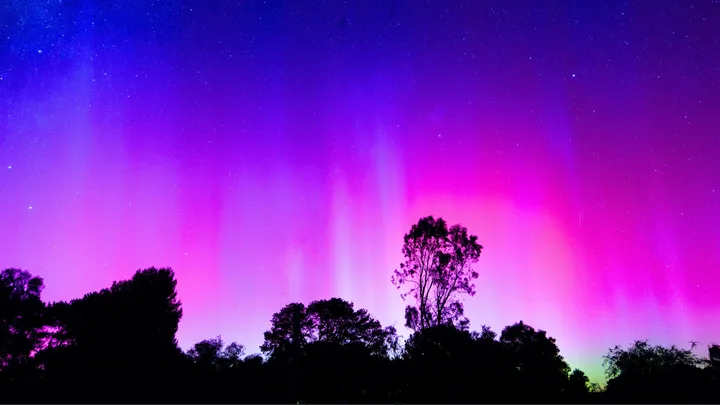
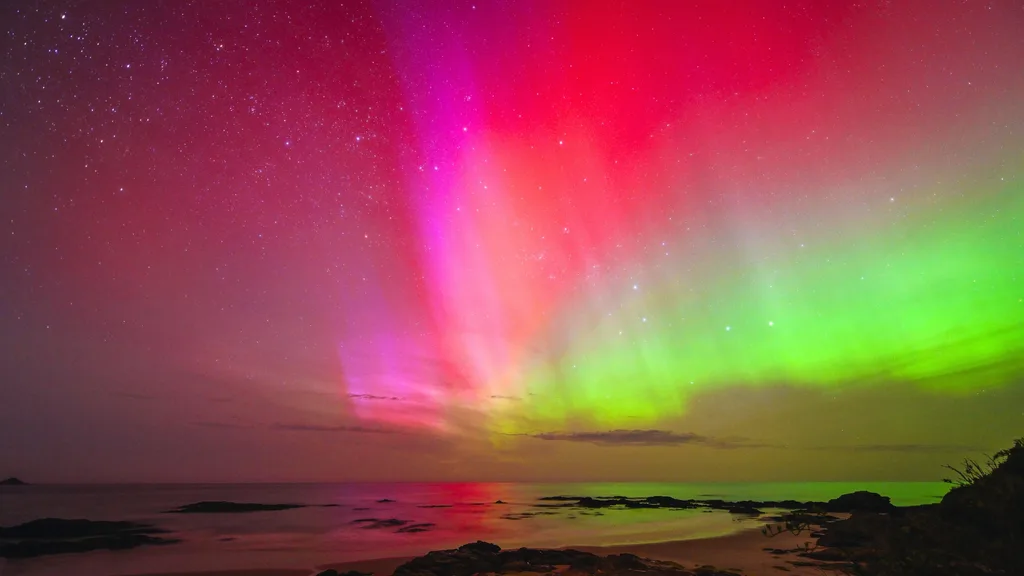
When these high-energy solar particles collide with gases in Earth’s upper atmosphere, they get funnelled toward the magnetic poles—igniting vibrant pink, violet, and emerald light curtains. The stronger the geomagnetic storm, the further toward the equator the auroral oval stretches, giving Australians a front-row seat.
Where & When To See Tonight’s Aurora
The strongest displays are expected across Tasmania and Victoria, where auroral activity is most commonly observed. If geomagnetic activity spikes to G2 levels, visibility will extend further north across:
- Coastal South Australia (including the Fleurieu Peninsula and Eyre Peninsula)
- Southwest Western Australia (Albany, Margaret River, and southern Perth coastal fringes)
- The Australian Capital Territory (ACT) and Southern New South Wales coastlines
Solar weather is notoriously unpredictable, so timings may shift depending on when the CME actually reaches Earth’s magnetic field, but the peak geomagnetic storm is expected to start around 10pm AEDT and last until 6am Saturday morning. It’s worth keeping one eye on the Bureau of Meteorology’s Space Weather page as the evening goes on.
| Region / City | Sunset | Optimal Viewing Window | Expected Intensity Level |
|---|---|---|---|
| Tasmania (Hobart) | 7:12 PM | 9:30 PM – 2:00 AM | High (Naked-eye visible) |
| Victoria (Melbourne) | 7:35 PM | 10:00 PM – 3:00 AM | Moderate–High |
| South Australia (Adelaide) | 7:30 PM | 10:15 PM – 3:00 AM | Moderate (Photographic) |
| ACT / Southern NSW (Canberra/Eden) | 7:08 PM | 10:30 PM – 2:00 AM | Low–Moderate (Horizon flare) |
| Southern WA (Perth/Albany) | 6:22 PM | 9:45 PM – 2:00 AM AWST | Low–Moderate |
Tips For How To See The Aurora
Even under the right conditions, the aurora can be easy to miss if you’re not set up for it. A few small adjustments to where and how you watch can make the difference between a washed-out sky and a proper light show.
- Get away from city lights. Regional or coastal spots with an unobstructed southern horizon give you the best shot.
- Face south. The Aurora Australis appears low on the southern horizon from mainland Australia, not overhead.
- Cold, clear nights are ideal — cloud cover will block the view entirely, no matter how strong the storm is.
- If you can’t see much with the naked eye, try your phone camera. Long exposure often picks up colour that isn’t visible to the naked eye.
- Patience is key. Auroras come in waves (sub-storms), so a quiet sky doesn’t mean it’s over.

Related stories

Native ad body.

Native ad body.




Native ad body.