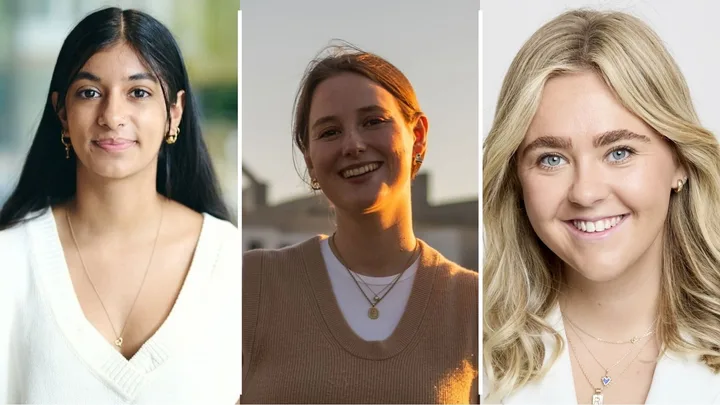
Girls are often told they can be anything. But what does it take to make that promise a reality? For climate campaigner Anjali Sharma, Womn-Kind founder Ruby Riethmuller and public policy advocate Lucy Skelton, it means giving girls a say in their future, support before they reach crisis and the safety to pursue their ambitions. This International Day of the Girl, the three young changemakers reflect on finding their voices, challenging expectations and what they want the next generation to know. In their own words, they share why girls deserve to be heard – and what needs to change when we listen.
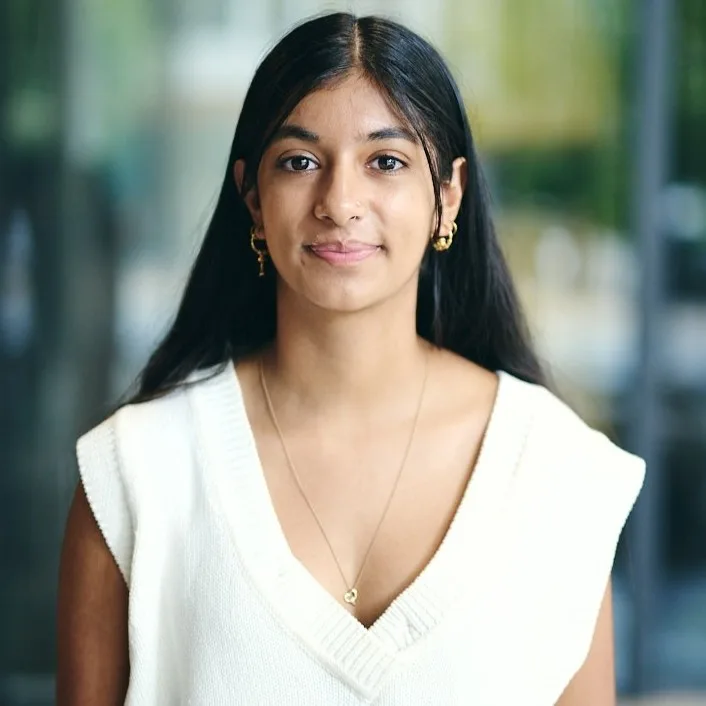
Anjali Sharma
Climate campaigner Anjali Sharma reflects on finding her voice at 14, challenging those in power and why girls shouldn’t wait to feel ready before speaking up.
I Started Because I Felt I Had To
When I started campaigning at 14, I wasn’t trying to end up in the spotlight. I wasn’t even setting out to hold politicians accountable. I was driven by necessity, responsibility and a sense of injustice. I was hearing about my home country, India, experiencing floods and heatwaves, each a little more damaging than the last. These disasters were affecting people’s lives and livelihoods, in a country where so many people depend on agriculture or work outdoors, as street vendors and rickshaw drivers.
Growing up in Australia, I couldn’t ignore how different my circumstances were. We have our share of climate disasters, but we also have resources to help us rebuild and protect ourselves against future devastation. I was acutely aware of my privilege. At 14, that inequality terrified me. I felt I absolutely had to do something.
I Don’t Always Feel Like I Belong
Young people are often told we’re too young to understand politics or policy. Whether that makes me doubt myself or more determined can honestly change from day to day. I’ve been attacked for being young, for being a woman and for being a woman of colour in policy conversations. The imposter syndrome can be strong. But so can the desire to prove people wrong.
Why shouldn’t a young woman of colour walk the halls of parliament alongside well-paid, well-resourced lobbyists? Why should conversations about our future be reserved largely for older, white men? I don’t have to feel confident every day to know I deserve to be there.
Community Carries Power
Taking my advocacy from school strikes to the courtroom and now to legislation has taught me a lot about power. Money carries enormous influence. Companies can afford lobbyists who spend sitting weeks networking in parliament. Political donors have access and resources that young campaigners simply don’t. But I’ve also learned how much power exists in community.
The Duty of Care campaign I founded is run by me and two other young women. We all work and study alongside campaigning. None of us is paid. We organise events, help people write submissions and connect with young people who want their voices heard. Through that advocacy, we helped secure a significant step forward: the ACT’s recognition of a duty of care to young people and future generations in the face of climate change. Community can create change. It takes time, but it carries power.
Climate Change Is A Girls’ Issue
As a young woman, it’s easy to feel terrified about climate change. We know its consequences will unfold throughout our lives, and that young people, women and girls face disproportionate impacts. We don’t talk enough about climate change as an issue of gender equality. Climate disasters can expose women and girls to additional risks, including increased violence after disasters such as bushfires. There are also risks to maternal health and pregnancy.
These consequences need to be part of the conversation. But the things that make us feel vulnerable also give us a perspective that deserves to be heard. Our fear can become a reason to act. We belong in conversations about climate change and future policy because these are conversations about our lives, and how we will get to live them.
You Don’t Need Permission To Care
To the 14-year-old girl who wants to change something but thinks, “Who am I to do this?”, I would say: you are a young woman who cares. That is enough. You don’t need to wait until you feel like the smartest person in the room. You might never feel that way. You don’t need to wait until you’ve graduated, know more or reached some milestone that supposedly means you belong.
It is enough to care. If you care, you can make change. My mum helped me believe that. She is the strongest woman I know, with an incredible sense of justice and fairness. She has supported me and believed in me endlessly. Her encouragement is a huge part of why I’m able to do what I do.
We Deserve A Seat Where Decisions Are Made
If I could change one thing today, I would put more women, particularly young women, in positions where they can make decisions. I want gender equity across parliament. More young women in ministerial roles. Another woman prime minister. More women CEOs.
When women are in those rooms, our lived experiences can inform the decisions being made. And representation reaches beyond any single decision: seeing a woman lead can help another girl imagine herself doing the same. Ten years from now, I want girls in Australia to feel they belong in those rooms. When it comes to climate change, I don’t want them simply to inherit the consequences of decisions made before them. I want them to have the opportunity to make those decisions themselves.
And to any girl who doesn’t yet know who she wants to become: neither do I sometimes. You don’t have to know exactly where you’re going to know what you stand for. Start there. Every girl deserves to know that being a girl can be her superpower.
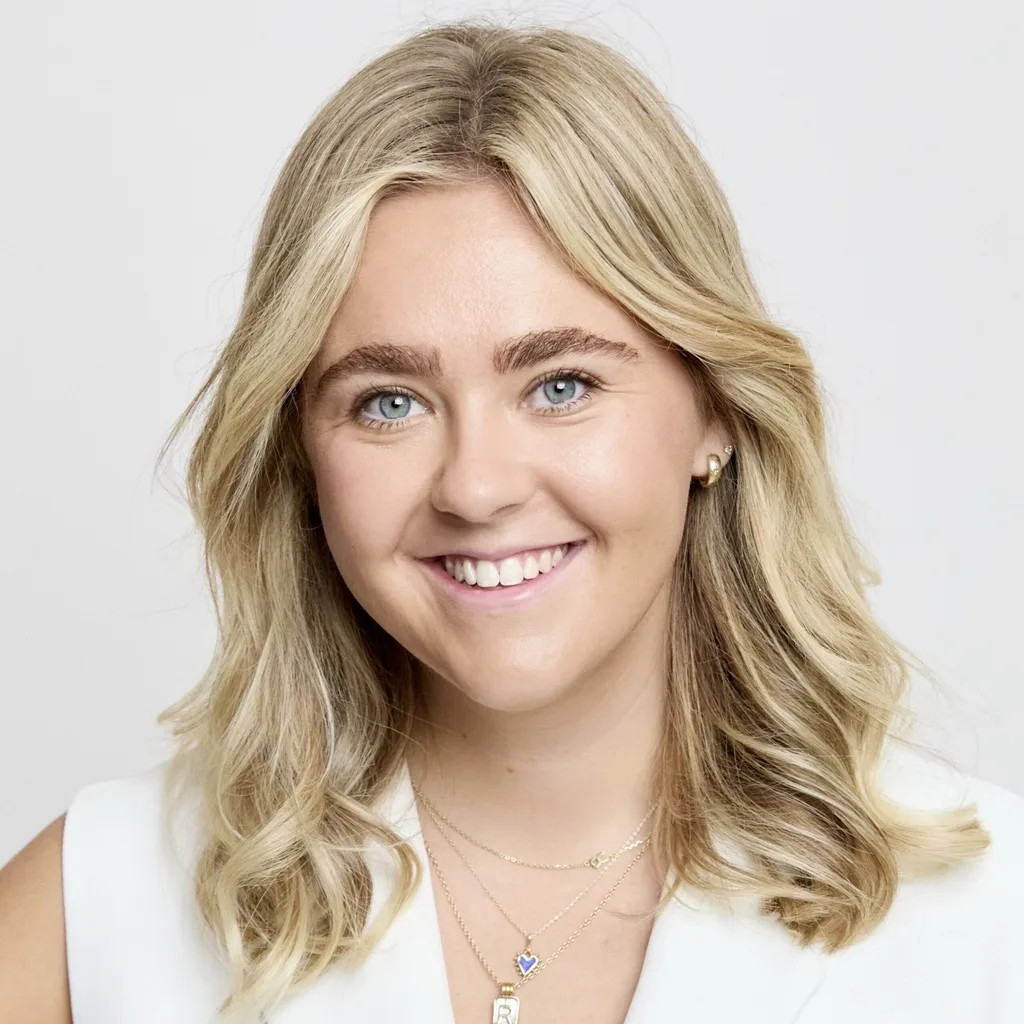
Ruby Riethmuller
The founder of Womn-Kind reflects on growing up in regional Australia, protecting girlhood and why we need to listen to girls long before they reach crisis.
Where You Grow Up Shouldn’t Determine How Far You Go
Growing up in regional Australia gave me a sense of community and connection that I’m incredibly grateful for. There is something special about knowing the people around you and looking out for one another. But geography can also shape what a girl believes is possible for her. Distance isn’t only about how far you live from services or opportunities. It can also be a distance from possibility.
When you don’t see many different versions of womanhood around you, your world can feel smaller than it actually is. You might not know a female founder, astronaut or member of parliament. But you shouldn’t have to know one in your local community to believe you could become one.
Regional girls don’t need to be saved from where they come from. They deserve to know that where they come from should never determine how far they can go. Access to support is part of that. You may have to travel hours for specialist mental health care. In a small community, asking for help can feel very public when what you desperately want is privacy.
Putting something online doesn’t automatically make it accessible. Access also means trust, transport, affordability, digital connectivity and being able to imagine yourself belonging in the spaces created for you.
Girls Were Asking Us To Listen Earlier
I founded Womn-Kind at 22. I didn’t have a business plan or decades of experience. I had a strong sense that things could be better. Girls were telling us, in countless ways: please stop waiting until we’re in crisis to care about how we’re feeling. Please speak to us in a way that resonates.
They were asking questions long before they reached crisis. Why don’t I like myself? Why does everyone else seem more confident? How do I know if a friendship is unhealthy? How do I help a friend who is struggling? Why do I feel lonely when I’m surrounded by people?
They didn’t necessarily want another adult at the front of a room telling them how to be resilient. They wanted honest conversations, language for their experiences and somewhere to ask the awkward question. That became foundational to Womn-Kind. We wanted to understand what happens when we listen to young people and believe in them early enough. Young people have always had powerful voices. Adults haven’t always created enough places where those voices can change what happens next.
Beneath The Pressure Is One Question: Am I Enough?
Through conversations with tens of thousands of young people, I’ve heard the same quiet question beneath so many different struggles: am I enough as I am The expectations placed on girls are exhausting. Be ambitious, but make it look effortless. Be beautiful, but don’t look like you’re trying. Be confident, but don’t intimidate anyone. Be kind, but have boundaries.
Achieve at school, have a social life, exercise, sleep, care about the world – and somehow look happy while doing all of it.
I don’t believe girls are fragile. I think many are exhausted. What worries me is how early that exhaustion begins. Girls are learning to measure themselves before they’ve had the chance to get to know themselves. But they also make me hopeful. This generation is emotionally intelligent, socially conscious and willing to question things others simply accepted. Their ideas deserve our attention and trust.
We Need To Look Beyond The Phone
Social media creates real risks: comparison, impossible beauty standards, algorithms and constant visibility. But blaming it for everything stops us looking closely at the wider world girls are navigating. For a young person who feels different or isolated, the internet may be the first place they find someone who looks like them, thinks like them or understands them. It can offer community and belonging.
We need to ask what girls are finding online that they aren’t finding offline. If a girl turns to TikTok to learn about her body, Instagram to find a role model and an anonymous forum to feel understood, we need to examine the gaps around her, too. We need to build offline worlds girls want to return to, with support that meets them where they are.
Belonging Means You Don’t Have To Edit Yourself
There is something powerful about walking into a room without having to edit yourself first. Without wondering whether you’re too loud, too quiet, too ambitious, too emotional or too different. Just knowing there is a place for you.
My mum and sister have given me that feeling. They remind me I’m enough because I am me, regardless of what I achieve or build. They’ve believed in me when I’ve struggled to believe in myself.
That is the voice I hope Womn-Kind can be for girls: you already belong. Your ideas matter. You don’t need to become someone else before you’re worthy of taking up space.
If I could give every regional girl access to one opportunity, it would be a mentor. Sometimes ambition needs evidence: a woman whose life introduces you to a possibility you didn’t know existed, who sees something in you that you haven’t yet learned to see yourself.
Talent is everywhere. Opportunity isn’t. I want to help change that.
Confidence Doesn’t Have To Come First
Starting Womn-Kind at 22 meant entering plenty of rooms where I was the youngest person, and sometimes the youngest woman. For a while, I thought credibility meant proving I deserved to be there. I over-prepared and over-explained. I felt I needed to know everything before I could contribute anything.
I’ve learned that lived experience and close relationships with the communities I work with are forms of expertise, too. Someone once told me the act of confidence comes before the feeling of confidence. I’ve carried that with me ever since.
I can’t control whether someone underestimates me. But I can control whether I let their estimation become my estimation of myself.
Girls Deserve Time To Be Girls
One of my biggest concerns is the erosion of girlhood. Girls are being asked to understand adult beauty standards, sexuality, fears, achievement and global problems before they’ve had enough time to be children.
We talk constantly about preparing girls for the world. We need to ask why the world demands so much preparation from them so young.
There should be years when your body is simply what lets you climb trees, swim and dance. When a mistake is just a mistake. When you can try different identities without declaring who you’ll be for the rest of your life.
I want us to protect girls’ futures without rushing them out of their childhoods.
That also means making early support a priority. Every young person should leave school knowing how to recognise when they’re struggling, ask for help, navigate an unhealthy relationship and support a friend without becoming responsible for them.
These skills deserve a place in their education.
You’re Allowed To Be Curious Instead Of Certain
To the girl who has no idea who she wants to become: you aren’t supposed to have everything figured out yet.
Try things. Be terrible at something. Change your mind. Love something for six months and then outgrow it. Meet people who make you question what you thought you wanted. Your life isn’t a test where everyone else received the answers and you missed the handout. Your job is to keep getting to know yourself.
When I imagine girlhood in Australia ten years from now, I hope it feels spacious. I hope a regional girl can dream as expansively as a girl in the middle of Sydney.
I hope girls are safe enough to be adventurous, supported enough to fail and free enough to become people we couldn’t have imagined for them. Most of all, I hope they spend less time wondering whether they’re enough. Every girl deserves to know she doesn’t have to earn her right to take up space. She already belongs here, exactly as she is.
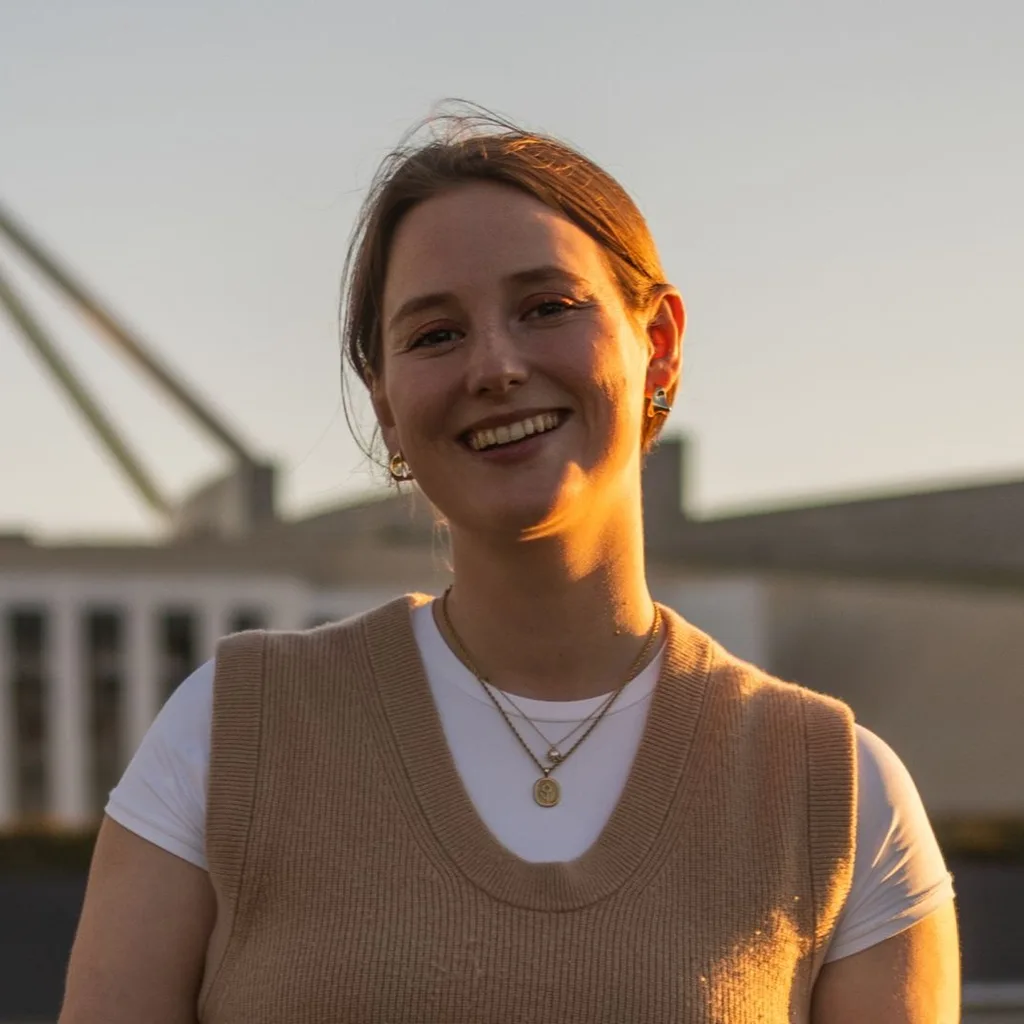
Lucy Skelton
After running for parliament at just 20, advocate and FORE Good founder Lucy Skelton reflects on finding her voice, challenging expectations and giving young women the support to lead.
I Wanted To Be In The Room Where The Rules Are Made
By the time I ran for parliament at 20, I’d spent almost a decade advocating for climate action and gender equality. Running wasn’t a sudden decision. It was years in the making. Every year, I became more convinced that politics has a power to act that nothing else quite has. You can advocate, protest and write the perfect report. But if you want to change the rules everyone lives by, you need to be in the room where those rules are made.
For me, putting my hand up was the natural next step. But the first time I realised my voice could change something came much earlier. I was 10 when a friend and I convinced our primary school to hold a pyjama day to raise money for the Starlight Foundation.
It showed me that people in positions of power could listen to us, even when we were young. We could organise something real that helped people we’d never met. That feeling never really left me.
You Shouldn’t Have To Shrink Yourself To Be Taken Seriously
I’ve been underestimated as a young woman: as the youngest candidate in the 2022 Victorian election, in early advocacy roles and while building FORE Good as a young founder and CEO. Each time, I’ve tried to use it as fuel.
What I’ve learned about being taken seriously is that the people around you matter enormously. Find mentors and teams who back you as you actually are. People who don’t expect you to shrink or reshape yourself to fit the room.
You need people who will support you while you learn, including when you make mistakes.
My mum gave me that belief early. She was confident in everything I could do long before I’d actually done it. Having someone who sees that possibility in you makes a difference.
Give Us The Training, Not Just The Invitation
There’s a lot of talk about empowering girls. To me, meaningful empowerment means removing the barriers that stop ambition before it has a chance to develop.
That means policy that supports girls’ health, safety and education. It also means giving young people the time and training to build experience.
We don’t have all the answers. Sometimes it feels as though people invite young people into a conversation and then expect us to arrive with every solution ready.
We have ambition and ideas. Include us, but give us opportunities to develop the skills to put them into practice. Don’t throw us in without support and expect us to know how everything works.
In our programs, around 70 per cent of participants are women. There are already talented young women showing up and wanting to contribute. We need to help them keep taking up space, and bring more women in behind them.
One of the fears I hear most often is public backlash online. If we want young women to participate, we need to understand what makes that participation feel difficult and support them through it.
Safety Has To Come First
If I could start with one policy change to improve girls’ lives, it would be consent education, alongside meaningful reform around sexual assault and sexual harassment.
I’m also interested in restorative and community justice models. We need to examine different pathways to justice when the existing system so often fails the people it is meant to protect.
Through FORE Good, I run a policy library full of ideas. But safety is something I keep coming back to.
When I imagine being a girl in Australia ten years from now, I want girls to feel safe and actually be safe.
I don’t want them second-guessing whether they can walk home at night. I don’t want a girl wondering whether a boy being pushy in the classroom is something she simply has to tolerate.
Safety first. Everything else follows.
Girls’ Opportunities Depend On Structural Change
We also need to talk about how women can leave poverty with real agency over their lives.
Increasing payments matters, but so does providing support around those payments: genuine pathways that help women move out of poverty and make their own choices.
When a policy doesn’t give someone a realistic chance to improve her circumstances, we need to question whether it is doing its job.
These are structural issues. Improving girls’ lives means looking at the conditions shaping their choices, as well as encouraging their ambitions.
There Is More Than One Way To Be Involved
To a young woman who looks at politics and thinks, “That world isn’t for me”, I would say: perhaps it isn’t. That’s okay. It won’t be for everyone.
But why not test it first?
Not every role is public-facing or combative. There is a whole range of work in and around politics that people may never have considered. We need artists, thinkers and designers in these spaces, too.
You don’t have to fit one particular idea of a politician to contribute.
And I would ask: if everyone like you decides not to engage, who is left making the decisions?
Those decisions are too important for us to assume we have nothing to offer.
Ambition Doesn’t Need To Be Quiet
If there is one rule about being a “good girl” I want the next generation to ignore, it is the idea that ambition needs to be quiet.
Be outrageously ambitious. Be loud and public about it.
But take care of yourself through it, too. Looking back at my 12- or 13-year-old self, that is what I would remind her: good sleep, exercise and friends matter. Your body is carrying you through all the ambitious things you want to do. It deserves care.
And if you don’t yet know what those things are, you have time.
Figuring out who you want to become isn’t a decision you make once. You keep doing it throughout your life. Nobody has everything locked in, however put-together they look from the outside.
You can change direction, learn and begin again.
Every girl deserves to know her voice matters, even when she is the youngest person in the room – or the only one in it.

Related stories

Native ad body.
Native ad body.
Native ad body.