


Sydney Sweeney’s latest campaign for sports trading app Novig, in which she holds an equity stake, has once again placed her at the intersection of provocation, commerce and the enduring commodification of the female body.
In the controversial advertisement, Sweeney poses in various sports uniforms while repeatedly intoning the word “sports”. The joke hinges on the conspicuous disconnect between her near-nudity and the campaign’s insistence that there is nothing to see but “sports”.
Beneath that provocation, however, sits a more complicated cultural paradox. Sweeney has previously spoken of feeling dehumanised by scrutiny of her body, while increasingly appearing to harness that same gaze as a source of agency and profit.

RELATED: Anyone Shocked By The Sydney Sweeney Discourse Hasn’t Been Paying Attention
What Have Australian Athletes Said About The Ad?
The advertisement has quickly drawn criticism from a number of Australian athletes, who have condemned what they describe as the unnecessary sexualisation of women in sport.
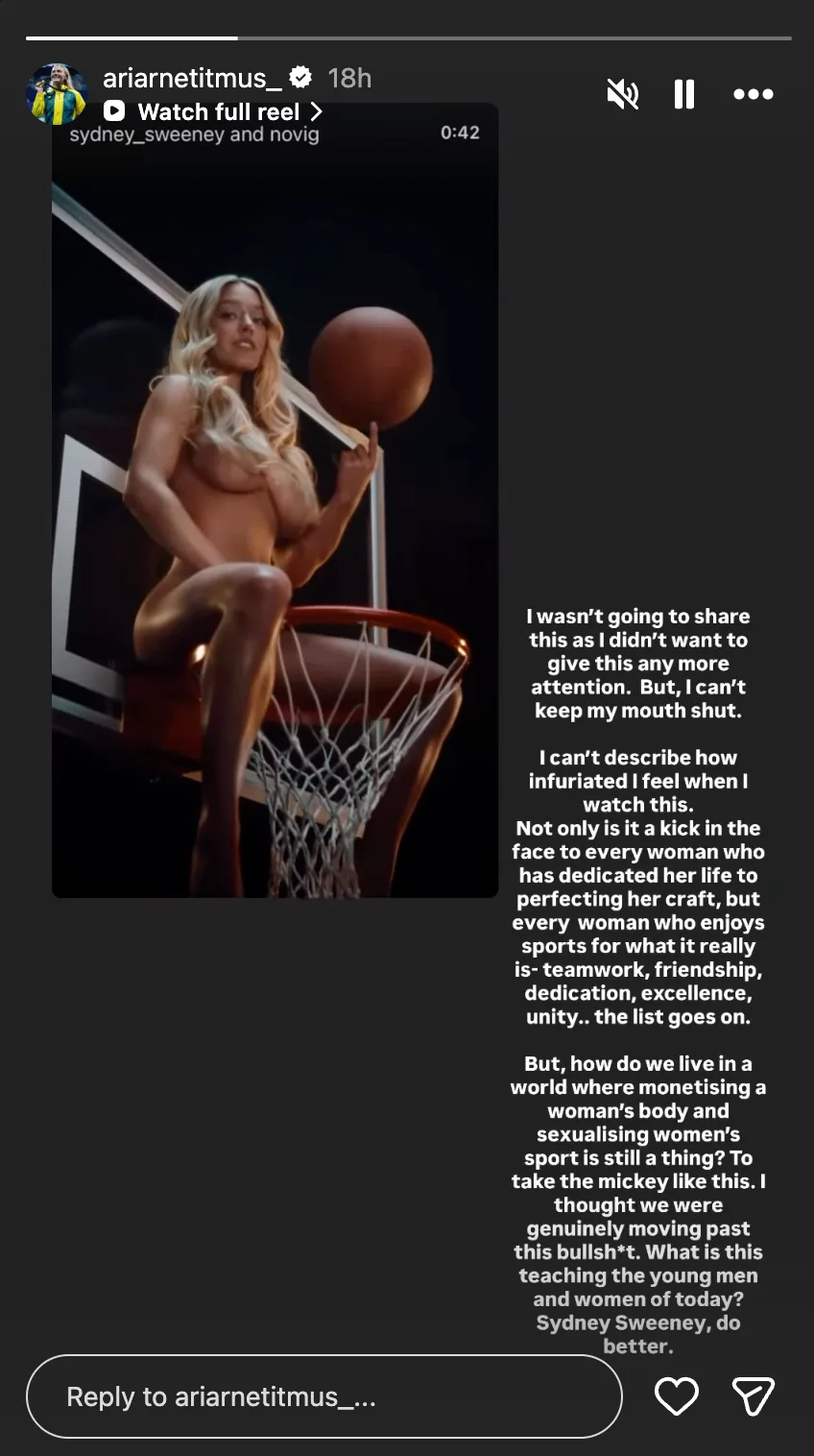
Retired Olympic champion Ariarne Titmus took to her Instagram Stories, describing the campaign as “a kick in the face to every woman who has dedicated her life to perfecting her craft.”
She further questioned, “how do we live in a world where monetising a woman’s body and sexualising women’s sport is still a thing?”
Olympic gold medallist Lani Pallister echoed the sentiment, sharing a montage of herself competing alongside the caption, “Don’t know what Sydney thinks sport looks like, but THIS is what sport looks like.”
The Female Athlete Project, founded by Olympic gold medallist Chloe Dalton, also weighed in, stating, “it’s incredible they could fit so much misogyny in 40 seconds.”
The women’s sport platform continued, “Sport has long treated women’s bodies as commodities, and this objectification does nothing to support real women in sport.”
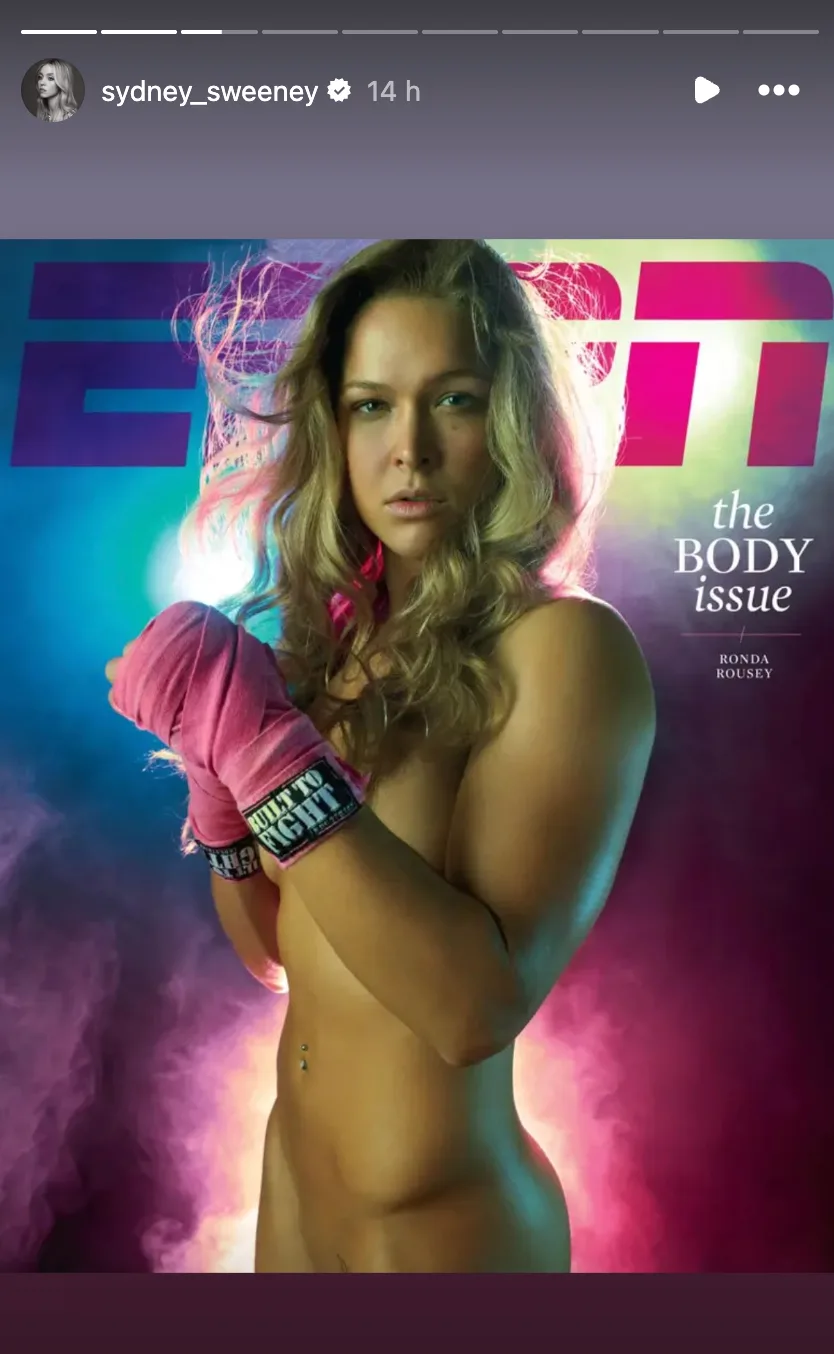
Sweeney has since indirectly responded to the criticism, sharing images from ESPN’s iconic Body Issue, which has featured nude and semi-nude athletes including Serena Williams, Ronda Rousey, Sue Bird, Megan Rapinoe and Caroline Wozniacki, seemingly drawing a parallel between its treatment of the athletic body and her own campaign.
But the two are not quite as correlative as Sweeney seemingly suggests. The Body Issue was conceived with a clear purpose: “to celebrate the incredible power of the athletic form”, placing the bodies of athletes within the context of their physical discipline, strength and achievement.
Over the years, the magazine’s Body Issue evolved into a platform for athletes to share stories of vulnerability, identity and achievement. Paralympic rower Oksana Masters, for instance, appeared without her prosthetic legs after years of grappling with self-image and identity, shaped by bullying and feeling different from her peers.
Speaking to Graham Bensinger, she recalled her experiencing shooting the feature: “I almost said no. No way in hell am I going to take my legs off or anyone’s going to see this or my body period…but I really wanted to show society and women that beauty comes in so many different shapes and colours and forms and there’s power in it.”
Transgender athlete Chris Mosier similarly used the Body Issue to publicly reclaim a body he had spent much of his life feeling disconnected from. Having previously avoided photographs because his physical appearance did not reflect how he saw himself, Mosier said appearing nude marked a profound shift in his relationship with his body: “To be at a point where I not only want to be in photos but with no clothes in photos is tremendous.”
In both cases, the body is inseparable from the story being told, serving not simply as spectacle, but as a window into the athlete’s identity, experience and achievements.
Sweeney’s Novig campaign operates within an altogether different visual economy. Here, sports equipment functions as a crass prop, while the humour depends upon the conspicuousness of Sweeney’s near-nudity.
Her body is not being presented as evidence of physical accomplishment, but as the visual currency through which a sports trading app captures the attention of its predominantly male audience (nearly nine out of 10 regular sports bettors are men).
There is, of course, nothing inherently unfeminist about a woman choosing to present her body sexually, nor does nudity, in itself, constitute objectification.
The difference lies in what the image ultimately asks us to see. While the Body Issue sought to turn the gaze towards what an athlete’s body can do, Novig turns it towards what Sweeney’s body can sell.





Share this post