There’s a particular kind of humiliation reserved for romantic hopefulness. The kind that could convince you to scour an entire university campus searching for someone you met once on a night out after a connection that, however briefly, seemed charged with cosmic significance. In Finding Emily, that humiliation becomes both the punchline and emotional thesis of the film.
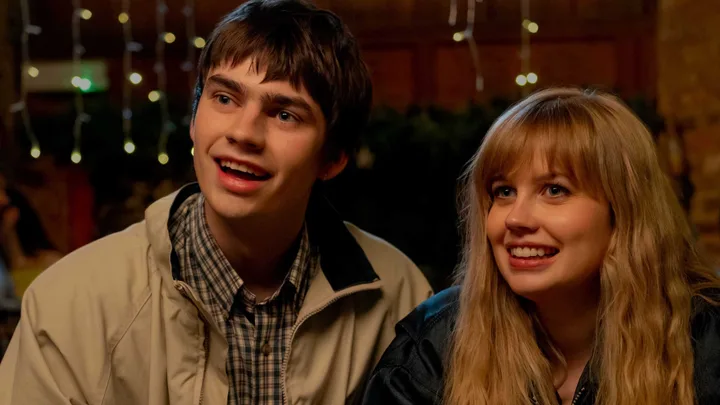
Directed by Alicia MacDonald and written by Rachel Hirons, the new British romcom follows Owen (Spike Fearn), a guileless university sound engineer who becomes consumed by the pursuit of a girl named Emily after a fleeting connection on a night out.
By morning, he discovers the phone number she gave him is missing a digit. Armed with little more than a first name and an almost delusional belief in romantic destiny, his search instead leads him to another Emily, played by Angourie Rice: a psychology student who offers to help track the mysterious woman down while secretly using Owen as the subject of a dissertation arguing that love is merely an irrational “evolutionary hangover” destined to culminate in obsession and emotional ruin.
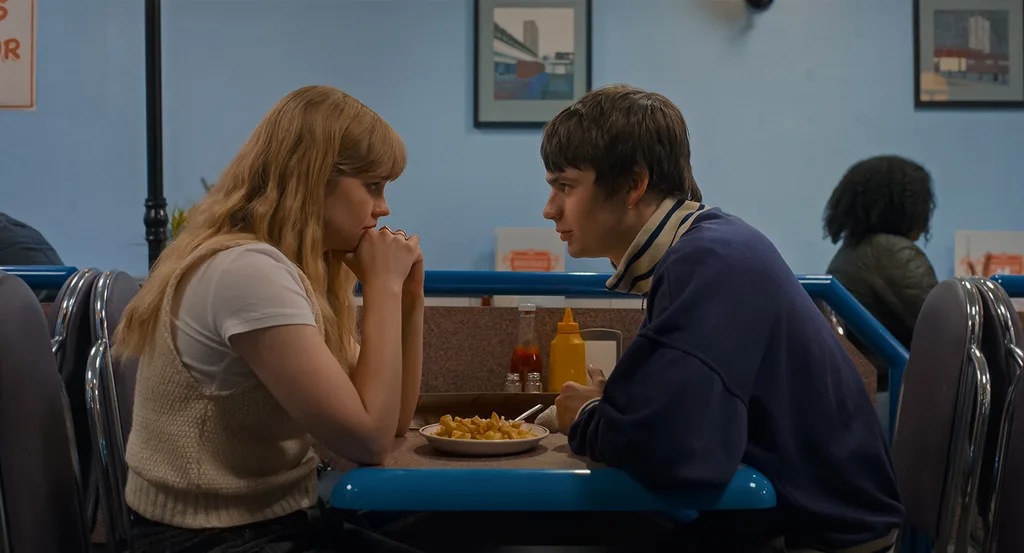
Speaking with the magnetic Rice, she tells marie claire the project was an immediate yes.
“I sat down to read the first 30 pages,” she says. “I think I had something else I wanted to do that day, but instead I sat down and read the entire thing, which for me is a really good marker of a script that is compelling and exciting and fun.”
By the time she finished, she already knew she wanted in.
“After I read it, I thought, yes, I want to be in this. I want to talk to the director. I want to see if they’re interested in me. So I knew from that first read it was something special.”
Rice approached Emily less as a villain than someone deeply at war with herself. To prepare, she immersed herself in philosophy and psychology texts recommended by MacDonald, including Essays in Love by Alain de Botton. The pair even attended a public lecture on Carl Jung together while preparing for the film.
“Alicia and I also went to a free talk on Carl Jung and psychology together. We listened and wrote notes, and that was really fun,” Rice laughs.
That intellectual framework helped Rice understand Emily as someone attempting to rationalise intimacy before she has to genuinely experience it herself.
“She makes pretty poor choices,” Rice admits. “But as an actor, that’s actually more fun. You have to think about why this person is making these choices.”
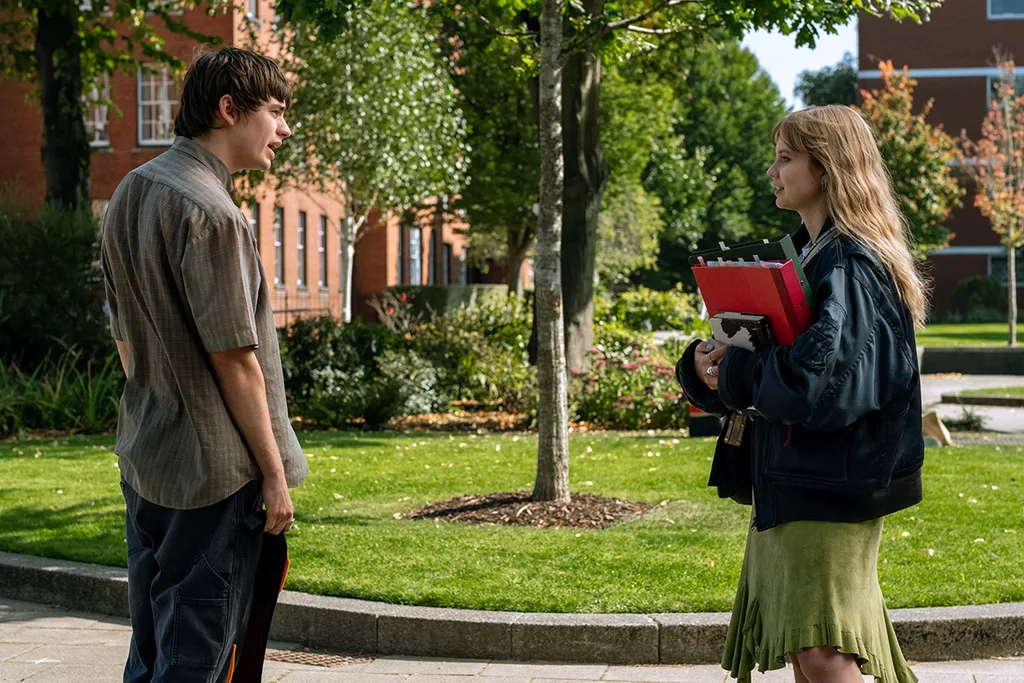
For Rice, Emily’s growing guilt over exploiting Owen became the key to understanding the character’s emotional contradictions.
“She’s kind of at war with herself. Her head is saying one thing, her heart is saying something else. In scenes with Owen or with her teacher or friends, she’s saying, ‘I don’t care about him, it’s all part of the project,’ but actually she really, really does care about him.”
That tension gives Finding Emily its sharpest edge. Emily’s behaviour is ethically messy and undeniably intense, yet the film refuses to flatten her into caricature. Instead, it frames her as someone terrified of emotional exposure, attempting to maintain control through analysis, irony, and intellectual distance.
Owen, by contrast, approaches love with almost reckless sincerity. With his Liam Gallagher haircut and distinctly scruffy British charm, he believes in grand gestures, chance encounters, and the possibility that surrendering one’s dignity in the name of love might actually be worthwhile.
“I think we have this almost allergic reaction to people being really honest and sincere,” Rice says. “It’s often seen as awkward and embarrassing.”
It’s this push and pull between cynicism and romanticism that makes Finding Emily feel distinctly contemporary. While the film borrows visually and emotionally from classics like When Harry Met Sally and Bridget Jones’s Diary, its anxieties are unmistakably Gen Z.
Rice points to the film’s fascination with how private emotions mutate once subjected to public consumption (here’s looking at you, TikTok).
“When Owen’s quest is discovered by the university sphere and the internet, it becomes something everybody has an opinion on,” she explains. “I like that the film explores the connection between something intimate being blown up onto this global, digital scale.”
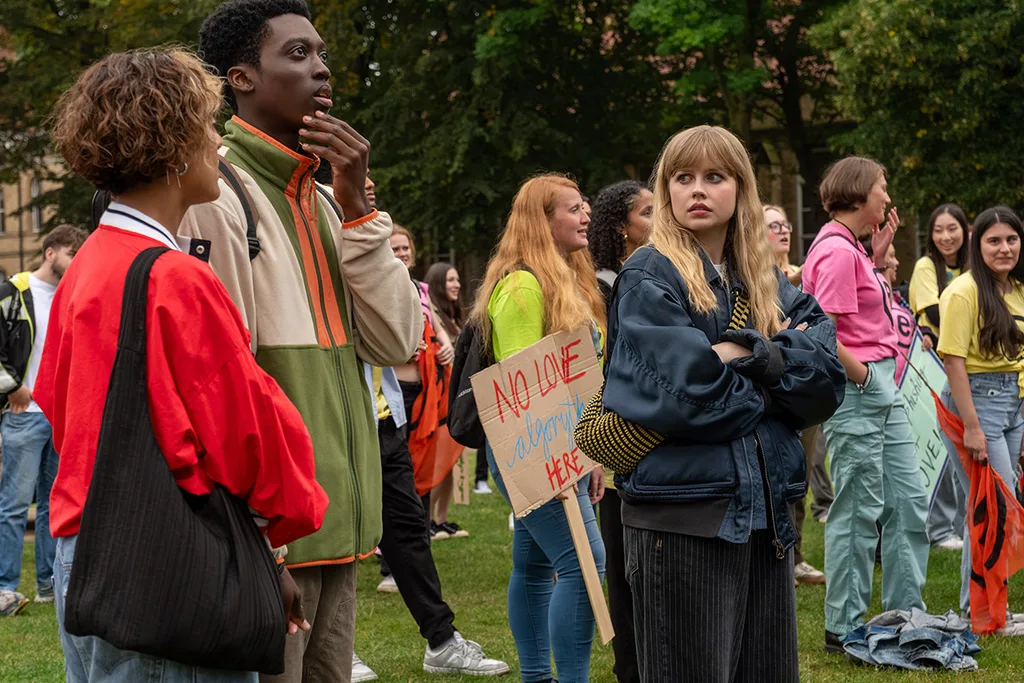
The film also arrives amid a broader resurgence of yearning-driven rom coms that reject detached coolness in favour of emotional risk. Unlike the carefully curated performances of dating-app culture, Finding Emily revels in awkward encounters, crossed wires, and impulsive decisions. Yet beneath its charm, the film probes the very forces that now complicate yearning, interrogating how romantic pursuit becomes politicised once filtered through online spectatorship and contemporary conversations around consent, entitlement, and emotional boundaries.
But that discomfort is precisely what gives the film its allure. Rather than smoothing over the indignities of modern dating, Finding Emily lingers in them. For Rice, that emotional openness is exactly what makes the story resonate.
“I think there’s always a dance between feeling vulnerable and saying what you feel…this movie is about doing the embarrassing thing and being okay with it, because it’s what you want to do and it’s how you feel,” she says. “I crave that. I want to be free of the embarrassment of doing something meaningful and real.”
Much of that emotional texture comes from the chemistry between Rice and Fearn, whose dynamic oscillates between chaotic and deeply tender. Rice describes her co-star as having an “electric” energy on set, with the pair bonding over music and rehearsing scenes together between takes.
“He would hand me his earbud and we’d listen to songs together,” she says. “I liked running lines a lot because if I knew them really well, then we could just play around and improvise.”
Beneath all the misunderstandings and ethical catastrophes, Finding Emily remains surprisingly hopeful. It understands that modern romance often exists in direct conflict with irony: people desperately want connection while simultaneously fearing humiliation.
Rice herself seems to sit somewhere between romantic fatalism and realism.
“I’m always believing one or the other,” she says. “Like, this is magical, this happened for a reason. And then I’m like, actually everything is random.”
Perhaps Finding Emily lands somewhere in that contradiction too. Romance isn’t presented as perfect or even logical. But it is presented as something worth risking sincerity for, which may ultimately be the film’s most radical fantasy of all.

Related stories

Native ad body.

Native ad body.


Native ad body.