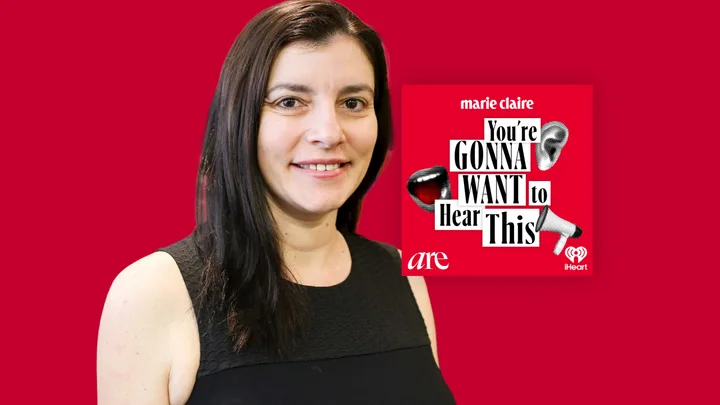
Fidan knows how unlikely it sounds. After years of building a legal career, it was a salad made at her desk that introduced her to an international audience.
“That is my biggest video to date with something like 14.5 million views. And I made a salad,” she tells Georgie McCourt on marie claire’s podcast, You’re Gonna Want To Hear This. “It was a pretty good salad.”
For anyone who follows her, that understatement will feel familiar. There are the generous platters, the grocery shops, the dinners squeezed in after work, and the reassuring refrain: “Don’t worry about it.”
But across a revealing two-part conversation, the lawyer, author and mother shares experiences rarely discussed during her dinner videos, including discovering her childhood cancer diagnosis as an adult and the months her twins spent in neonatal intensive care.
“I’m such a bright, positive person constantly, that that was kind of a dark time,” she says of becoming a mother. “There was nothing I could do, whereas normally I’m always, like, really, really proactive.”
The Salad That Changed Everything
TikTok began as a solution to a professional problem. A partner in her law firm, Fidan needed to bring in clients. When the local publications she used to advertise family-law seminars disappeared after COVID, she looked online.
“One day I put my phone leaning against my hole puncher … and just went record and started talking about case stories,” she recalls.
Initially, the audience was small.
“I’d come home to my husband and say, ‘I don’t understand. I’ve got such great content, but I have no followers and nobody’s listening.’”
Clips from a television appearance discussing prenups helped attract followers. Then, in October 2024, came the salad video, complete with a perfectly timed “Thank you, Beyoncé” that tapped into a circulating online joke.
“All of a sudden I had viewers in the UK, in Europe, in Canada,” she says. “So then I went over a million because of the salad.”
Why People Keep Watching
For Fidan, the appeal comes down to how little she changes herself for the camera. Viewers get the woman who has finished a demanding working day and still needs to make dinner.
“Often I’ll be tired, and whingy, and grumpy, and I’ve had a long day, and I really don’t wanna cook, but I’m home, and dinner needs to be served, and I need to get on with it,” she says. “So that’s what I’m presenting.”
There is no script or elaborate preparation.
“I’m not brushing my hair. I’m not doing makeup. I’m not doing a mirror check before I get on.”
That familiarity keeps people returning. As Fidan puts it, following her daily life is “like a TV show”.
“They need the next episode. So what’s happening? What did Fidan have for dinner? … What did Fidan buy in her grocery shop? What’s happening on platter day?”
Her favourite weekly ritual also offers something to anticipate.
“If I’ve got nothing on, that’s the thing to look forward to, ’cause that’s my favourite day of the week.”
The attraction is easy to understand: watching Fidan, an ordinary evening can feel like something worth enjoying.
“I don’t have to think about it ’cause it’s all real,” she says. “Like, I really did do that.”
“I didn’t even know I had cancer”
At 13, Fidan found a hard lump on her abdominal wall while showering. Surgery and radiotherapy followed. What her parents didn’t tell her was that she had cancer.
“My parents never told me that it was cancer, so I was somewhat protected from it. I had no idea,” she says. “There’s a lump. We have to remove it. It shouldn’t be there.”
At about 21, encouraged by a boyfriend to understand her medical history, she returned to Westmead Hospital. Inside her file was a photograph of her teenage self beneath a radiation machine.
“When I saw that, I burst into tears, I couldn’t talk.”
She asked the doctor to write down her diagnosis, then left.
“I took the bit of paper, I left, I went home, I put it in my journal, and I didn’t look at it for years.”
Only in her late 20s did she search the diagnosis and discover she had survived synovial sarcoma. She remains grateful for her parents’ decision.
“I think they did the right thing,” she says. “I’m grateful that they did it that way.”
The Motherhood Story She Rarely Shares
Trying to conceive in her late 30s brought another experience she couldn’t organise her way through.
“You have that disappointment every month when you are actively trying and thinking, ‘I don’t understand. I thought, I thought that one was it.’”
Fidan underwent three IVF cycles. The first produced no embryos. During the second, she became pregnant but miscarried; subsequent frozen embryo transfers were unsuccessful.
On the third cycle, two embryos were transferred. Both took.
“It was so fabulous, and I was so happy,” she says. “It was the greatest thing ever to happen to me.”
Then, at 26 weeks, her waters broke. Her twins were born by caesarean and remained in neonatal intensive care from late February until June.
“I was grateful that they were alive,” she says. But being separated from them was heartbreaking.
“The other mums are there breastfeeding their babies, and I could hear the babies. And, like, I didn’t have my babies.”
At home, she woke through the night to express milk.
“I’ve got this breast pump machine. I put it on, the noise, the humming, in total darkness, and … it was just really depressing.”
She describes the NICU nurses as “phenomenal”. Eventually, being able to bathe and dress her children became a milestone.
“When you finally get to do the baths and the dressing, you feel like you’re being the real mum.”
What Divorce Has Taught Her About Love
After more than 20 years in family law, Fidan has heard plenty of separation stories. In her experience, relationships often unravel through communication problems and a gradual loss of connection.
“The romance is gone. You raise the kids,” she says. “At some point they’re like, ‘I can’t do this anymore.’”
In her own relationship, she values separate interests alongside shared time. Her partner books days playing Dungeons & Dragons; she organises dinners with friends.
“He understands. ‘All right. I got you. You go have a good time.’ And then we have our things that we do together.”
For women feeling worn down during separation negotiations, her response is direct: “Let me be your backbone, because you fucking need one.”
She stresses the importance of advice tailored to individual circumstances.
“Every situation is different. There’s no one-size-fits-all.”
A Decision Made On Her Own Terms
For years, unsolicited suggestions that Fidan have a breast reduction were met with the block button.
“I’m perfectly happy with my body and I don’t need to do anything to it,” she recalls telling viewers.
Persistent back pain eventually changed her mind. She researched surgery and says nearly three kilograms were removed. Although she experienced complications, the relief was immediate.
“The back pain is gone, and now it’s just opened up all this shopping.”
She describes the operation as the “best thing I ever did”.
Learning What Can Wait
Her familiar catchphrase grew out of managing competing demands.
“I constantly say to myself out loud, whether or not the camera’s on, ‘Don’t worry about it. It always gets done.’”
Now, she’s learning to say no, including to the pressure to fill her seven-year-olds’ schedules.
“They don’t have to be perfect and do everything that you want.”
There is plenty ahead, including a cookbook planned for early 2027. But her favourite moment remains sitting down after the children are in bed.
“The day’s no longer, nothing to be done. I can just sit, right? And it’s just so nice.”
Listen to Fidan’s two-part conversation on marie claire’s You’re Gonna Want To Hear This, or watch on marie claire’s YouTube channel.

Related stories

Native ad body.
Native ad body.



Native ad body.