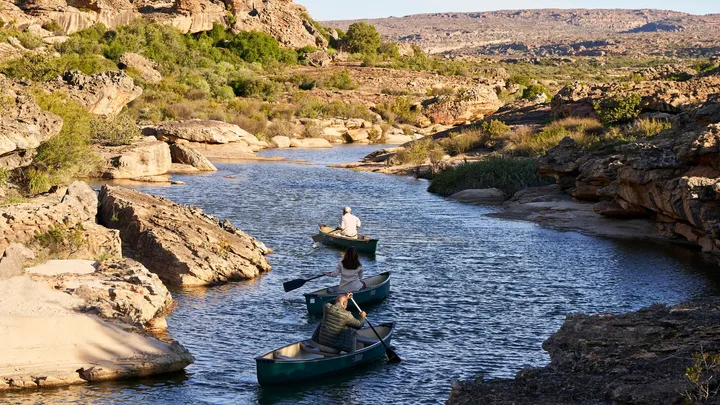
The sun is setting in South Africa, slowly being swallowed by the horizon in vivid shades of red and gold. I’m trundling back to my lodge in an open-air 4WD after spotting a dazzle of zebras (can you believe that’s the collective noun?). Our guide, Tristan, is navigating the way through burnt-orange rock formations to return us to Bushmans Kloof, a family-owned lodge and wilderness reserve cradled by South Africa’s rugged Cederberg Mountains.
Here, iron-oxide sandstone has been sculpted over millions of years into finger-like rock towers, dramatic overhangs and weathered formations that appear almost hand-carved. Long before luxury lodges arrived, people were already drawn to this striking landscape. Hidden among the reserve’s sandstone shelters are more than 135 documented San rock art sites, offering a rare glimpse into ceremonies, rituals and daily life dating back thousands of years.
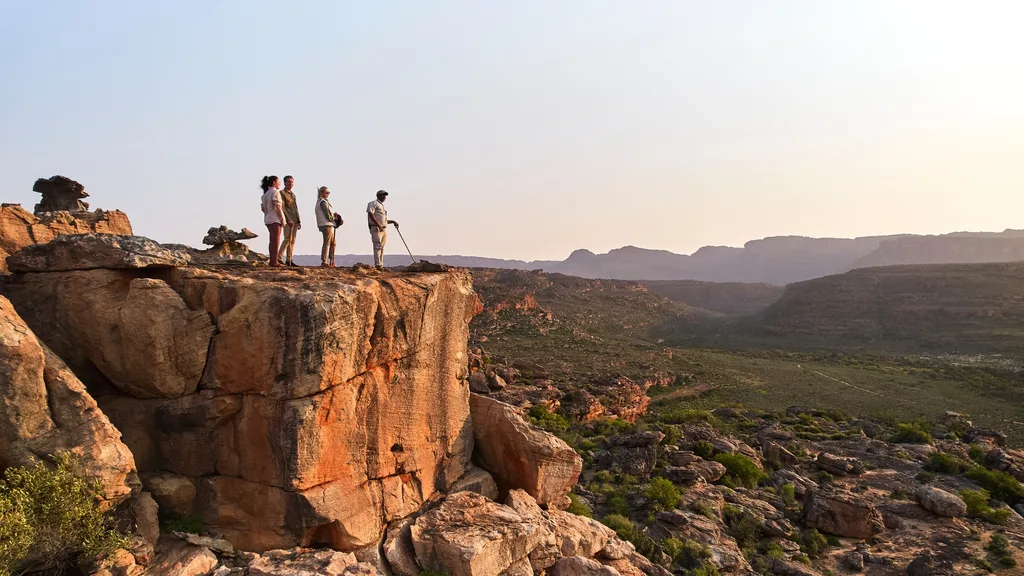
At 7500 hectares, the reserve encompasses an extraordinary concentration of biodiversity. It is also increasingly becoming a model for conservation-minded tourism, proving that luxury travel and environmental stewardship need not be mutually exclusive. Bushmans Kloof is home to hartebeest, springbok, ostriches and the aforementioned Cape mountain zebras.
I am especially taken with the springbok. Although predators are absent from this part of South Africa, the small antelope remain skittish, breaking into their trademark “pronking” whenever our safari vehicle turns towards them.
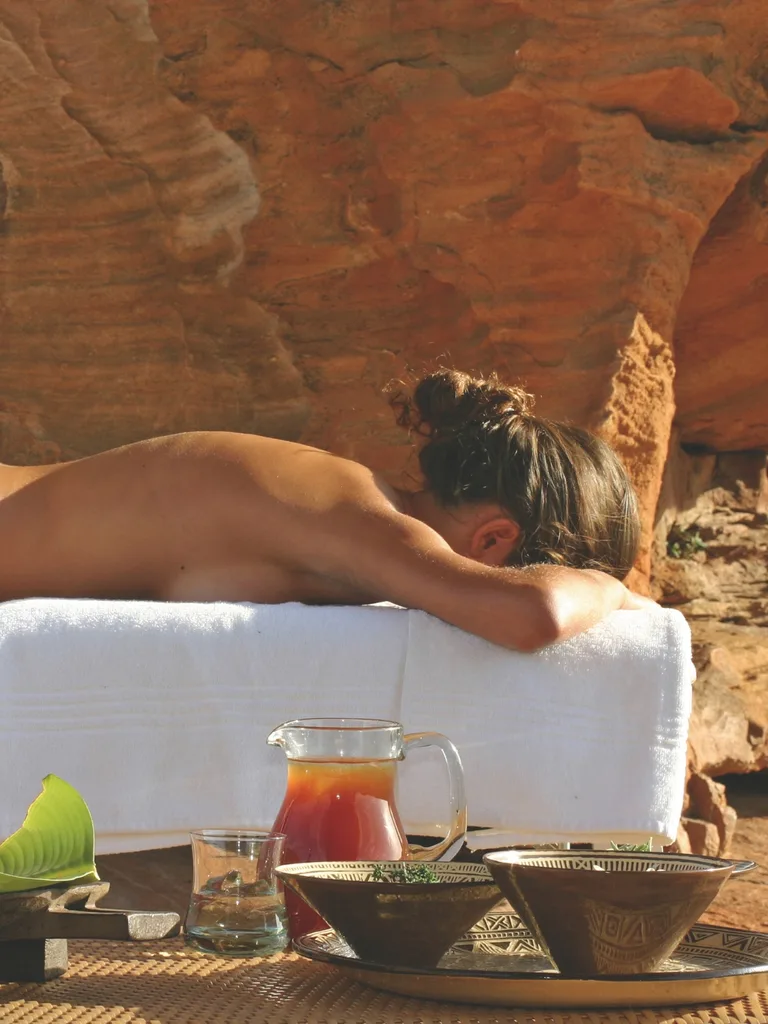
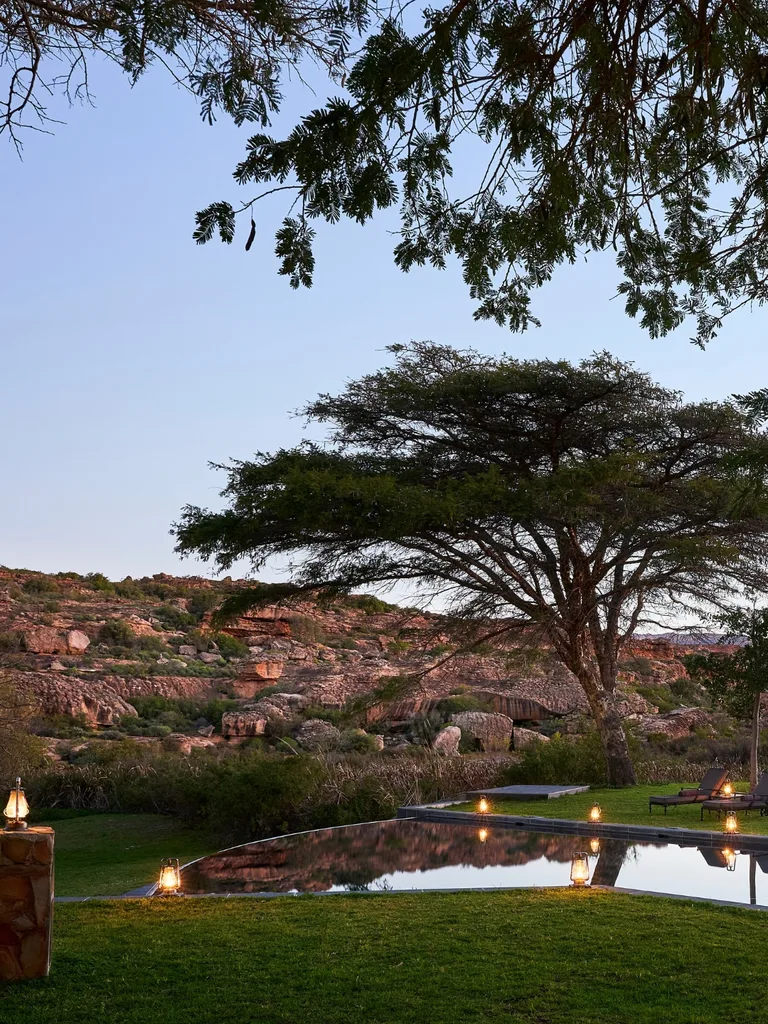
Back at the lodge, my sprawling room awaits, complete with a fireplace, crisp cotton bed linen and a fluffy robe and slippers laid out by the diligent housekeeping team, who service my room three times a day, somehow completely undetected. Yet the real pièce de résistance for me at Bushmans Kloof is the spa.
Treatments draw on ancient African traditions and an exclusive line of products formulated with native African plant extracts, such as baobab tree oil, mafura butter, Cape aloe and rooibos. Using aromatherapy oils, my therapist massages my skin in long, sweeping motions with perfectly heated volcanic stones, stopping only moments before I drift into a deep slumber.
This massage is thorough: she’s seeking out knots and focusing on them tenaciously, and by the end of the 90-minute treatment, the tension I’ve been carrying in my shoulders for years seems to have finally surrendered.
Although before I get ahead of myself, it’s worth noting my South African journey began days ago, hundreds of kilometres from here. It’s on my first day in Durban, during a Zulu cultural immersion experience, that I quickly discover the country’s greatest asset is not necessarily its wildlife or landscapes, but its people.
Here, I visit reconstructed traditional homesteads and step inside the home of a sangoma (traditional healer), where we discuss the role ancestral knowledge continues to play in contemporary South African life. It’s a fascinating introduction to a country that’s cultural depth is every bit as impressive as its beauty.
More importantly, it challenges many of my assumptions. Wildlife-watching has become synonymous with South Africa – and the country is one of the African continent’s most prolific safari destinations – but to reduce it to a single drawcard would be unjust. With its blend of culture, urban cool and natural wonders, South Africa offers experiences that stretch well beyond the safari circuit.
From Durban, we fly to Cape Town. Few cities are blessed with a setting quite like this. Framed by mountains and ocean, the South African capital possesses a natural grandeur that is difficult to overstate. Whether wandering through neighbourhoods, over-indulging in long lunches or watching surfers tackle the coastline, a palpable energy permeates every corner of the city.

A visit to Boulders Beach to say hello to the African penguins toddling around the shoreline was a particular highlight. InterContinental Table Bay offered front-row seats to it all. Inaugurated in May 1997 by former South African president Nelson Mandela, the landmark hotel has been reimagined for today’s luxury traveller following a multimillion-dollar redevelopment. The rooms are spacious and beautifully appointed, but it’s the warmth of the staff and the effortless hospitality that lingers most in my memory.
An hour’s drive from the capital are some of the Western Cape’s finest attractions. The Cape Winelands unfold in a patchwork of vineyards, mountain ranges and historic towns. Home to some of the world’s most celebrated wine estates, the region offers a slower, more pastoral contrast to Cape Town’s urban energy.
In Stellenbosch, I check into Lanzerac Hotel & Spa, where an imposing, tree-lined driveway immediately reveals the hotel’s deep sense of history and character. The estate dates back to 1692 and has witnessed centuries of winemaking history. It is perhaps best known for releasing the world’s first bottled Pinotage in 1961.
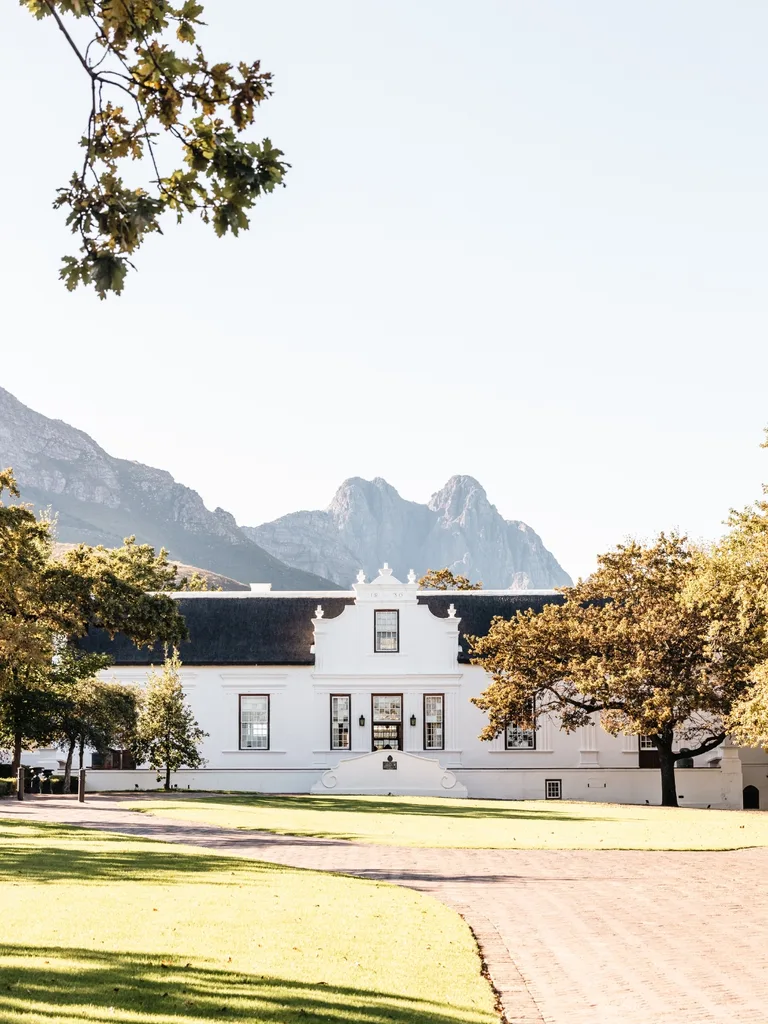
Each room is distinct, yet all blend the estate’s heritage with contemporary design through an eclectic mix of finishes. Antique furniture and art from an extensive private collection add character, while heated flooring and a deep Victorian bathtub make leaving the room surprisingly difficult.
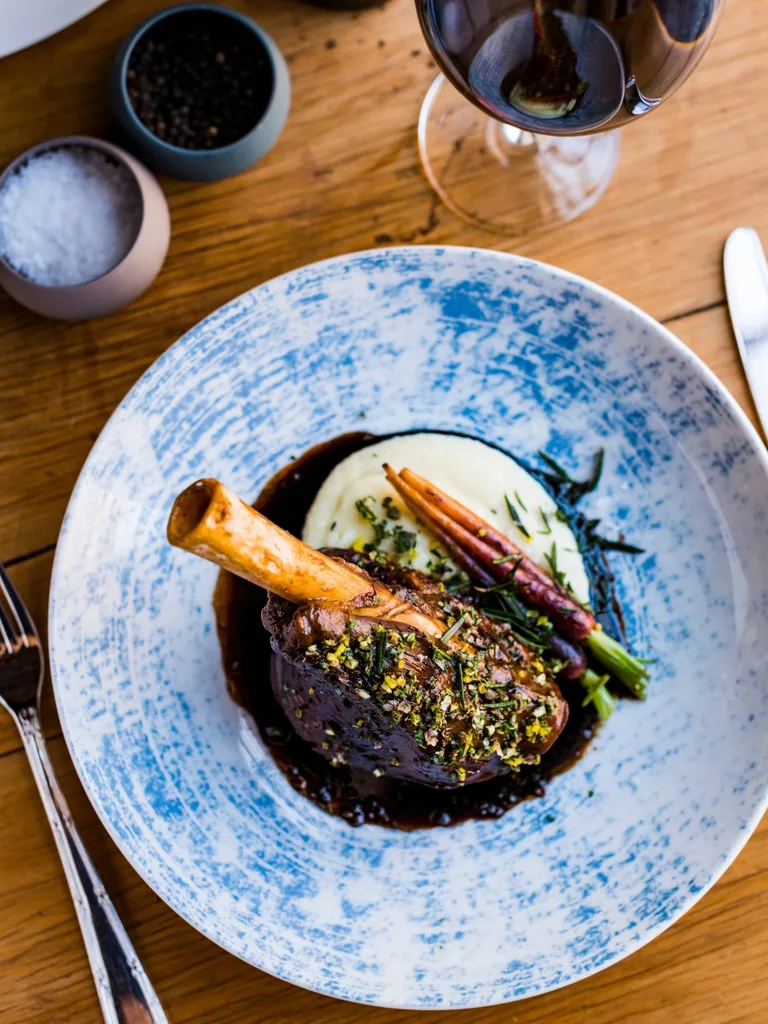
The estate’s greatest indulgences extended beyond its guestrooms, with the dining proving equally memorable. At the Manor Kitchen, dishes such as shellfish risotto with tomato bisque and ginger-coconut foam, alongside shiitake-crusted springbok, celebrate local ingredients and flavours. During the wine tasting, I sample pinotage, sauvignon blanc and chardonnay, each revealing a distinct expression of the region’s celebrated terroir.
Where Lanzerac offers tranquillity, our final destination in South Africa delivers exhilaration. Set within the Greater Kruger region, Kapama Private Game Reserve provides my first true safari experience, and ensures it won’t be my last.
Less than 24 hours after arriving, I find myself clambering into an open-air safari vehicle well before sunrise. The early start would normally be enough to dampen my enthusiasm, but on this occasion, I can barely contain it. Pre-dawn is quiet in the South African bush, the sky slowly lightening to a soft powder blue as we set off in search of wildlife.
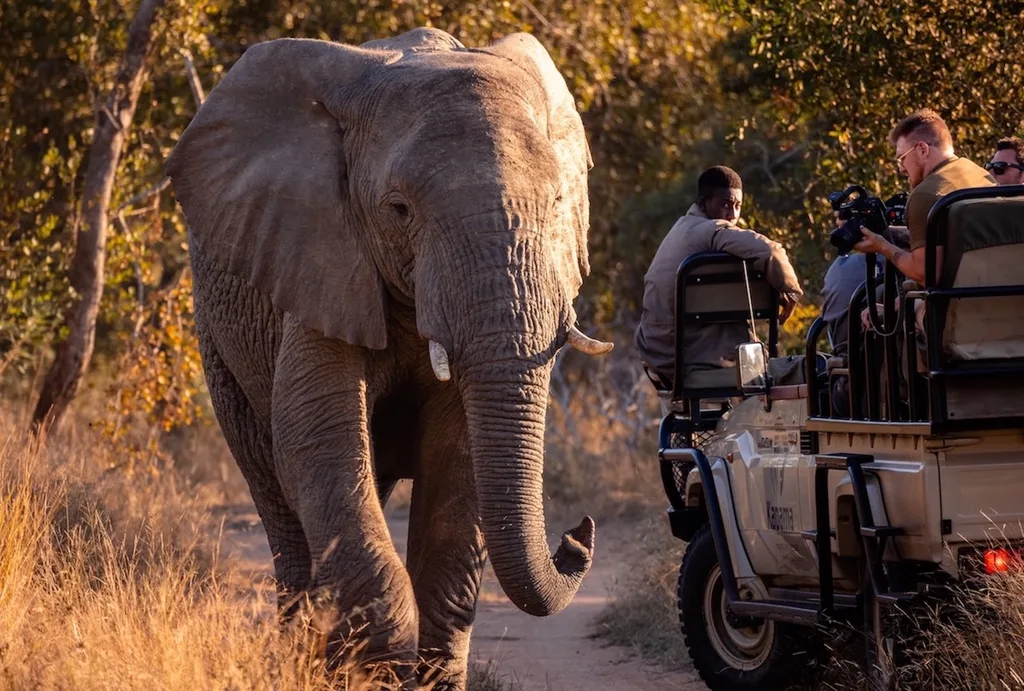
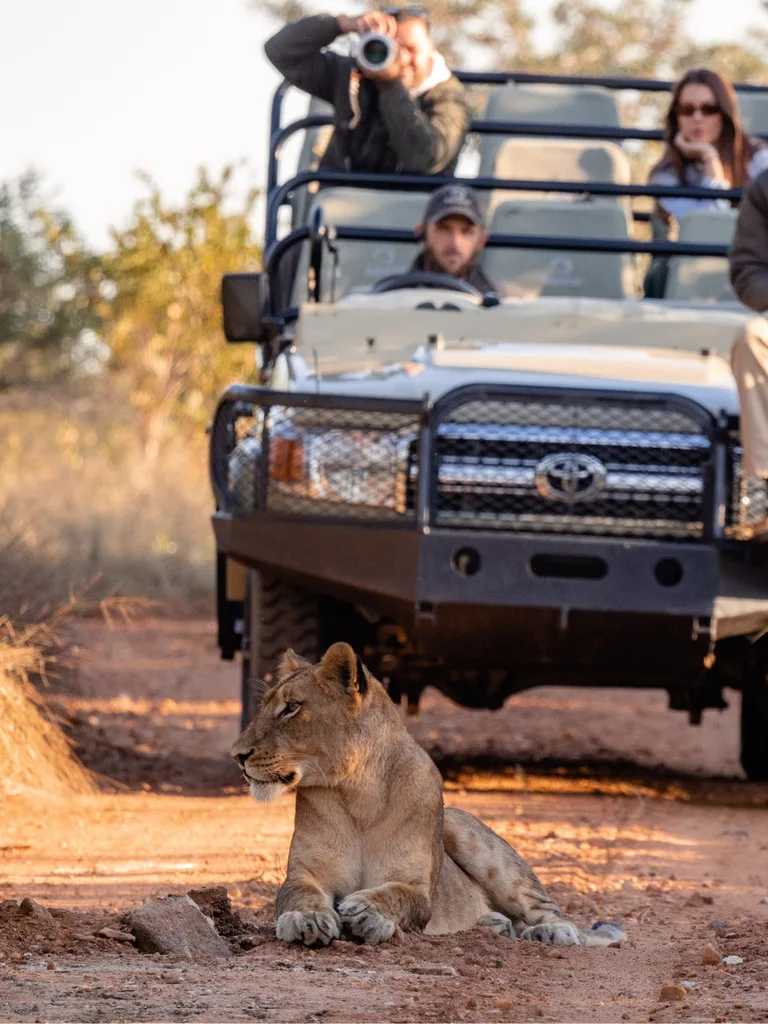
This first journey into the bushveld yields immediate sightings: a family of baboons scrambling up a tree, an elephant plodding along the road and several vultures perched on sprawling, gnarled branches overhead. By the evening, my morning’s excitement has been superseded by an unnervingly close encounter with a lion. He lies beside another male, softly purring, his magnificent mane streaked with blood. I wonder whether he can hear my heart hammering in my chest.
While the Big Five may be the reserve’s most famous residents, they are far from its only attraction. Lilac-breasted rollers streak through the sky like vibrant jewels, while a hundred birds flitter and squawk in a melodious cacophony. A sounder of warthogs scurries by ahead, while an African hoopoe, its flamboyant crest fanned like a feathered crown, sounds its wood-flute call.
There are no sighting guarantees on safari. Yet our ranger, Edwin, and wildlife tracker, Humphrey, possess an uncanny ability to read the landscape. Together, they study paw prints, animal tracks and even dung, piecing together clues that lead us towards elusive species.
When not on safari, I retreat to Kapama’s newly refurbished Tamboti Superior Suites at River Lodge. Designed to blend seamlessly into the surrounding landscape, each suite feels contemporary yet deeply connected to place. Soft taupes, walnut tones and elephant-grey walls reference the colours of the African wilderness, while sandstone, granite and natural textures reinforce the connection to the environment beyond. The rooms are spacious and calming, featuring an open rain shower as well as a vast bathtub overlooking the bush.

Wildlife remains the main attraction, yet Kapama’s Wellness Centre offers a compelling counterpoint. I indulge in a Rasul treatment combining steam and mineral-rich mud while overlooking a watering hole where hippos wallow and grunt. Seeing wildlife while receiving a spa treatment feels wonderfully surreal, yet somehow entirely normal in this extraordinary part of the world.
As evening descends, guests gather around roaring fireplaces, exchanging stories from the day’s adventures. At the Boma dining area, long dinners unfold over dishes inspired by the rich flavours and culinary traditions of Africa, providing a fitting conclusion to days spent exploring the wilderness.
Edwin joins us for dinner on our final evening. He has been at Kapama for nearly 14 years, so his knowledge is encyclopedic and his enthusiasm for the bush utterly infectious. Our group feels incredibly fortunate to have explored the reserve alongside him and Humphrey, whose intuitive understanding of the landscape and the wildlife added yet another layer of magic to an extraordinary experience.
On my drive back to the airport, a giraffe cranes its neck around a marula tree, offering an apt farewell. It strikes me that what I’ll remember most is not one singular highlight but the cumulative effect of experiences that have enriched one another.
South Africa’s appeal has always been obvious: the wildlife, the wine and the scenery. What I hadn’t anticipated was the richness of its culture, the warmth of its people and how wellness felt woven so naturally into every experience. Perhaps that’s why, before I’d even left, I began planning my return.

Related stories
Native ad body.
The Holiday That Makes You Feel Like Yourself Again
Native ad body.

Native ad body.