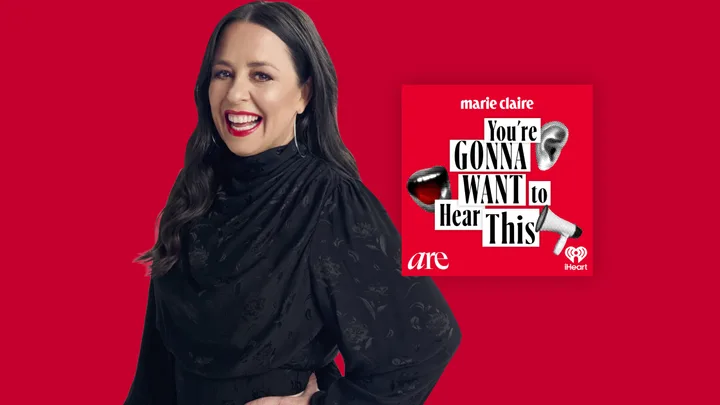
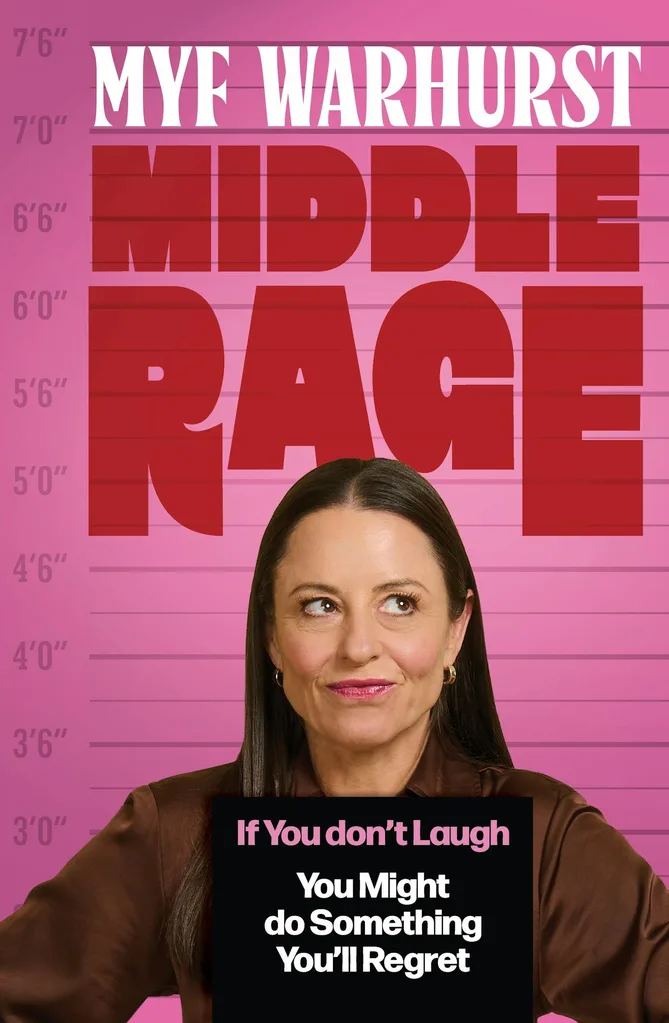
Myf Warhurst has spent much of her career making Australians laugh. But when the beloved broadcaster, now 53, sat down to write a funny book about the indignities of middle age, something unexpected happened. The jokes disappeared. In their place came years of buried frustration, anxiety, relationship disappointments and uncomfortable realisations about what it means to be a woman getting older. What emerged was Middle Rage, a personal exploration of midlife, and a woman who is no longer prepared to accept the things she once did.
“I thought, ‘I’ll write a funny book about all these things.’ And when I actually sat down to write it, so many things had happened in my own life by then that I just couldn’t find any laughs,” Warhurst tells marie claire editor Georgie McCourt on the latest episode of the You’re Gonna Want To Hear This podcast. “It was almost self-help in a way. It was [therapy]. And I didn’t write it for anybody else, I don’t think, even though I knew I was writing it for other people. But the result has been, I think, probably the most authentic thing I’ve ever done, and it was really hard, and I’m really proud of it.”
For Warhurst, middle age has been less about slowing down and more about waking up. After decades of people-pleasing, pushing through exhaustion and questioning herself, she has reached a point where she is reassessing almost everything: her health, her career, the relationships she has accepted and the expectations society has placed on women. And central to that awakening is something women have spent generations being told to suppress: anger.
“I think anger is, first and foremost, a very rational response to what’s happening to women right now,” she says. “I think we’re angry about the fact that we’ve been told we’re not allowed to be angry as women. We’ve been conditioned by society to behave, to be polite, to think about the needs of others first.” That conditioning, she argues, has consequences far beyond good manners. “To be told to behave and not to be angry keeps us compliant, keeps us quiet. We don’t talk about things, which is not who we are.”
The Menopause Symptoms Nobody Warned Her About
For Warhurst, the changes began long before she understood what was happening. Looking back, she believes she may have been experiencing perimenopause from her early 40s, with symptoms becoming particularly difficult in her mid-to-late 40s. Despite decades of experience in broadcasting, she suddenly found herself struggling with overwhelming anxiety, sometimes so severe that she questioned whether she could go on air.
“I had huge anxiety. Anxiety spike was terrible. And I work in radio, and it got to the point where I felt like I couldn’t even go on air some days. And my body was coming out in hives,” she recalls. “It was like I had to sit myself down and take myself out of my own head. Like, I’d have to be sitting there tapping myself and going, ‘That’s a tree, that’s a cupboard,’ things like that, like really basic stuff. And it just meant that my thoughts were racing so much that I couldn’t actually focus on what I was saying.”
What made the experience particularly frightening was that nobody connected her symptoms with perimenopause. “I just was so uncomfortable in my body and my brain. And at that time, no one pointed me in the direction of perimenopause,” she says. It wasn’t until she made an ABC documentary about menopause that she began understanding the changes she had experienced. Even then, she initially hesitated to take on the project, fearing she would become known as “the menopause lady”.
“I had to confront my own ageism, my fear of ageing and being seen as an older woman. I had to confront my internalised misogyny and shame about my body and making that up for discussion in public,” she admits. “And once I did that, it was the best thing I ever did because I learnt so much, and it helped so many people.” Her message to women experiencing similar symptoms is to seek out a medical practitioner with a strong understanding of menopause rather than accepting debilitating symptoms as an inevitable part of ageing.
The ADHD Diagnosis That Changed Everything
Compounding those challenges was another discovery: Warhurst has ADHD. Diagnosed later in life, she says the revelation helped explain decades of perfectionism, overworking and feeling as though she was constantly struggling to keep up with everyday demands. For many women, she believes, ADHD can remain unrecognised because its symptoms don’t necessarily resemble the hyperactivity traditionally associated with young boys.
“Girls are taught very early to behave in a certain way, which means from a very early age they’re masking. They’re covering it up,” Warhurst explains. “So the busyness is often in the brain. It doesn’t present as hyperactivity, which is very common for young boys.” For her, the diagnosis brought a profound sense of relief, particularly when she revisited old school reports filled with familiar criticisms about paying attention and distracting classmates. “I made a life around it without knowing about it. And now that I know, I can work with it. It’s awesome. I’m not saying it’s easier, but it’s definitely very enlightening to know about how your brain works.”
“We’re really great at other things, big ideas, creativity,” she says. “However, it’s the minutiae of our lives that means that’s where we struggle, and it costs a lot of money because we’re always playing catch-up.” For Warhurst, learning to understand her brain has also meant learning when to stop. Rather than constantly pushing herself, she now prioritises silence, nature and time alone. “I need to be the opposite,” she says of her former relentless pace. “I haven’t felt better than I have more recently.”
Why She’s No Longer Waiting To Be Chosen
Perhaps one of the most revealing parts of the conversation comes when Warhurst discusses relationships. At 53, she says she is no longer actively pursuing romantic love, having spent much of her adult life feeling that being single somehow reflected a personal failure.
“Look, I think for now I am,” she says when asked whether she is finished with relationships. “At 53, I’ve had a lifetime of giving it a try, and I’ve had some great relationships. Don’t get me wrong, beautiful men, but none of them worked out.” Watching friends marry and have children left her questioning herself. “I was happy, but I was like, ‘Oh, but what’s wrong with me? Why can’t I do it when everyone else seems to manage it?’”
Now she sees those feelings differently. “I think that means you do accept things that are probably not great for you if you feel like you, that not enough-ism, not good enough-ism, or whatever it is,” she reflects. She also believes popular culture has conditioned generations of women to mistake persistence, manipulation and even coercive behaviour for romance. Discussing The Notebook, Warhurst points to the famous Ferris wheel scene, in which Noah threatens to let go unless Allie agrees to a date. “That’s saying, ‘I don’t respect your boundaries, and I’m also gonna threaten suicide if you don’t say yes to me.’ Like, it’s not okay.”
Her perspective on love today is refreshingly simple: women no longer need to measure their worth by whether somebody wants to be with them. “We don’t have to stick to these ideas of how we must live,” she says. “We have that freedom, so we don’t have to wait to be chosen. If you like someone, sit back and ask, ‘Would I choose you?’ Instead of going, ‘Oh, I’m just really grateful someone thought I was good enough.’”
Finding Freedom In Her 50s
These days, Warhurst finds happiness in a surprisingly ordinary place: her home. Living on an acre of land outside Melbourne, she says she has never felt more content. It’s a far cry from the conventional markers of success she once might have imagined for herself, but that is precisely the point.
“I’m in a rental and it’s not even my house. And I’ve never been happier,” she says. “Every morning I open the curtains and go, ‘How lucky am I?’ And I don’t even wanna go away on a holiday, because I would pay to stay in a house like this.” It’s a sentiment that resonates with McCourt, who shares her own experience of selling the large family home after divorce and moving into a smaller property in the country, relieving herself of an overwhelming mortgage. Both women agree that freedom can come from letting go of the life you thought you were supposed to have.
That same philosophy is shaping Warhurst’s professional life. She is increasingly determined to create her own opportunities rather than wait for someone else to offer them. “I mean, there are a million podcast bros out there. They don’t sit around going, ‘Oh, should I be doing this?’” she laughs. “So I’ve gotta lose that myself if I wanna exist in that world.” For women of her generation, she believes, learning to back themselves is essential, even when it feels uncomfortable.
And if there is one thing Warhurst hopes women take from her story, it’s that anger doesn’t have to be destructive. It can be the beginning of something extraordinary. “I hope what they take away is that their anger is very justified for what’s going on right now, but it’s historical, and it’s been suppressed. So learn about it. Learn about your anger, and for me, it became productive,” she says. “Use your anger. Understand it. It’s very, very normal, and it can be something that shows you if your boundaries have been crossed or you’re in danger.”
Ultimately, her message is one of empowerment through understanding. “Knowledge is power. That is it,” she concludes. “We are armed with the knowledge to say no. We are armed with the knowledge to make choices for ourselves. We are armed with the knowledge to stand up for ourselves.”
And at 53, Myf Warhurst is finally doing exactly that.
Listen to Myf Warhurst’s full conversation with Georgie McCourt on marie claire’s podcast, You’re Gonna Want To Hear This, available wherever you listen to podcasts.

Related stories

Native ad body.
Native ad body.


Native ad body.