A sleepy town in regional Victoria. An ordinary middle-aged mother of two. An estranged husband. A mundane family lunch that ended with three people dead. The events of the “mushroom murders” could have been ripped straight out of an Agatha Christie novel, or, more accurately, a Shakespearean tragedy.
In July 2023, Erin Patterson served individual beef wellingtons to her in-laws, Don and Gail Patterson – the parents of her estranged husband, Simon – as well as Gail’s sister, Heather Wilkinson, and Heather’s husband, Ian. Unbeknownst to her guests, Erin had laced their meals with poisonous death cap mushrooms. Don, Gail and Heather died excruciating deaths within six days; Ian spent nearly two months in hospital, but survived.
The cold-blooded nature of the murders seized the attention of the media, and subsequently the public, with numerous print and online articles, opinions, think pieces and podcasts generated in the past two years. Media missteps were called out during the high-profile 10-week trial from April to July this year, including ABC Radio’s Mushroom Case Daily podcast breaching a suppression order, and news outlets Crikey, Mamamia and Network 10 being “warned” about certain elements of their reporting.
Most notably, radio presenter Kyle Sandilands declared Erin guilty on the Kyle and Jackie O Show in June – smack bang in the middle of the trial – saying, “You can tell by looking at her. Just lock that bitch up.” He also called her a “big lump” and “miserable looking thing”.
The show faces possible prosecution for contempt for remarks it made during the trial, but judging women accused of murder based on their looks, demeanour or behaviour rather than on evidence is nothing new.
It is well-documented how viciously the media treated Lindy Chamberlain after her baby daughter, Azaria, was killed by a dingo while the family was camping at Uluru in 1980. In those awful days following the death of her daughter, and throughout her flawed 1982 trial that resulted in a miscarriage of justice, Chamberlain was portrayed as “heartless”, “cold”, and “detached” because she did not express grief the way society expected a mother to.
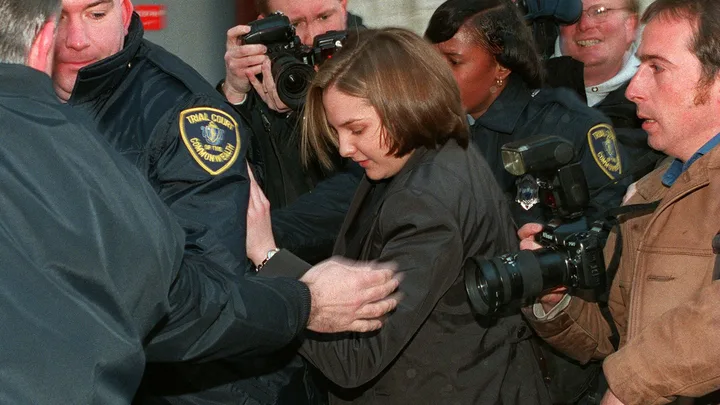
In 1997, British nanny Louise Woodward, 19, was living in the United States when she was accused of murdering a baby in her care. The media often focused on her age and appearance, with the public interest around her case reaching a level of mass hysteria. A fair trial was never on the cards.
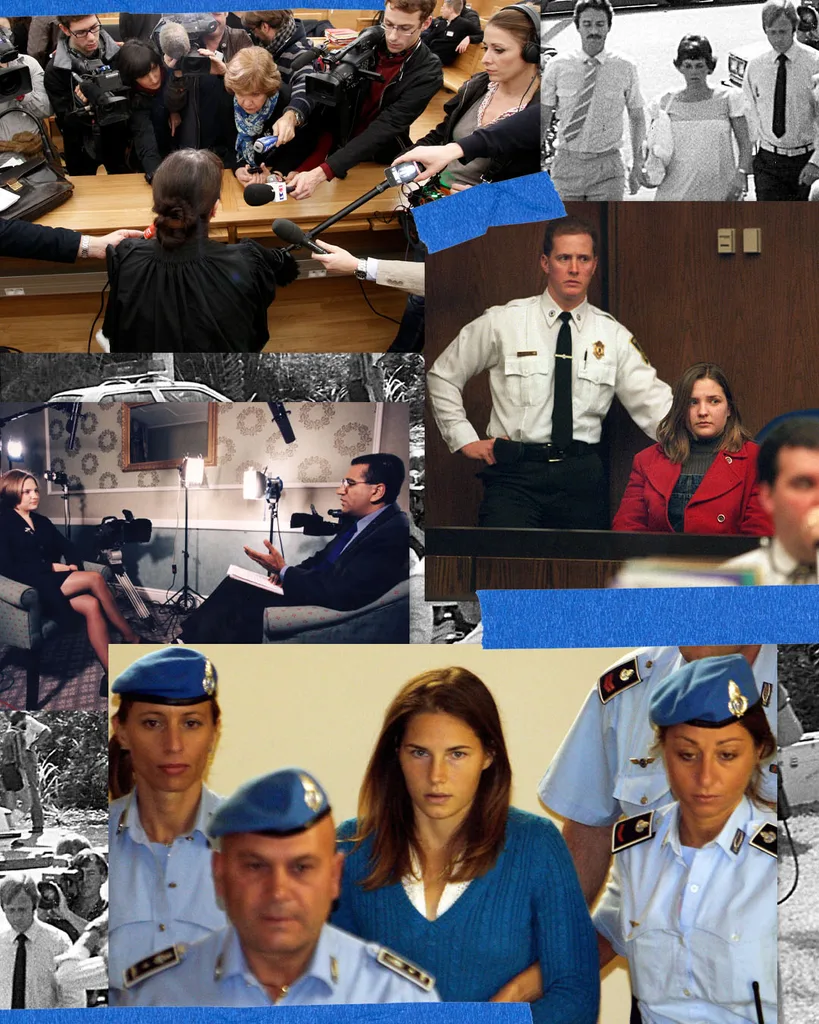
In 2007, American exchange student Amanda Knox was photographed kissing her boyfriend in the hours after the discovery of flatmate Meredith Kercher’s body in their shared house in Italy. That single image condemned Knox, even though other images would show just how distressed she looked moments before and after. Knox’s childhood nickname “Foxy Knoxy” was seized upon by the media, often run alongside pictures of her smiling.
“When women are accused of a violent crime and they don’t show emotion in the way that the gendered lens says they should, people tend to see her as guilty,” criminologist and forensic anthropologist Dr Xanthé Mallett says. “‘Lindy Chamberlain should have been in tears. She’s a mother, a nurturer. Why isn’t she crying?’ It goes back to the Salem witch trials. That’s the same pack mentality that judged women like Lindy and Amanda Knox and Kathleen Folbigg.”
In 2003, Sydney’s Kathleen Folbigg was wrongfully convicted of murdering her four infant children. After spending 20 years in prison, she was pardoned in 2023 when evidence at an inquiry showed pre-existing genetic conditions in her babies. Like Lindy Chamberlain (now Chamberlain-Creighton), Folbigg was portrayed by the media as cold and emotionless, heavily influencing the public’s opinion of her.
“I feel our cases were quite parallel. Our parenting was under scrutiny, our roles as mothers were under examination, and our reaction to what happened to our children was vilified,” Folbigg tells marie claire.
“We were both grieving our losses, while undergoing this horrendous public trial. It didn’t help that a lot of the judgement was made by men, whether in the legal system or in the media, and I feel there was a lack of understanding from them on what a grieving mother is going through as they just couldn’t relate. My parents raised me in a way that emphasised emotion as a weakness. This, combined with my coping mechanism of detachment, was absolutely used by the media and public in determining their judgement of me. I had to detach myself from what was happening – I was grieving and had to separate the grief and emotion I was experiencing from what was playing out in the very public eye, and this was interpreted in a certain way.”
Folbigg, who co-wrote a book about her experience, Inside Out, with her friend and biggest supporter, Tracy Chapman, says she felt let down by the media during that traumatic time. “Even if I’d spoken up in the early days, I don’t think anyone would have listened,” she says. “It wouldn’t have suited the narrative that had been decided on.
There was a toxic narrative to start with, and that’s what remained for many years, until certain media decided to ask more detailed, in-depth questions. When the right questions were asked, and research was done, that’s when things started to change.”
Senior philosopher at The Ethics Centre Dr Tim Dean explains how most media’s two primary goals – to report honestly and to attract an audience – can sometimes be at odds. “We have this inherent appetite to create a narrative and understand what’s going on around highly sensational cases such as the mushroom murder case,” Dean says.
“And that narrative is both to make sense of what’s going on, but also to judge. So if somebody is biased in such a way to see a picture of Erin Patterson and assume that she’s guilty, they may be more inclined to be drawn towards narratives that reinforce that. So the media has a problem, because they can say, ‘OK, we could remain impartial and be very careful about the way that we address this case but we might get fewer listeners. Or we can feed into that narrative and get more listeners.’ Or, in the case of commercial radio, ‘We can deliberately push buttons and be provocative and say outrageous things in order to draw attention.’”
Journalism needs to operate under an aspect of journalistic ethics called the public interest test, advises Dean. “Is the public going to benefit from the information that we are sharing at the moment or are we just doing this because we think it’s going to generate an audience at the expense of the public interest?” In July, Erin Patterson was found guilty of murder. She was sentenced in September to life in prison with a non-parole period of 33 years.
With time already served, the 50-year-old could be released in 2056, when she will be 82. While the trial may have ended, the case is far from over for the families of the victims, including Simon and the two children he shares with the convicted killer. It will likely take the family years to recover from this horrific crime. In his victim impact statement, Simon berated the “occasionally callous mainstream media”, describing the behaviour of journalists as “deplorable” and “remarkably dehumanising”.
This distrust of media is likely the reason he has reportedly shunned all offers of an exclusive interview, and there are suggestions he will instead work on a podcast telling his side of the story. He reportedly plans to then turn the podcast into a series for other victims of crime to share their own stories. There are a slew of books, documentaries and television dramatisations that have either been published recently or are in the works.
The Mushroom Murders by Greg Haddrick and Recipe for Murder by Duncan McNab are both out now, and The Mushroom Tapes by award-winning writers Helen Garner, Chloe Hooper and Sarah Krasnostein will be released in November. The Nine Network aired the documentary Murder by Mushroom in July, shortly after the guilty verdict, and the Stan documentary series Revealed: Death Cap Murders began streaming in September.
ABC-TV’s Toxic is the first scripted drama series about the murders, with a release date still pending. All content relating to true crime, especially in murder cases that are relatively recent, tread a fine line.
“We need to be mindful that there are people who are directly affected by this case, people whose lives have been lost or their families have lost loved ones,” Dean says.
“There’s a risk that the titillation and the sensationalism aspect can treat those people with disrespect. The media does have a role to play in helping us understand the world and making sense of a case like this. We should expect respectful and ethical coverage. The public also needs to be responsible consumers of media. We need to give media a chance to do the right thing, rather than giving our time, attention and money to support those who are cutting corners and potentially not doing their due diligence.”
Mallett hopes the books and documentaries help people better understand these murders.
“So much was suppressed in the courtroom for legal reasons, and it would be good for those things to be pulled out in the documentaries and books,” she explains. “This case is so out there in terms of the lack of being able to comprehend how something like that could happen. And it’s the sheer vanilla-ness of Erin Patterson herself. You look at her and you think she is the human version of a death cap mushroom. They’re so innocuous. They look harmless, right? But they are deadly.”
For Greg Haddrick, author of The Mushroom Murders, the process of how the prosecution took a jury from a position of presumed innocence to guilty was the one of the most interesting elements. Haddrick wanted to show the importance of the judicial system – rather than the court of public opinion – and wrote the book from a fictional juror’s point of view.
“There are many cases where you look at the overall case and you go, ‘Well, they did it.’ And there are others where there’s enormous doubt. In this mushroom case, there was doubt, but there were also a lot of people thinking, ‘Surely she did it.’ But that’s not a legal process,” he says. “At the end of the day, what convicted Erin was only what they were allowed to present to the jury. There’s a reason the criminal justice system, for all its flaws, is better than almost any other system, because it forces jurors to just look at all the evidence, not how people present themselves.”
For Folbigg, the changes she’s seen in the media over the years are positive. But that doesn’t mean there isn’t more to learn.
“As the years went on, I found that journalists who could investigate and could dedicate time to researching, and not just look for a negative angle to draw the reader in, were most helpful,” she says. “There have been plenty of negative headlines about me in the past – and even today – and that’s all people remember. They don’t remember the content of the story, just that headline that draws them in. There’s still a long way to go.”

Related stories

Native ad body.
Native ad body.



Native ad body.