 Getty
Getty
If you’ve spent time in the beauty aisle, have been served wellness content at the 3pm slump or longevity talk has taken over your algorithm, you’ve more than likely heard of peptides. They’ve become the most talked about ingredient in modern skincare, stacked in serums, raved about by dermatologists and embedded in everything from eye creams to injectables.
Now, as the science of cellular signalling becomes more widely understood, a new frontier is opening up beyond skin and into hair and scalp care.
Google Trends data shows that global search interest for ‘peptides’ has quadrupled over the past year, with hair-specific terms such as ‘GHK-Cu peptide’ hitting breakout status in Australia as of mid-2026. The numbers reflect something bigger than a passing trend: a fundamental shift in how we think about hair health.
What Are Peptides And Why Are They Important?
We can think of peptides as the body’s internal memo system — short chains of amino acids that act as molecular signals. In skin, they prompt collagen and elastin production. In hair, they speak to keratin, the structural protein that gives hair its integrity, and to the scalp itself: a complex biological environment of follicles, sebaceous glands and immune cells. The result is haircare that doesn’t just coat or condition but targets the cellular conversation that determines how hair grows, behaves and holds up over time.
“Peptides act as signalling molecules that can influence cellular communication within the scalp and around the hair follicle. Depending on the specific peptide, they may help support follicle function, improve scalp condition and reinforce proteins involved in hair structure and strength,” explains Sydney trichologist Lena Hovardas.
Don’t expect dramatic before-and-afters. What’s building is cumulative, systemic support that can maintain the conditions needed to grow healthy hair.
The Skinification Of Hair And The Role Of Peptides
The concept of skinification — treating the scalp with the same active-ingredient rigour as the face — has been building for years but it’s only recently come to fruition with formulations accessible enough to deliver actives to the follicle level. After all, the scalp is an extension of the face with the same fundamental architecture — epidermis, dermis, subcutaneous layer and the same vulnerabilities: inflammation, oxidative stress, barrier disruption. Peptides can play a role in addressing these common concerns.
“Peptides are an exciting ingredient category because they may help support scalp and follicle health as part of an overall haircare routine,” says Hovardas. However, it’s not a singular solution. Hair health is multifactorial — shaped by age, hormones, stress, nutrition and genetics — and peptides work best as a supporting player.
Peptides And The Microbiome
Much like the gut and the skin, the scalp hosts its own ecosystem called the microbiome: a community of bacteria, fungi and microorganisms that, when balanced, maintain barrier function, regulate inflammation and sustain a healthy environment for growth. “When this balance becomes disrupted, it may contribute to conditions such as dandruff, irritation or excess oiliness,” Hovardas notes. That’s where peptides can come into play to communicate at a cellular level and address these common concerns.

Who Can Benefit From Adding Peptides To Their Routine?
The peptide conversation in hair tends to surface most urgently around thinning and hair loss — and for good reason. “As we age, hair naturally becomes finer, drier and less dense and when combined with hormonal shifts and slower cell turnover, texture, growth rate and overall quality can be affected too,” says Hovardas.
But the audience is broader than those already experiencing these changes. “Most peptide-based formulations are well tolerated across different hair types and age groups,” Hovardas adds. However, it’s not about deploying these products when you’re in crisis mode. It’s about preventive, proactive scalp health — the kind of thinking that has long underpinned the most sophisticated skincare routines.
How To Add Peptides To Your Routine
Adding peptides doesn’t have to mean a complete routine overhaul, maxing out your weekly spend, or visiting an elite clinic. The delivery systems are more varied and accessible than ever: targeted scalp serums, tonics and now everyday shampoo and conditioners that work the ingredient in at the most consistent touchpoint of all — the shower. As Hovardas puts it plainly “hair health is a long-term journey, not an overnight result.
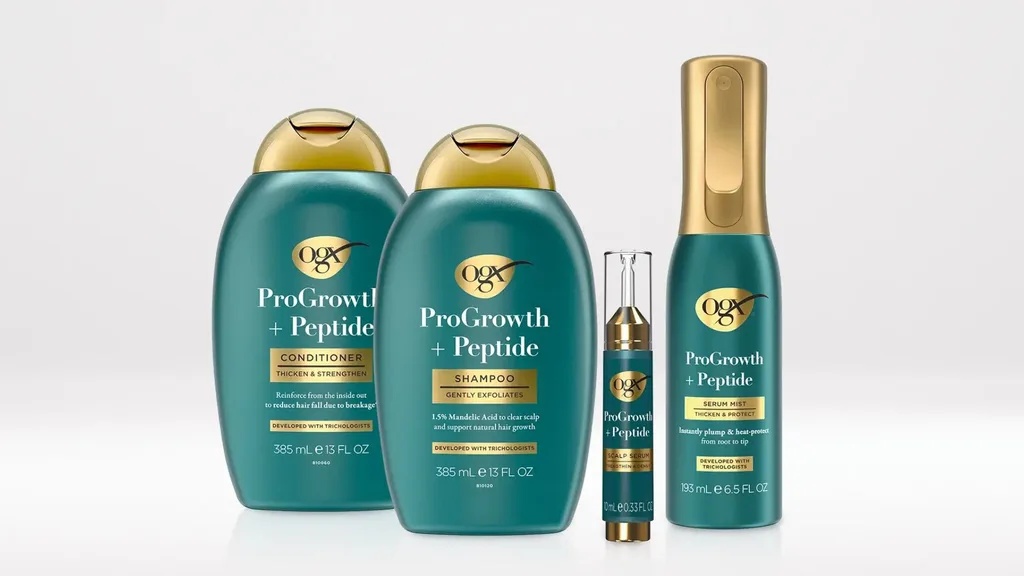
OGX Progrowth + Peptide range offers exactly that kind of entry point. Developed with trichologists and built around 9 per cent Long7vity Complex peptide technology, it’s designed to support scalp health, reduce breakage and encourage stronger-feeling hair over time. At the centre of the range is the fast-absorbing scalp serum click pen, which allows for precise, direct application along the scalp. Formulated with a blend of Pea Peptides, caffeine and niacinamide, it’s gentle enough for everyday use, particularly for fine or thinning hair.
As peptide science continues to evolve, hair is no longer playing catch up — it’s in the conversation.

OGX ProGrowth+Peptide range is a scalp first system developed with Trichologists to support natural hair growth & achieve fuller and thicker hair.

Related stories

Native ad body.

Native ad body.


Native ad body.