The first solar eclipse of 2026 takes place today, with a rare “ring of fire” eclipse visible along a narrow path across Antarctica, offering a fleeting glimpse of one of the year’s most remarkable astronomical events.
Known as an annular solar eclipse, the phenomenon occurs when the Moon passes directly between Earth and the Sun but sits too far from our planet to fully block the Sun’s disk.


Instead of complete darkness, a thin halo of sunlight remains visible around the Moon’s silhouette, creating the luminous ring that gives the event its name.
Only a small portion of the world will witness the full spectacle. The path of annularity cuts across a remote sliver of Antarctica, while a partial eclipse will be visible across the rest of the continent and parts of southern Africa and South America.
For most viewers, including those of us in Australia, the eclipse will unfortunately be something to watch unfold via livestreams and social media rather than from the ground.
Annular eclipses occur every one to two years, though their visibility is shaped by geography. This is the first annular eclipse since 2024 and forms part of an eclipse season, periods when solar and lunar eclipses arrive in close succession.
A total lunar eclipse will follow on March 3 and, unlike this week’s event, it will be visible from Australia.
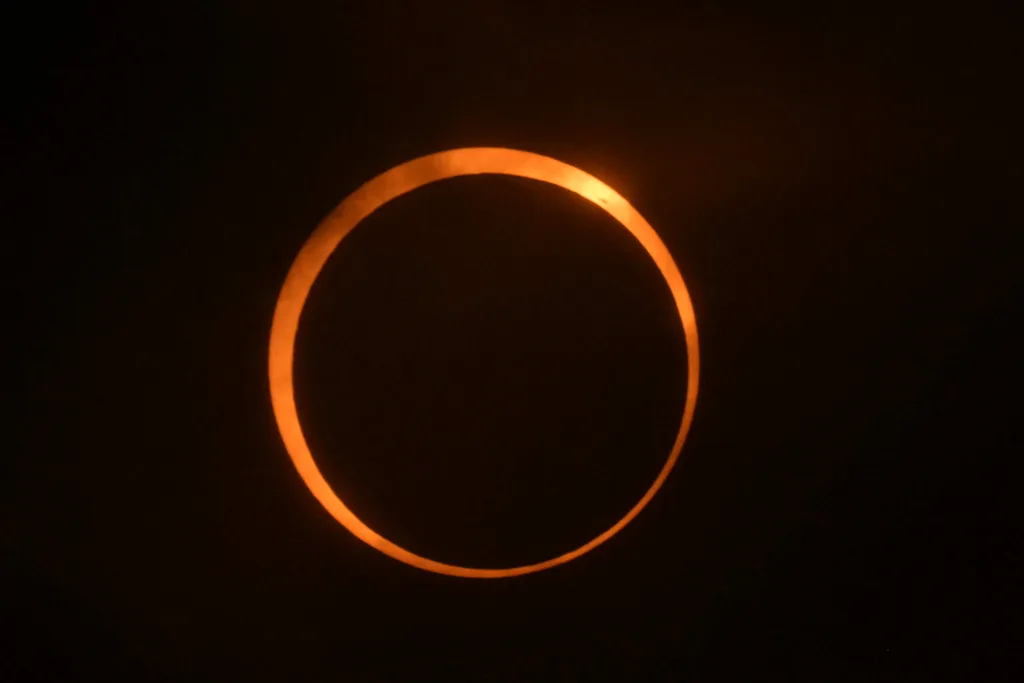
At its most dramatic, the eclipse will peak over Concordia Station in Antarctica in the early evening (local time), lingering for close to two hours. In Australia, this translates to approximately 10pm (AEDT). For viewers elsewhere, the moment is fleeting, a reminder that celestial alignments are as precise as they are rare.
The next annular solar eclipse will occur on Feb. 6, 2027
The next total lunar eclipse visible across Australia will unfold on March 3, 2026, offering sky-watchers a rare chance to witness the Moon slip fully into Earth’s shadow. A lunar eclipse occurs when the Sun, Earth and Moon align in a straight line, placing Earth between the Sun and the Moon.
The March 3 eclipse will be visible across much of Australia, making it one of the most accessible and visually striking celestial events of the year.

Related stories

Native ad body.
Native ad body.


Native ad body.