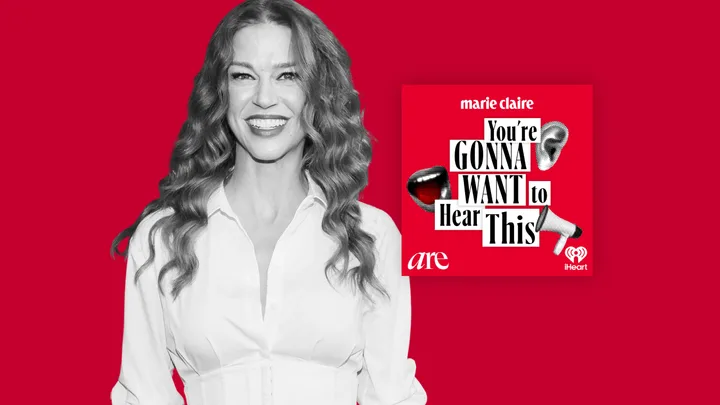
Twenty years after Friday Night Lights changed her life, Adrianne Palicki opens up on the latest episode of marie claire Australia’s podcast, You’re Gonna Want To Hear This about the show’s enduring legacy, the pressure placed on women in Hollywood and why she’s determined to make films that start difficult conversations...
Adrianne Palicki knows exactly how she feels about a Friday Night Lights reboot – unless, of course, Tyra Collette is involved. “If Tyra’s in it, I might change my tune a little bit,” the actor tells marie claire. It has been 20 years since Palicki first appeared as the fiercely ambitious, frequently underestimated Tyra in the beloved series. Yet she remains wary of trying to recreate its magic.
“It’s a perfect show,” she says. “I think that when things can be redone and they’re not done well, it can ruin the whole thing.”
“Kyle and Connie were the meat of that show. They’re unbelievable, and I just don’t know how you have that show without them. So it’d have to be something very different.”
Listen To You’re Gonna Want To Hear This
Palicki believes the original series continues to resonate precisely because it hasn’t aged. “The thing is, this show is actually timeless,” she says. “People are finding it for the first time now. Young people are finding it now and loving it.”
“I have all the faith in the world in Jason Katims, and if he’s going to write it, then it’s going to be amazing. But, again, if Tyra’s in it, I might change my tune a little bit.” As for where Tyra might be today? Palicki already has an idea: “She’d be Tami Taylor, ultimately. She’d have to be the counsellor.”
‘It was lightning in a bottle’
Speaking exclusively to marie claire, Palicki describes Friday Night Lights as “lightning in a bottle” – a formative experience shared by a young cast living and working together in Austin, Texas. “It was special. We were all in Austin, we were all young,” she says. “We were just all in it together. It was really us against the world, and we just loved each other.”
Despite its enormous cultural legacy, Palicki says the series didn’t feel like a success while they were making it. “This is still when ratings mattered, so every time we would tune in, we would have the worst ratings,” she recalls. “We were like, ‘We’re going to get cancelled.’”
“It felt successful to us, but it didn’t seem like that to the world, at least at the time.”
The impact on Palicki’s career only became clear later. “It wasn’t until afterwards where I realised, ‘Oh wow, okay, I’m getting roles where they’re not putting me in a swimsuit. That’s awesome,’” she says. “It was the first time people really started seeing me as an actual actress.”
Palicki admits audiences weren’t always kind to Tyra during the show’s first season. While walking through Austin with her close friend and co-star Connie Britton, fans would enthusiastically praise Britton’s Tami Taylor – then turn to Palicki and bluntly declare: “Hate you.”
“That would happen to me all the time,” she says. “That was hard because I’m like, ‘You don’t know her yet. You haven’t seen it. She’s a good person.’” Today, however, Palicki regularly hears from young women inspired by Tyra’s refusal to accept the future others imagined for her. “I still get young girls coming up to me at Whole Foods or on the street,” she says. “They’ll go, ‘I’m going to UT because of Tyra,’ or, ‘I went to college because of Tyra.’”
“She’s impacted so many people who didn’t think they could go anywhere. I think she will go on and be a character that gives other women – young girls who don’t feel like they have a chance – hope.”
Reflecting on Tyra’s famous college essay, Palicki says its message remains deeply relevant: “She’s like, ‘I’m not going to let the world define me. I’m not going to let the world make me small.’”
‘Being famous isn’t success’
Palicki was in her early twenties when Friday Night Lights premiered, but says she never felt particularly famous. “I feel successful, which is cool. But I don’t know that I feel famous,” she says. “Which is probably a good thing, because I think that can go to people’s heads, especially at a young age.” Still, she admits there was a period when fame felt like the ultimate measure of a career.
“There was a moment in time where you felt like if you’re not famous, you’re not successful,” she says. “If you’re not on the cover of magazines, you’re not successful.”
“Once I let go of it was when things got much simpler. Being famous isn’t success. Success is success. Being a working actor is success, and the other portion really doesn’t matter.”
At 43, Palicki says her forties have been her happiest and most freeing decade – something she never expected when she was younger. “I think my forties have been my best years,” she says. “You know so much more and you know what you want. You’re more decisive. It’s freeing. I feel very free.” She laughs about once having a rigid timeline for her life and career.
“I had the whole 10-year plan, and I was supposed to win an Oscar by 28,” she says. “Then you get to be 35 and you’re like, ‘Okay, none of the things that I had planned happened.’”
“You start to go, ‘Okay, but this is actual success.’ The things I thought I wanted would’ve been great, I’m sure, but they don’t make or break you.”
That perspective has also helped her navigate the relentless scrutiny around ageing and appearance in Hollywood. “It does suck. Being a woman is very hard, and being a woman in Hollywood is even harder,” she says. “But I just look at it as: as I get older, I’m going to get to play new characters. I’m going to get to do something I haven’t done before.”
“So I don’t look at it as a bad thing. I look at it as an evolution.”
‘We should have rights to our bodies’
That evolution has taken Palicki behind the camera as a producer on Due West, a film exploring abortion, choice and community.
Palicki says she was so moved after reading the script – written for her by Evan Miller and his writing partner Hardy – that she couldn’t discuss it for three days without crying. “When he gave it to me, I said, ‘Not only am I doing this, I’m going to help you find the financing,’” she recalls.
Finding that support in Texas was difficult, particularly for a film dealing with abortion. But Palicki was determined to tell a story that existed in the grey, rather than attempting to lecture audiences. “It’s a movie to get people to start talking,” she says. “It lives in the grey, it dances in the grey, and I think that’s really important – so people can start talking and not yelling.”
She says men who do not identify as pro-choice have approached her after festival screenings and admitted: “I never thought of it like that.”
“That’s the point,” Palicki says. “Every person’s different, and it’s never going to be easy for a person to make a decision.”
Making the film also revealed how many women in her own life had experienced abortion. “I didn’t realise how many of my girlfriends or women in my life have had an abortion,” she says. “Whether they were married or not, or it was a health condition or whatnot, it affects everybody.”
When discussing abortion online, Palicki largely avoids the comments, knowing how quickly social media can become an “unending cycle”. But she has no intention of becoming quieter. “Nobody’s pro-abortion. People are pro-choice,” she says. “Hopefully those people are also going to tune into this movie and maybe start thinking about some things.”
“It might not change their mind, but at least they could have a little bit of empathy and maybe understand that it’s not simple.”
“I’m going to keep making movies that are important politically and are pro-women, because we should have rights to our bodies. I don’t want anybody telling me what to do with mine.”
And after two decades in an industry that can make even its most successful actors question themselves, Palicki’s message to women is fittingly direct. “You have to believe in yourself, and you have to be strong,” she says. “You have to stand up for what you believe in, whatever that is – and yourself. You have to have your own back.”
Listen to Adrianne Palicki’s full interview on marie claire’s podcast, You’re Gonna Want To Hear This.

Related stories
Native ad body.
Native ad body.

Native ad body.