TRIGGER WARNING: child abuse, sexual assualt, murder
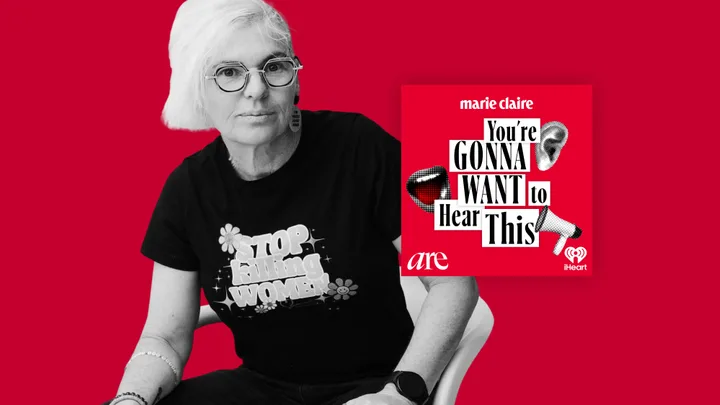
On this week’s episode of marie claire’s podcast You’re Gonna Want To Hear This, Sherele Moody takes us back to her childhood. “I can still feel the pain of not being loved by her,” Moody tells editor Georgie McCourt. “The pain of being ostracised and hated so much that she was violent towards me.”
It’s a line that lands heavily – and it sets the tone for one of the most confronting, urgent and deeply human conversations the podcast has hosted to date. Moody is known today as a journalist, activist and the founder of the Red Heart Movement and Australian Femicide Watch – a living, evolving record of every known woman and child killed by violence in Australia. But before the data, before the advocacy, before the national recognition, there was a childhood defined by chaos.
Listen To You’re Gonna Want To Hear This
A Childhood Shaped By Violence – And Survival
Moody describes her early years in stark terms: “It was chaos. It was very bad.” Removed from her parents as a baby alongside her siblings, she moved between foster homes and unstable environments, eventually returning to what she describes as a “very violent household,” where she experienced sexual, physical and emotional abuse.
There were moments – what she calls “sliding door” moments – that could have changed everything. A foster family wanted to adopt her. Her mother said no. Instead, she grew up navigating violence, running away “hundreds of times,” and learning early what it meant to survive. It wasn’t until she moved in with her grandmother at 13 – “this strong, powerful Black woman who overcame the odds” – that she glimpsed a different kind of life. But even that stability would be short-lived.
The Decision That Changed Everything
At 15, after years of estrangement, Moody’s mother re-entered her life – newly married, asking her daughter to come and live with her in Queensland. “For a 15-year-old girl… suddenly being wanted by this person… you don’t question it,” Moody reflects. She said yes.
The man her mother had married – Barry Gordon Hadlow – presented himself as reformed. He told elaborate stories about prison, about finding God, about leaving violence behind. There was no Google, no easy way to verify his past. “We believed him,” she says simply.
Within months, Moody had left home again, drifting through jobs across regional Australia. Then, at 19, she returned. What followed is the moment that would define the rest of her life. After being invited to visit her younger sisters in Roma, Moody arrived to find her stepfather already immersed in the search for a missing nine-year-old girl, Stacey-Ann Tracy. Days later, Stacey-Ann’s body was found.
Police arrived at the family home with a search warrant. “There was about 30 officers,” Moody recalls. They told her, her mother and her sisters that her stepfather was the suspect in the abduction and murder. Within hours, Moody found herself inside a police station, standing over evidence laid out on the floor – a child’s backpack, shoes, clothing. “I knew that stuff had come from my home,” she says. In that moment, she became a witness for the prosecution.
Then came the second revelation: her stepfather had killed before. It turned out he was on parole for killing five-year-old Townsville girl Sandra Bacon in 1962. Her mother, she later learned, had known.
The Weight Of What Cannot Be Explained
Moody asked the detective the only question that mattered: why? The answer stayed with her. “Even the best psychiatrist in the world couldn’t tell you that,” she was told. Her stepfather never confessed. He maintained his innocence until his death in prison. For Moody, the absence of answers became part of the burden – alongside the grief, the guilt, and the complex trauma of a mother who not only defended him, but blamed the victim. “She victim blamed her… It was a nine-year-old girl,” Moody says.
Turning Trauma Into National Impact
It is this personal history that underpins Moody’s life’s work. Through Australian Femicide Watch, she has documented more than 3,000 deaths of women and children over the past decade – a number she describes as both “far too high” and still incomplete. At its core, the project is simple: to ensure these lives are not reduced to statistics. “A place where families knew that their person’s story was maintained,” she explains. But it is also a form of accountability.
Moody argues that official data often fails to capture the full scope of violence – missing cases where deaths are misidentified or never prosecuted as homicide. Without visibility, she says, there is no urgency. And without urgency, there is no change. “If we don’t have the count… people think it’s only happening once or twice a year,” she says.
Why Women Can’t Just “Leave”
One of the most persistent questions surrounding domestic violence – why women go back – is one Moody answers with clarity. “Because we as a society make it impossible for women to leave.”
From inconsistent police responses to under-resourced support services, systemic barriers – especially for Aboriginal women, women with disabilities and those from culturally diverse communities – create a landscape where leaving is not just difficult, but dangerous. “The next time it gets physical, she could be dead,” Moody says.
Finding Light In The Work
For someone who spends her days documenting violence, Moody is clear: survival requires finding moments of hope. Right now, that hope lives in something tangible – a one-bedroom apartment she has created for women escaping violence, stocked with food, furniture and essentials.
“I never thought I would be able to do something like this,” she says. It’s called Stacey’s Sanctuary – named, in part, for the girl whose death changed her life. “It’s only one home,” Moody says, “but at least it’s contributing to the solution.”
The Cost – And The Courage – Of Speaking Out
Moody’s advocacy has come at a personal cost. In 2018, after speaking publicly about domestic violence, people tracked down her home and poisoned one of her pets. It’s a reminder that misogyny is not abstract – it is lived, experienced, and often weaponised against those who challenge it. Still, she continues.
At the end of the conversation, Moody distils everything into a single, unflinching message – one now permanently inked on her hands:
“Stop killing women.”
And alongside it, another:
“She matters.”
It is both a demand and a reminder – that behind every headline, every statistic, every case file, there is a life that should never be forgotten. As Moody puts it: be difficult, speak up, challenge the systems – and refuse to let silence win.
Go to australianfemicidewatch.org and if you or someone you know needs help, it is available: 1800RESPECT

Related stories

Native ad body.
Native ad body.



Native ad body.