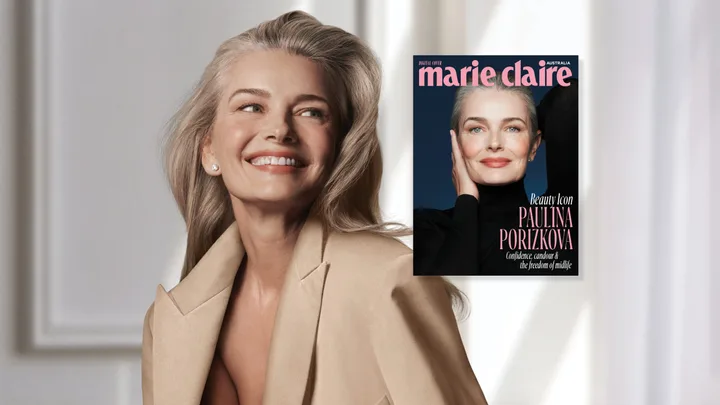
For decades Paulina Porizkova was one of the most recognisable faces in fashion – now the Estée Lauder global brand ambassador is using her voice to change the conversation around ageing. Here, marie claire celebrates the iconic model with a special digital cover and interview…
Paulina Porizkova is packing for a trip to LA when we speak. It’s where her fiancé lives, the Emmy-winning writer Jeff Greenstein (Friends, Will & Grace, Parenthood, Desperate Housewives), and they’re in the process of looking for a house to buy.
When she appears on screen from her New York apartment, her long grey hair falling loosely over a blue sweatshirt, she looks relaxed, upbeat and madly in love with life. Getting here, to this delightful moment of contentment – where finally, at 60, everything seems to click – has not been straightforward.
“Well, here’s the bad news,” she says. “It didn’t happen until about three years ago, in my mid to late fifties.”
A decade earlier, Paulina had thought her career was over. “I was unbelievably depressed. I felt completely invisible. I had no career. My children were moving out of the house. My husband didn’t seem to notice I existed. I was throwing myself into little tasks like pottery classes, and I would go and get a massage once a week just so somebody would touch me. It was fucking pathetic. I couldn’t see a light at the end of the tunnel. I didn’t even know I was in a tunnel. I just thought this was what life was going to be.”
The irony is that Paulina Porizkova is one of those women the world has never stopped looking at. And yet there was a time in her life when she’d go to a spa simply to be touched – a detail that is both mind-boggling and, for many women, uncomfortably familiar. (If you’ve ever craved affection from a partner who won’t give it to you, you’ll know how unbearably sad it is.)
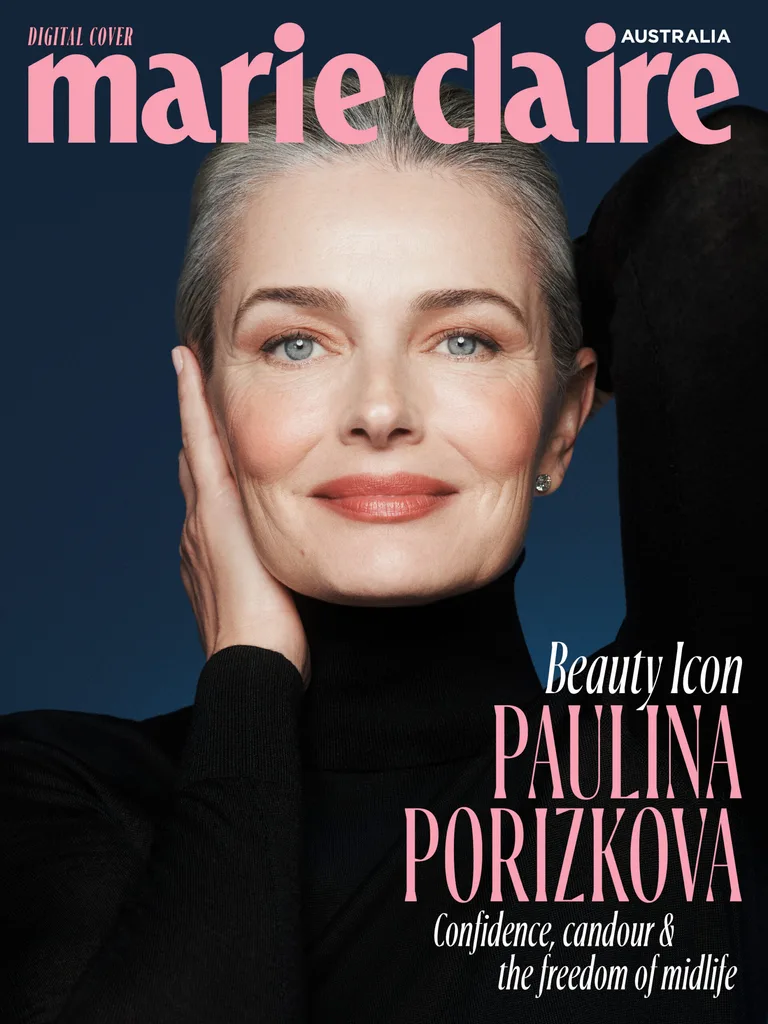
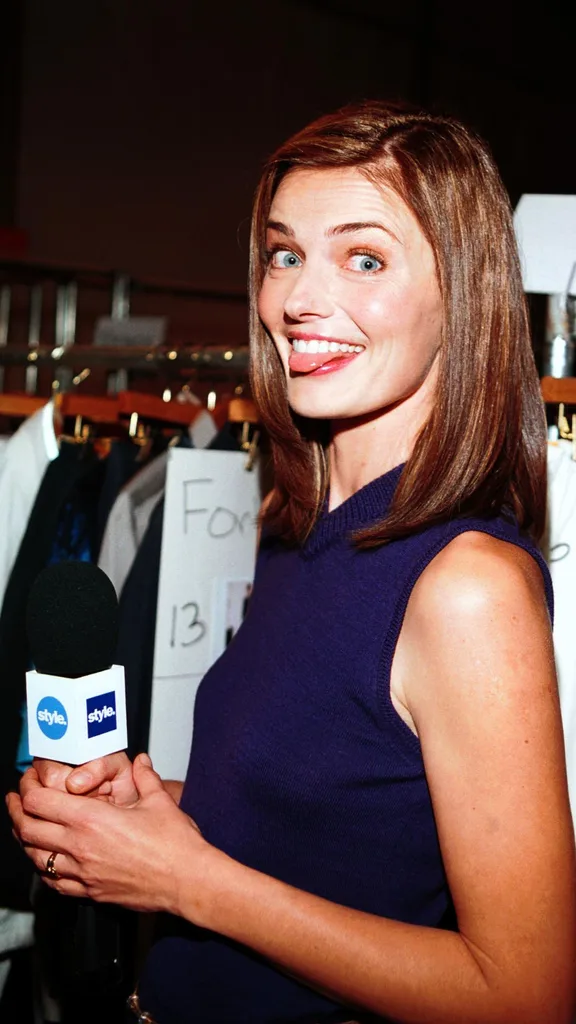
She’s lived several very public lives: supermodel, wife, widow, author, advocate. In the 1980s and ’90s she was everywhere: magazine covers, billboards, beauty campaigns, fashion editorials that helped define the look of an era.
She’s still everywhere, most notably Vanity Fair covers and campaigns for Estée Lauder, with whom she recently signed as a global ambassador three decades after being one of the most famous faces in the brand’s history.
I was throwing myself into little tasks like pottery classes, and I would go and get a massage once a week just so somebody would touch me. It was fucking pathetic. I couldn’t see a light at the end of the tunnel. I didn’t even know I was in a tunnel. I just thought this was what life was going to be.
And yet the thing she keeps coming back to is how lonely it was to be admired only as an object. “I was seen, but I wasn’t heard,” she says. “Who I was as a person was completely immaterial. It absolutely didn’t matter.”
People are often surprised, she tells me, by how warm she is in person, as if extraordinary beauty should come with a certain aloofness. When she began modelling, the job description was simple: look pretty and be quiet. “Back then, models didn’t have a voice,” she says. “Unless you were famous, you didn’t get to speak. We were clothes hangers.” When journalists did ask questions, they were always the same ones: what do you eat? How do you stay thin? What products do you use?
“Being a young, attractive model meant that the only thing people were interested in about me was exactly that,” she says. “So, of course, the perfect vehicle to sell you things.” The idea that a model might have opinions – or worse, might want to express them – was not part of the contract. Even so, Paulina was never very good at pretending. At the height of her success, while she was one of the most recognisable faces in the world, she famously said that “modelling sucks”.
That independent streak ended up shaping her entire career. She worked hard, became successful on a scale hard to imagine, and then used that to move sideways – into acting, into writing, into work that required her mind as much as her face.
The more you read about Paulina, the more you realise that nothing about her life has been ordinary. Long before the cameras of fashion found her, she had already lived in the public eye. Her childhood was shaped by geopolitics rather than glamour.
When her parents fled Czechoslovakia, she was forced to stay behind, separated by a regime that refused to let families move freely. From Sweden, they waged a very public campaign to get her back, including a hunger strike that captured national attention.
For years, journalists tracked the story while she waited in her grandmother’s home, growing up under a kind of accidental spotlight. She was nine when she was finally allowed to leave and join her parents.
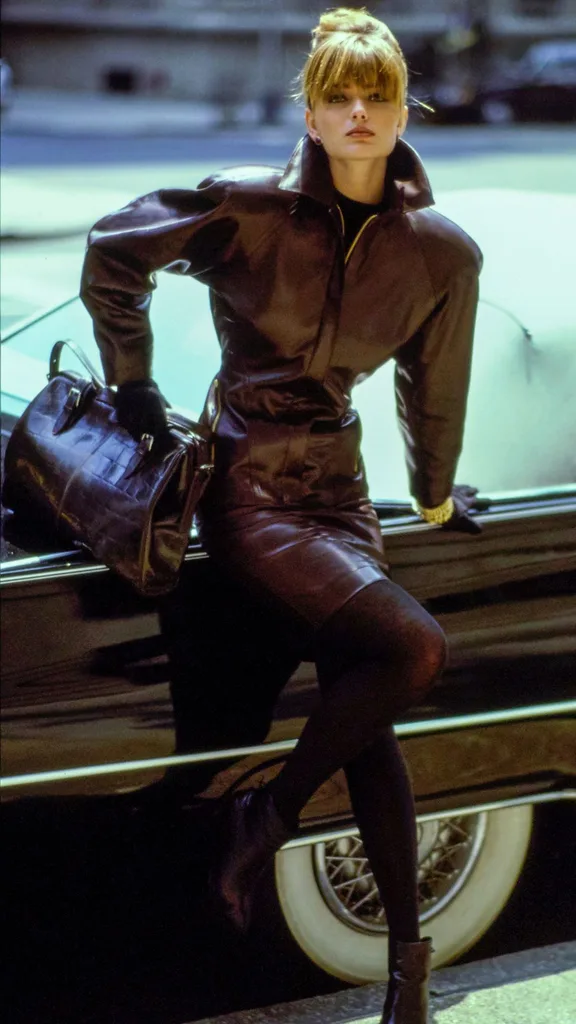
When she was 13 and living in Sweden, she let a friend – an aspiring makeup artist – paint her face for a portfolio. Someone else saw the pictures. Then someone else. And suddenly she was being flown places.
There was no childhood ambition to conquer fashion. Just a series of doors flying open faster than a teenager could reasonably understand. At 18 she became the first Central European woman to appear on the cover of Sports Illustrated’s swimsuit issue. Soon after, she was walking every major runway, appearing in every major magazine, and signed an Estée Lauder beauty contract so lucrative it made her the highest-paid model in the world. It was during this period she was cast in a music video for a song called “Drive”.
The band was the Cars and its frontman was Ric Ocasek. She was 19. He was 40. He was already a star, and she was becoming one. They fell in love, and from the outside it looked like a long, successful second act. A beautiful woman, a famous musician, a creative household, a marriage, a family (she became a stepmother to four boys by the time she was 22, then the couple had two sons of their own).
Porizkova gradually stepped away from full-time modelling to focus on her family. She also acted in films (16 of them) and television, including a stint judging on America’s Next Top Model, and began to write. She published her first novel, A Model Summer, in 2007.
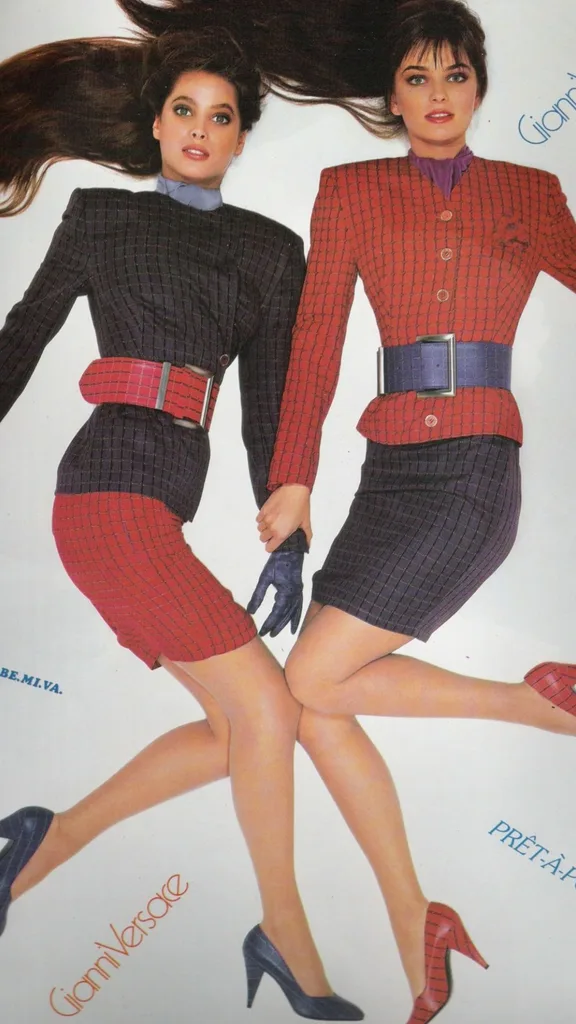
Inside, the story was more complicated. After 28 years of marriage, they separated in 2017. Ric had been living with hypertensive and atherosclerotic cardiovascular disease, and in 2019 he passed away. She was caring for him at the time while he was recovering from surgery.
One morning, she walked into the room and found him dead. In the days that followed, another shock arrived – Paulina discovered she had been removed from his will. It later emerged that Ric had amended his will just weeks before his death, formally excluding her on the grounds that they were in the process of divorcing and that she had “abandoned” him. The grief was immense, and the healing was painful.
I’ve never known a love like this, and I’m not sure that I was able to understand what a love like this was when I was younger. I thought love was what we learned from Romeo and Juliet – you want to die, you want to kill him, drama, emotion, passion, tears, sex – and it turns out not so much. That’s called drama.
“It completely shattered me,” she reflects. “I had to rebuild. I felt like I was rebuilding from scratch.” Eventually, she started saying yes to everything. There was skydiving and dating. “How long do we have? We don’t know. I started saying yes to whatever anybody asked me.”
When she met Jeff, the healing took a different turn. “It became about learning to trust again and feel safe – it doesn’t happen overnight. So that’s the phase I’m in.”
Paulina says it took her nearly 60 years to find Jeff. “I’ve never known a love like this, and I’m not sure that I was able to understand what a love like this was when I was younger. I thought love was what we learned from Romeo and Juliet – you want to die, you want to kill him, drama, emotion, passion, tears, sex – and it turns out not so much. That’s called drama,” she says.
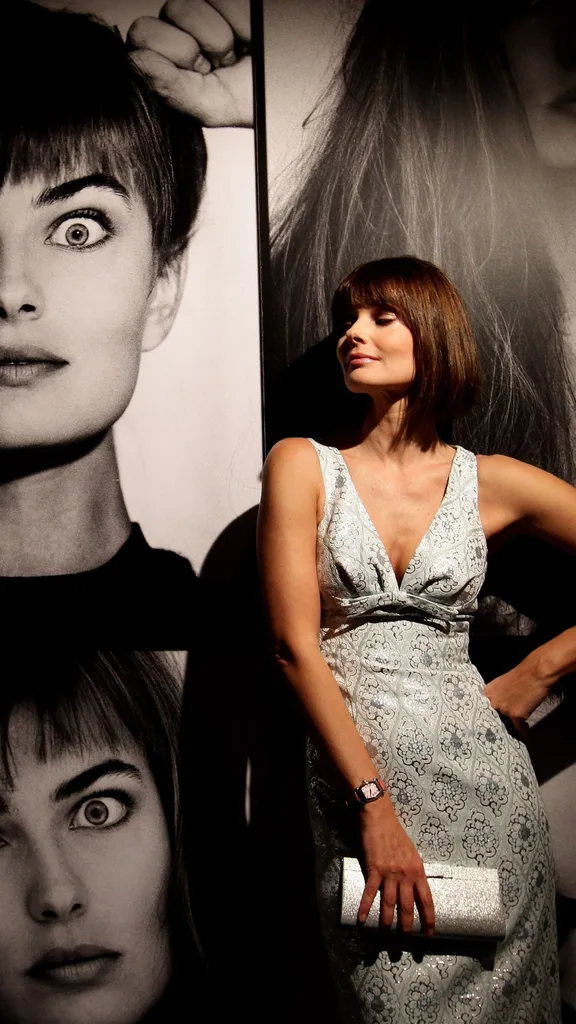
What does falling in love at 60 feel like? “‘Give me a firm place to stand and a lever and I can move the Earth,’” she says, quoting the Greek philosopher Archimedes. “Jeff is that safe piece of ground – I can do everything else around it. I can move the world. That’s how I feel.”
In the end it was writing which gave her a voice that finally resonated. When her memoir No Filter: The Good, the Bad, and the Beautiful came out in 2022, actor and friend Selma Blair wrote that she stayed up all night reading it, calling Paulina a brilliant and generous truth-teller. She’s also remarkably resilient. “I don’t believe in things happening to you,” she says of her success.
“I don’t believe good things are happening if you’re just going to sit around your kitchen and whine. You have to go out and do it. You have to provoke things to happen, otherwise nothing will.”
Paulina’s return to Estée Lauder as a global brand ambassador comes at a time when women are rethinking what beauty, age and visibility actually mean. Of course, she’s been banging on about it for decades, but it’s not easy getting women to embrace ageing.
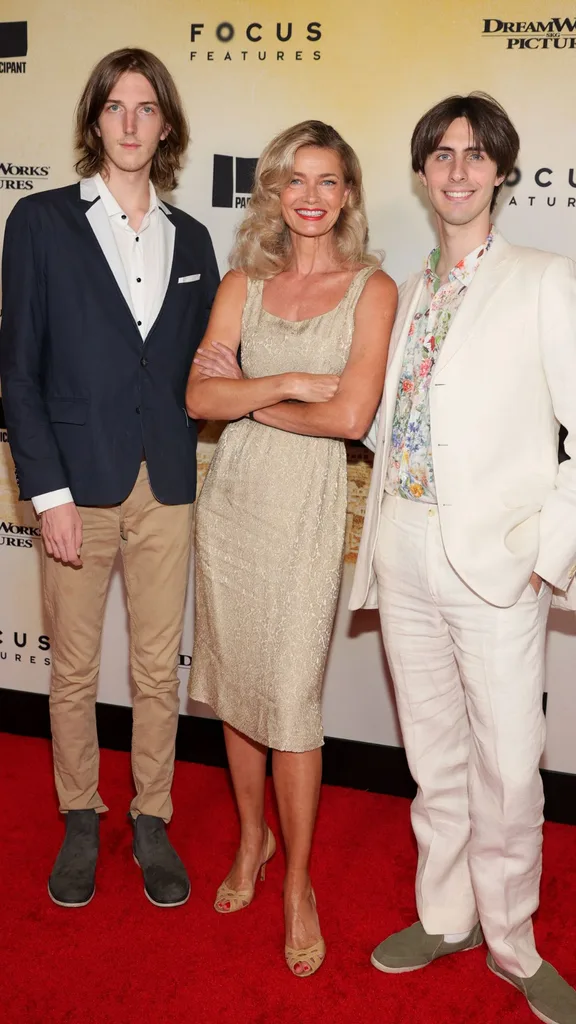
It’s why Estée Lauder launched its #BecauseOfMyAge campaign – to celebrate the remarkable achievements and individuality of women as they embrace the beauty of ageing, because the truth is that we do get better with time.
And, yes, Paulina knows what you’re thinking. What would a genetically blessed supermodel know about ageing? Yawn. She hears it all the time. Comments such as, “Easy for you to say embrace your age when you have always been more beautiful than average.”
She points out, however, that “it would be far, far easier for me to not accept ageing, to use everything at my disposal to extend my desirability. After all, I’m in the public eye and am judged on a daily basis for how I look. So why haven’t I? Because I don’t think ‘ageing’ equals ‘breaking’.”
Paulina posts unflattering photos of herself on Instagram. She doesn’t dye her hair. She cries online. And she really doesn’t care what the world thinks of her. Letting go of other people’s opinions, after all, is one of the most satisfying parts of getting older. Now, life feels lighter, happier, freer, and so much more interesting. “When I was 20, I suffered for beauty. Now I don’t have to.”
Accepting how she’s ageing, she says, is a daily practice. “Every morning, I meet a new version of myself in the mirror. OK. Hello, you.” Makeup is more minimal these days. “The thing that has changed the most is I wear a lot less makeup, and I think this is true for most older women – not that we don’t care to look nice, but we don’t care what you think. We’re kind of doing it for ourselves. Blush makes me feel happy, so I like to wear blush.”
She’s also more likely to add a bright lip now. “The thing I discovered, which I never really did when I was younger, was a bright lipstick – it really makes your face look happy. It’s kind of like you shine a little warm light on yourself.”
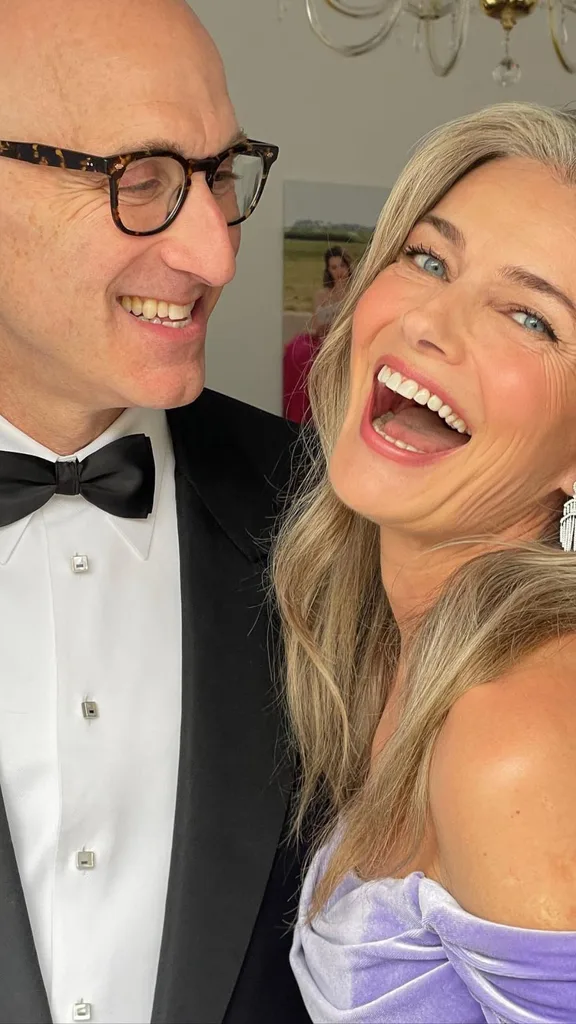
The new iteration of Estée Lauder’s Double Wear foundation is top of her list too (she’ll be wearing it on her wedding day). So where is Paulina right now in her life? “Sorry, I’m going to give you another metaphor,” she says. “We could go anywhere in the world right now – how exciting is that? It’s an incredible privilege, the sense of freedom that I have now. My children are good. Everything is taken care of. I have enough money.” she says. The metaphor is coming.
“I’m standing on top of a cliff ready to fly. We all have that feeling when we’re teens into our twenties, the little bird being pushed out of the nest, and when you’re 20 you’re excited about all the possibilities. When you’re forced up that cliff again when you’re 60, you think: I already know what happens. I know I will jump, I know I can fly, and I also know I’m going to fly smack bang into a tree. A storm’s going to come. There’s a mountain over here. It’s going to hail, and then snow, and then I’m going to fall into a desert – I know what is ahead. And I have the choice of not jumping or doing it anyway. And that’s where I am now. I’m doing it anyway. I’m using all the courage I have to jump again.”

Related stories

Native ad body.

Native ad body.

Native ad body.