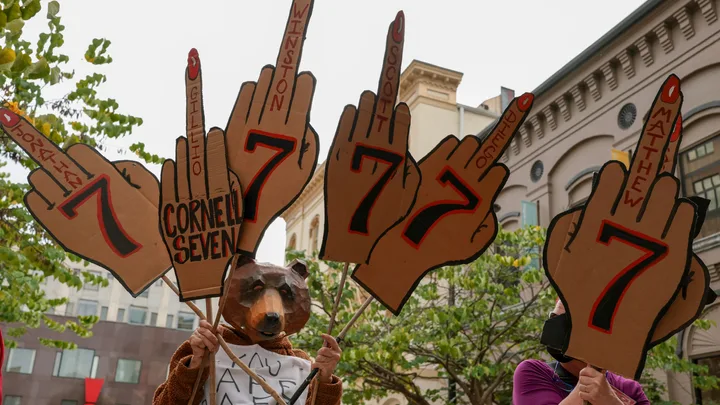
When news broke in September of a young woman allegedly assaulted while at Cornell University, the details of the case followed a painfully familiar pattern: a group of men, a vulnerable woman, a police report that goes nowhere. But it was the revelations that followed, of what played out in a group chat with 57 men, that felt most disturbing.
A woman – known anonymously as Jane Doe – has alleged that in October 2024 she was pressured into taking drugs and consuming alcohol, which rendered her incapacitated. In her telling, she was raped for several hours by seven men from Cornell’s Chi Phi Fraternity, who have been dubbed The Cornell Seven.
While the then-20-year-old woman was allegedly assaulted, she says, live commentary played out in the 50-member fraternity group chat, called Chi Phi Actives. According to CBS News, which obtained a video of the messages exchanged, the men suggested a woman was available for sex, one going as far as to ask, “Shop still open?” And another responding, “Yea.” As though a living, breathing human was a place of convenience to frequent at their whim.
Jane Doe notified the college of the alleged incident three weeks later, and it’s been widely reported that Cornell’s response was to have the men write essays. The Ivy League college has since denied this was the “sole consequence” offered, adding that expulsions and suspensions were issued after it investigated the incident. Police and the district attorney declined to press charges, following an investigation that many, including Chloe Akers, former criminal defence attorney and Cornell alumna, say “fell well beyond professional standards of conduct”.
Two years on, the case has been reopened, made global headlines and, with it, seen an outpouring of rage – in group chats, in comment sections, and in the very specific resharing of clips from the 2020 film Promising Young Woman.
For those unfamiliar with the movie, it follows Cassie (played by Carey Mulligan), a woman seeking revenge for the death of her best friend, who died by suicide after being sexually assaulted by a group of fraternity brothers. In her quest for justice, Cassie is constantly met with maddening excuses such as “benefit of the doubt” and “if you have a reputation”.

The storyline is shockingly similar to what has been alleged by Jane Doe. And it’s the parallels of the group – its language, ease, loyalty – that make this case so upsetting. As reported, Chi Phi Actives is a microcosm of the degrading way men talk about women when they’re emboldened by their peers and the sense of safety that comes from sitting behind a keyboard.
“In a male peer group, sexual entitlement can make a woman’s vulnerability seem like an opportunity, while loyalty can make challenging another man seem like betrayal,” says Lauren Mahoney, adjunct assistant professor in the psychology department at City University of New York School of Professional Studies.
When a derogatory comment is said out loud and met with silence, often there’s an undertone of rejection and dismissal. In a chat group, Mahoney says silence operates as permission and approval, creating a digital bystander effect.
“Collective silence can allow people with different motives to produce the same harmful result,” she explains. “One member may approve, another may fear confrontation, and another may assume someone else is acting. To the person threatening harm, those differences may be invisible. What he sees is an absence of resistance. Concerned members can also mistake everyone else’s silence for acceptance, making each less willing to be the first to object.”
“They’re the men we think we know; the nice guys in our lives, who politely smile at their crude friend’s derogatory joke but never call them out on it”
Online, the verdict was clear, with comments claiming those who stayed silent should be equally responsible for the alleged assault. In fact, it’s the men who stayed silent whose betrayal cut the deepest. They’re the men we think we know; the nice guys in our lives, who politely smile at their crude friend’s derogatory joke but never call them out on it. They’re the ones we expect to act in a situation such as the Chi Phi Actives chat, but don’t.
“Nobody has to say ‘stay quiet’ if the group has already taught its members that objections lead to ridicule or exclusion,” Mahoney explains. “‘I wasn’t involved’ is an incomplete account. It may mean someone did not directly participate in the assault, but it does not answer whether he encouraged the conduct, recognised the danger, or declined an available opportunity to seek help.”
This safety in numbers mentality is a culture built over centuries, one we need to break down and reshape. Akers saw it on the very Cornell campus in Ithaca, New York, where this alleged assault unfolded.
“There was a feeling that the male students had more authority and more agency,” she recalls of her time at the university. “My own belief is that the Greek system really fuelled this fire by taking these young men and grouping them into these packs. I think it emboldened behaviour that, in isolation, we wouldn’t necessarily see.”
Weeks after the case made global headlines and as pressure mounted on the university, Cornell suspended parties at its fraternity houses for the rest of the academic year. In a letter to the Cornell community, president Michael Kotlikoff also said the university would work with New York State Police to investigate incidents on campus.
Separately, under Title IX, the US federal civil rights law, universities must respond to reports of sexual assault through their own process, meaning a student can be disciplined even if the district attorney declines to press charges.
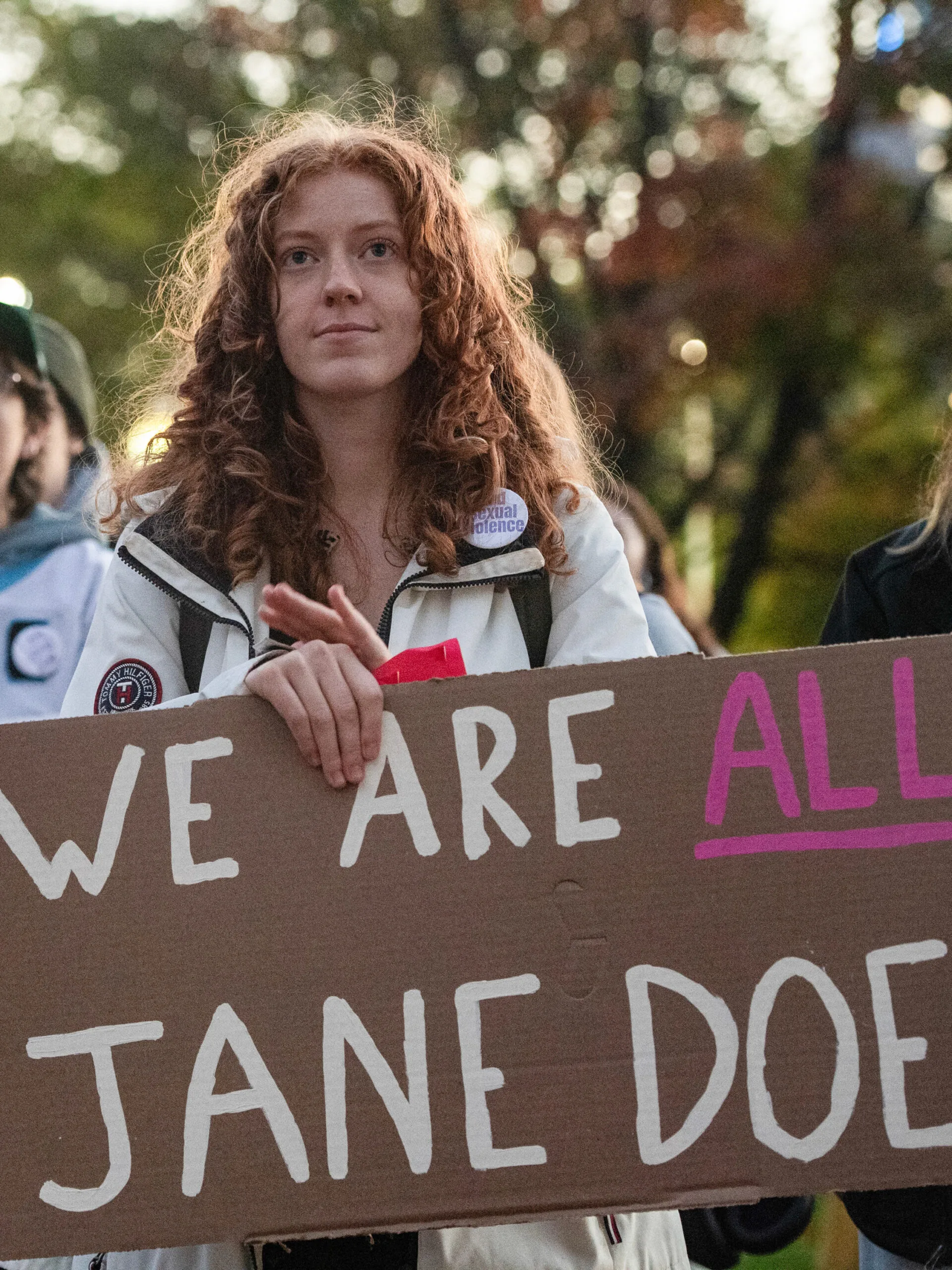
It would perhaps be comforting to simply confine this case to American college culture, but that would be wrong. In August, a week apart, two Sydney private schools were linked to two separate cases in which a group of teenage boys allegedly sexually assaulted a teenage girl.
So, if this is a global issue, how do we shift pack mentality behaviour?
“This goes beyond the familiar lesson about peer pressure,” Mahoney reminds us. “Recent research supports the value of training that strengthens confidence and willingness to intervene, although those outcomes do not guarantee action. Education should ask what respect, courage and loyalty require when following those values carries a social cost. Young people need preparation for challenging a friend, teammate or older member whose approval matters to them.”
But teaching boys to speak up only works if someone is listening when a woman does. This kind of behaviour continues when, like in late 2024, the Jane Does of the world are dismissed.
“Generally speaking, our society has evolved its understanding of gender, power dynamics, and sexuality in ways that tend to support more nuanced and critical evaluations of sexual assault,” Akers says. “However, the systems in place to adjudicate many of these issues are systems designed by and for men. Many of those involved in these systems are also men.”
Having spent 14 years working in the judicial system, defending people accused of serious crimes, including rape, Akers insists the first step is to believe women, always.
“Women deserve to be taken seriously,” she says. “We do not need to be coddled. We do not need to be protected.”
If this story has raised concerns, please call Lifeline anytime on 13 11 14.

Related stories

Native ad body.

Native ad body.




Native ad body.