

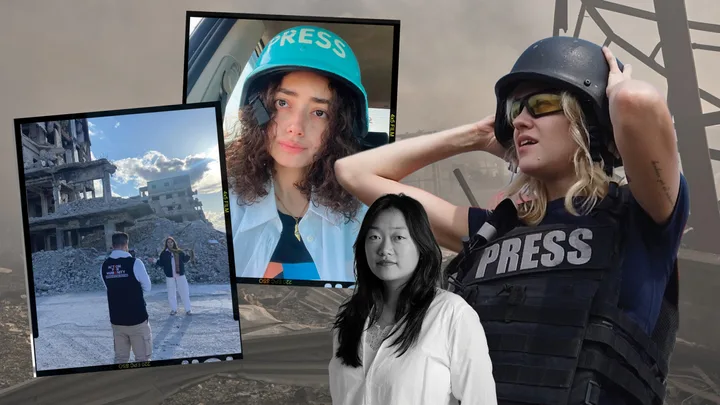
A new generation of foreign correspondents is here. They’re young, they’re female and they’re as familiar with the sounds of air raids as they are TikTok POVs. Meet the women redefining war reporting.
Anna Conkling
Anna Conkling logs into our video call from a hotel room in Kyiv, Ukraine, where she arrived just a few hours earlier, warning me that she’s very tired but has plenty of coffee.
“I go from Berlin to Warsaw, about five hours, then I take an hour to get a cocktail and go to Burger King,” she pauses to laugh, “then I get a train for another three hours to the other Polish border, then the night train to Kyiv.”
I’ve seen this journey – the night before we speak, she’s posted a bedtime GRWM titled: “Getting ready for bed on night train from Poland to Ukraine”, in which she does her skincare routine and makes her bed before climbing in, only to still be wide awake come morning.
“I’ve been doing this every other month for about a year since I moved out of Kyiv last year,” she says.
Conkling, who grew up in Texas but is now based in Berlin, was living in New York and sitting at a Brooklyn bar with a friend when news came out that Russia had invaded Ukraine in February 2022.
“Something came over me and I told my friend, ‘I have to go home right now.’ The next morning, I got up early and went to the East Village, which is the Ukrainian village, and I was the first journalist there, asking people about what was happening.”
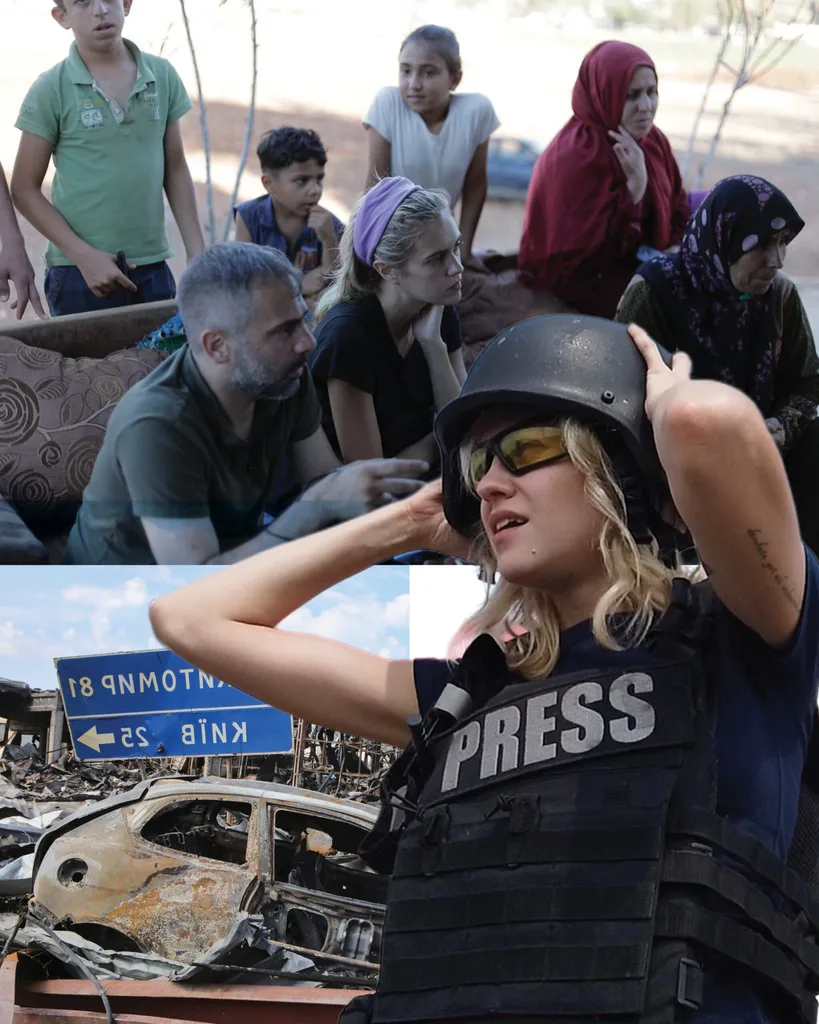
Until then, she’d been working for local city publications but began spending so much time pitching stories about Ukraine that it soon became her specialty.
Her first major byline was for Rolling Stone in a story about a transgender woman who had fled the country. Ukraine bars people with male documents aged between 23 and 60 from leaving the country in case of military mobilisation. “I was just thinking about how hard that must be for transgender women,” she says.
That story set the tone of Conkling’s reporting: it’s not breaking news or in-the-trenches pieces to camera (though she has been in the frontline trenches: “not the most dangerous situation I’ve been in,” she says).
“[At the time], everyone was focused on breaking news, and I was one of the first journalists to take a step back and think about the culture of war, the environmental impacts of war, what people my age are going through,” she says.
Since then, she’s written about the strength of the beauty industry in Ukraine, Russia’s use of rape as a war weapon and women who are undergoing cosmetic surgery during the war, as well as a story about body repatriation that saw her become a finalist for the Livingston Award.
Conkling has also reported from Armenia during Azerbaijan’s invasion in 2023, as well as the site of an Israeli attack in southern Lebanon, where Syrian refugees had also fled to escape the Assad regime.
She’s recently been promoted to international correspondent for Noosphere, a new journalism platform that connects news readers with international reporters, launched by former war reporter Jane Ferguson.
She’s also working on a documentary, details of which are currently under wraps. Social media is a huge part of Conkling’s reporting: she posts BTS and GRWM videos as well as on-the-ground reports and interviews from attack sites to her thousands of followers on Instagram (@annaconkling) and TikTok (@annathejournalist).
“The first time I went to Ukraine, I was trying to assess the risk and so I went to Lviv, which was supposed to be the safest city,” she says. “But on my second day there, it was hit with the worst attack since the early days of the war. I was in a parking garage while there were explosions. I was thinking, ‘Well, I don’t think I’m going to die, but if I do, I signed up for this.’”
Conkling has since been at the site of huge attacks, and regularly posts videos of herself in her bed or garage bunkers with the sounds of drones striking all around. She tells me a story of her fixer, Sergey, picking her up one day and asking if she wanted to go to Donbas, “the most dangerous place”. “It’s literally the frontlines, so at first I was like, ‘No, I don’t think so.’ And five minutes later, ‘I’ll think about it.’ Then, ‘Actually, probably.’ Then two minutes later, ‘OK, yeah, let’s go.’”
They travelled to a rear position of the frontlines, about 10 kilometres from the Russians, with “explosions in the distance and the military just chilling”. But then a drone came, and they had to run. She fell in the mud and couldn’t get back up under the weight of her helmet and vest, so Sergey scooped her up and set her back on her feet.
Conkling doesn’t tell her family when she’s going on assignment. She’ll “maybe” tell them once she’s safe back at home, but not always. Her “emotional support person” is her Ukrainian boyfriend, who she met and lived with in Kyiv and now lives with in Berlin.
“We’re trauma bonded; he’s my best friend,” she says. “I’ve seen a lot of suffering, and all before 30,” Conkling adds. “I received a therapy grant, I work out, I get massages, I journal, but the main thing is that I love doing this – I’m happiest when I’m in the field and telling the stories of people who are impacted. I feel privileged that people are willing to speak to me; they don’t know me, they don’t know what my motivations are, but they trust me to listen to the worst parts of their lives.
“I think because I’m a woman, people feel less threatened by me,” she adds. “More women should be war correspondents because they see you as a mother, a friend, a sister, and they feel comfortable, they invite you into their homes. Men want to be in the trenches, but I want to be in the homes drinking tea with the women and hearing their stories.”
Rachel Hagan
After we get off our Zoom call, an email from Rachel Hagan pops into my inbox. “I totally forgot to tell you the wild story of when our tiny propeller plane in South Sudan nearly crashed with an unmarked Russian jet lol …”
That “lol” at the end tells you everything you need to know about 29-year-old Hagan: a foreign correspondent who regularly finds herself in precarious – if not downright dangerous – situations, and has a remarkable ability to shake it off.
That’s because it’s all for a greater purpose; it comes with the territory when your job is to highlight the suffering regular people are facing in their everyday lives, and making sure the world doesn’t forget about them. If that puts her in the line of danger, her attitude is more “whoopsie daisy” than “I’m never doing that again”.
Hagan had started out wanting to be a fashion journalist, but an internship at ELLE UK with the award-winning journalist Louise Donovan (“I glued myself to her a bit”), who has reported from countries in Africa, Asia, Latin America and the Middle East, showed her a different side of reporting.
“I’m not very academic, so I didn’t feel I was clever enough to be able to do [that kind of journalism],” she says.
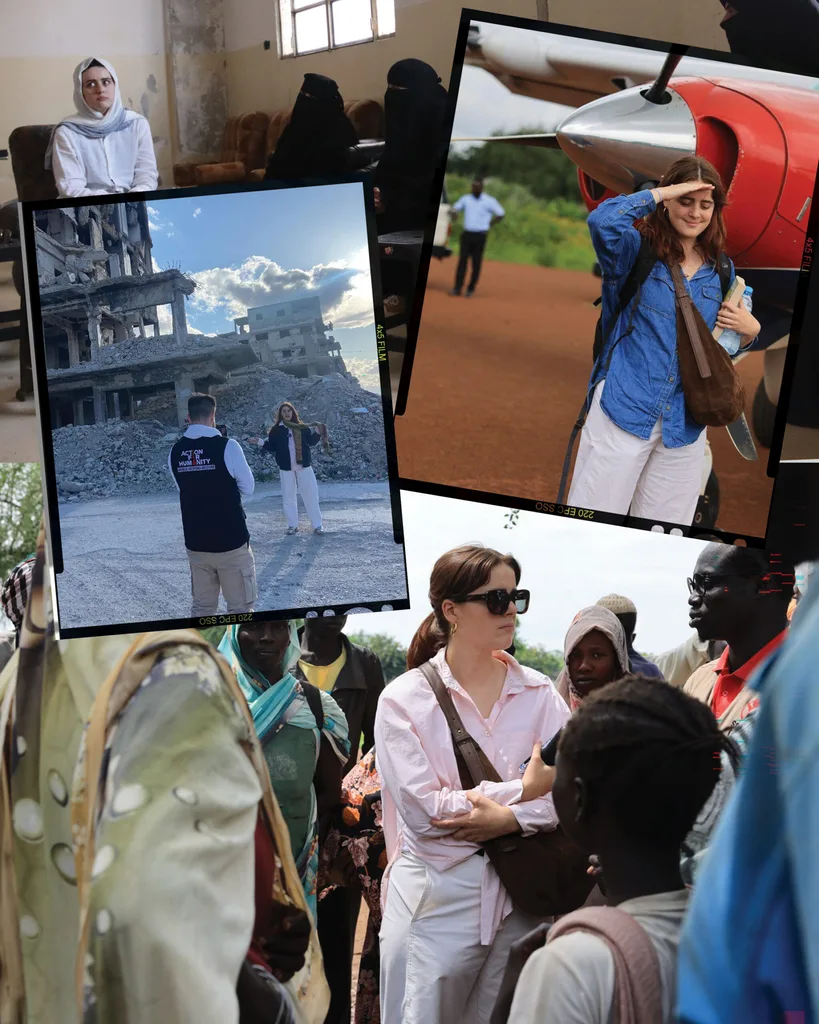
But as she discovered more female reporters and filmmakers, she realised she could tell stories in a different way: from the heart. She regularly reports on war and conflict for glossy women’s titles like ELLE, marie claire and Stylist.
“People can easily pooh-pooh women’s magazines but, actually, they highlight such important issues,” she says. “It’s amazing to be writing about such important issues for titles that are close to my heart.”
Growing up in Bristol, England, Hagan’s parents had a rotating door of international students living with them from when she was in her early teens.
“They’d stay with us for up to six months and they became part of the family, so it opened my eyes and ears to different cultures and how to interact with people over the dinner table,” she says.
That’s a quality she tries to bring into her reporting: the intimacy of a conversation over the dinner table. “I always try to bring it back to the people – tell the politics through the people,” she explains.
After moving to London for university, Hagan’s first major commission was a piece for Vice about the Yazidi genocide. In 2014, ISIS invaded the Sinjar region of Iraq, killing as many as 5000 Yazidis for refusing to convert to Islam.
More than 400,000 people were displaced. ISIS kidnapped young boys for radicalisation and enslaved and sexually abused women and girls. When Hagan started working at the left-wing UK tabloid The Mirror, she kept covering the plight of the Yazidis.
“I’d been reporting remotely on any legal updates about the genocide, and I was also covering breaking news in Syria and other global events – earthquakes, elections, assassinations, all of it. But there was never any budget to send me to those places.”
She took the plunge and went freelance in 2024. “It was the 10th anniversary of the genocide, so I thought, given my body of work, it would be an amazing opportunity to go to Iraq and report from the IDP [internally displaced people] camps.”
She teamed up with an NGO, and off she went. “It’s crazy that for my first-ever trip I went to Iraq,” she says, laughing. “When I look back on that trip now, I see how unprepared I was, and it’s just wild to think about. Ultimately, I was safe because I was with an NGO, but I spent a few days by myself at the end because I thought I’d explore Erbil, the capital of Iraqi Kurdistan, and maybe write some other stories, but I was so terrified that I didn’t end up leaving the hotel.”
She now considers fear a positive thing: “If you’re not scared, you’re not going to relate to the people who are living there; you’re not going to tell a good story.”
Hagan’s parents, though, didn’t sleep much while she was on that first trip. “They were so worried, but they trust me and they know I’m doing everything in a safe way, so it’s getting easier for them.”
Earlier this year, Hagan and her fiancé, who she’s been with since they were at university, moved from London to Istanbul, Turkey, so she could be closer to the areas she reports from. “I could never have anticipated that the Iran War would happen,” she says.
She was able to report from the Iran-Turkey border, as well as Iraq and Syria, within the space of a month.
“It’s a testament to his amazing character that he supports me through it, and I’m just so blessed that he’s so proud of me,” she says. “He jokes that it’s quite nice that he gets the bed to himself for a week.”
Asked for one of her most memorable moments, Hagan recalls a trip to Syria after the fall of the Assad regime.
“We went into a house to interview two men who’d been amputated by bombs, and after we finished, one of them said, ‘My family in the kitchen want to speak to you.’ So we went in, and it’s his wife and daughters, and they didn’t have their hijabs on and they wanted to meet me and wanted me to sit with them.”
Another time, she was interviewing women at a community centre. “They weren’t really offering up much information, but once the male photographer left the room, they took off their niqabs and it was the most amazing conversation.”
That’s the power of women journalists. “It’s so easy for a situation to be disarmed when it’s just women in the room.”
Plestia Alaqad
You might remember the moment you were introduced to Plestia Alaqad. The then-21-year-old was filming inside a house in Gaza on October 10, 2023, three days after the start of the Israel-Hamas war, when she flipped the camera around into selfie mode.
Suddenly there’s an explosion, and a rush of wind blows around her face. She barely flinches. This was her daily reality that she’d been trying to get the world to notice. They did.
“At the time, it gave me hope that if a global audience could see what was happening in Gaza, this madness would stop,” she says now from her new base in Lebanon. “But it turns out it doesn’t work like that; the problem isn’t visibility.”
Alaqad is, of course, referring to the genocide that Israel has been raging in Gaza for almost three years now in response to Hamas’ attacks in Israel, during which 1200 people were killed and 251 taken hostage. The current death toll in Gaza is reported to have exceeded 75,000, according to Al Jazeera.
While Alaqad had studied journalism at EMU in Cyprus, she didn’t think her first assignment would be reporting on the genocide of her own people.
“When I was in Cyprus, I realised people from different countries knew very little about Palestine,” she says.
She found that the little information people did have was coming from external sources, rather than from Palestinian people themselves.
“So I returned home to Gaza after graduating”, intending to share her own stories. “And the rest is history.”
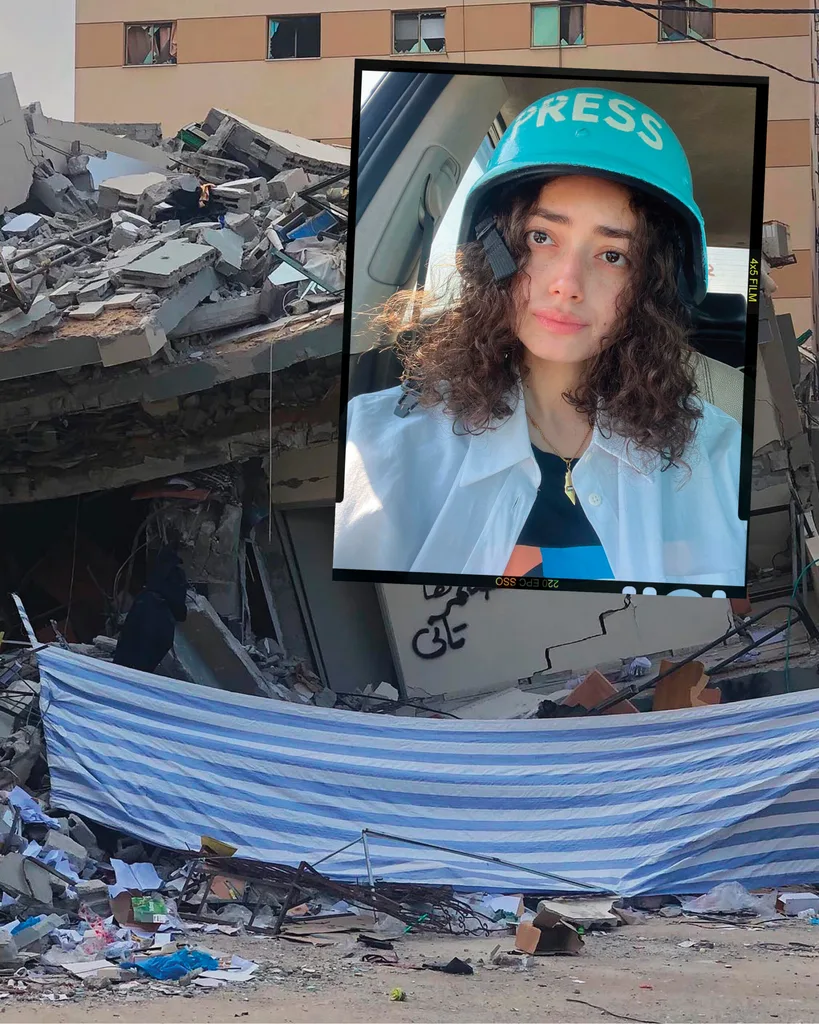
When the attacks began, she grabbed a press helmet and bulletproof vest and travelled with two male colleagues, Mohamed and Hatem, who were heading off to gather footage across the region, reporting to international news outlets from makeshift camps, bombed-out homes, hospital shelters and evacuation relocations.
All the while, Alaqad was posting to Instagram. “Social media plays a huge role in the coverage of the Israeli genocide in Gaza,” she says. “[It] allows a global audience to see and learn about it from people who are living through it. And because international journalists weren’t allowed in, we were the ones reporting on what was happening to us.”
For her reporting on Gaza, Alaqad was named one of the BBC’s 100 Women in 2024, and won the One Young World Journalist of the Year Award, the Lyra McKee Award for Bravery and a Human Rights Defender Award. Her work has appeared in Al Jazeera, The New York Times and The Washington Post.
She also delivered her first TEDx Talk virtually in 2024. In 2025, Alaqad published her diaries from the first 45 days of the war, called The Eyes of Gaza.
“My friends and family were terrified that Israel might kill me for reporting, yet they were proud of me for having the courage to tell our stories in the midst of a genocide,” she says.
Alaqad still frequently posts about the journalists being killed in Gaza. “It only took a matter of weeks reporting on the ground and wearing a press helmet that I took them off because they put you at greater risk instead of protecting you,” she says. “It’s not supposed to be dangerous to be a journalist in a war zone: it’s a job, not a crime.”
Frances Mao
Frances Mao gets frustrated with how “othering” traditional conflict reporting can be. “You read something and you’re like, ‘Oh, that country is in strife,’ but because you’ve never experienced it, it’s easy to think it’s just foreign,” she says. “But if you read something that’s like, ‘Oh, there’s a guy my age, literally in a trench, and he’s listening to Drake and watching TikToks to pass the time,’ it changes your perspective.”
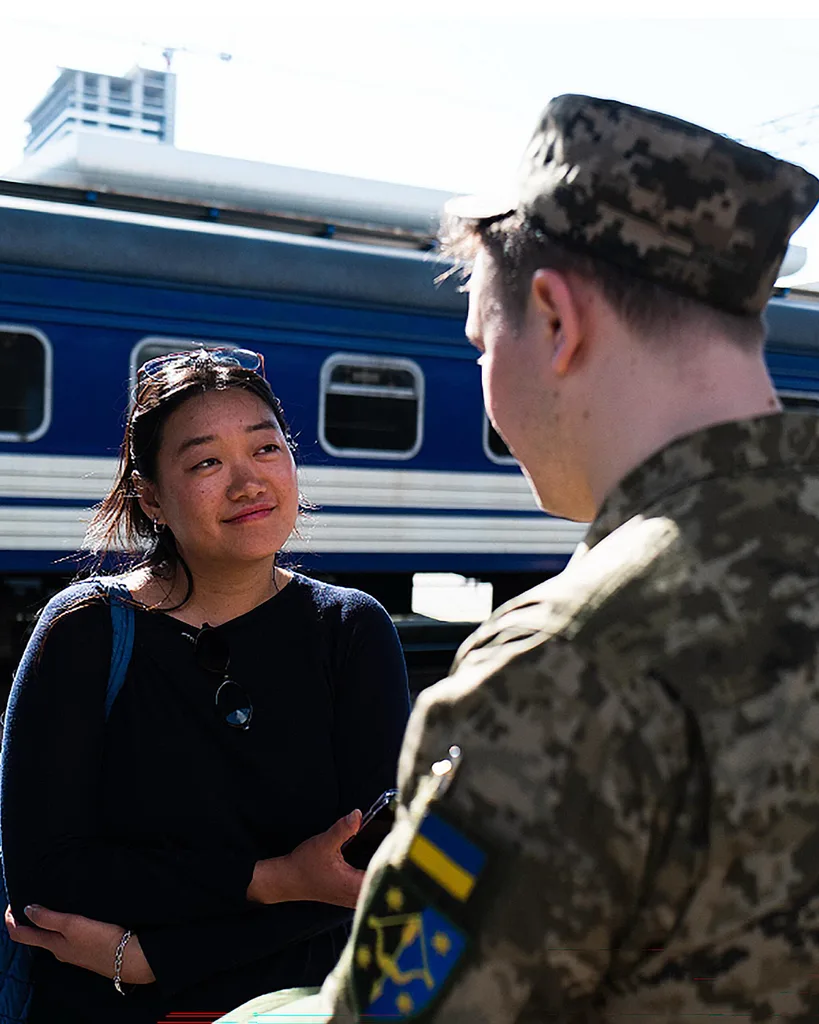
Mao gives the example of a young soldier she met in Ukraine. “He was a total hipster, such a coffee nerd, and he brought two different ways of making coffee with him to the frontlines,” she says, laughing. “He pulled his fancy coffee maker into the diesel electricity generator, and then had his cold-drip set up, too. It’s those details – they’re wearing Air Jordans on the frontline – that make a war report human.”
Now based in London as Newsweek’s world editor, Mao has spent her career on major news desks: The Guardian, BBC News, the Australian Associated Press (AAP) and Sky News. She’s reported from Asia, Brazil, Ukraine and, recently, Cuba.
But it all started at home, specifically, in Sydney during the Lindt Café siege in December 2014 in which three people died after a lone gunman took 18 people hostage. Mao was working for AAP as an editorial assistant and remembers it as her first significant breaking-news event.
One of the first foreign conflicts she reported on happened by accident. Mao was on a family holiday in Brazil in January 2023 when thousands of far-right protesters broke into the National Congress, Supreme Court and Palácio do Planalto in an event mirroring the January 6 attacks on the US Capitol in 2021.
“We were just doing what tourists do, going around the galleries, and we knew there was a political rally happening, but then thousands and thousands of people started pouring off buses and streaming into the city,” she recalls. “It was surreal. And because I happened to be there, I covered it for the BBC.”
Earlier this year, Mao and her team were invited by the communist Cuban government to interview the president – the first time a US news outlet had been offered an interview in three years.
“It’s a massive deal, but we knew they wanted our coverage for a certain reason, and we would be monitored closely, but we accepted their deal to get the access, and then when we were on the ground I really pushed us to get out and away from their itinerary sometimes and talk to people living under this authoritarian communist state,” she says. “It was incredible access to Cuba at a time when the country is truly on its knees.”
Some areas experience blackouts for up to 22 hours a day, there are severe food and water shortages, and soaring inflation and a sharply devalued currency have made basic necessities increasingly unaffordable.
“We went to the neighbourhoods to talk to regular people playing cards on the street, into the poorer neighbourhoods, talking to doctors,” she says, “because if we didn’t, then we weren’t doing our job properly; we were just on a PR trip.” One thing Mao struggles with in her job is the ability to leave.
“You go in to talk to people about their hardship and suffering, then you leave; you have a way out. That’s something I really battle with. I try to address it with good reporting and I make sure that if I go somewhere, I’m going with a purpose and that I come back with something meaningful or helpful.”

Related stories
Native ad body.
Native ad body.
Native ad body.

Share this post