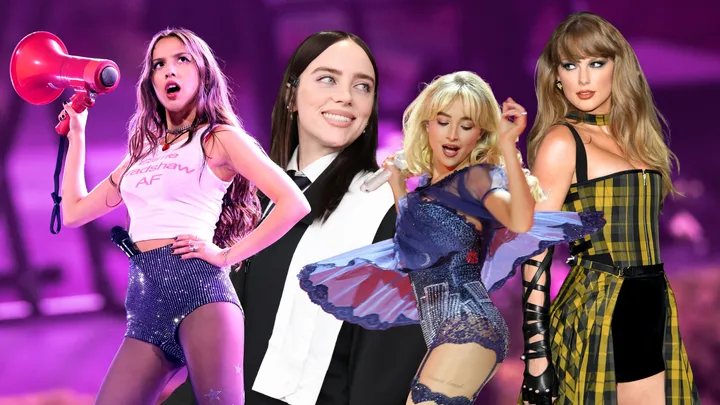
The age-old adage “stay in your lane” feels increasingly obsolete in the 21st century.
People now have three to seven careers across a lifetime, need second incomes to survive the cost-of-living crisis, and are constantly upskilling while vaguely planning to monetise a hobby before they turn 35.
Social media has also collapsed the boundaries between celebrity, expertise and public opinion, creating an environment where audiences increasingly expect public figures to share not just their work, but their perspectives too.
This, of course, is nothing new for American singer Joan Baez.
For more than six decades, the folk icon has treated political activism not as a side project to her music career, but as part of the job itself. So unsurprisingly, she has little patience for the political silence of today’s biggest pop stars. Why, exactly, aren’t the pop girlies speaking up?
Appearing on the latest episode of Wiser Than Me with Julia Louis-Dreyfus, Baez reflected on the reluctance of many contemporary musicians to publicly engage with politics, despite possessing enormous cultural influence and global platforms.
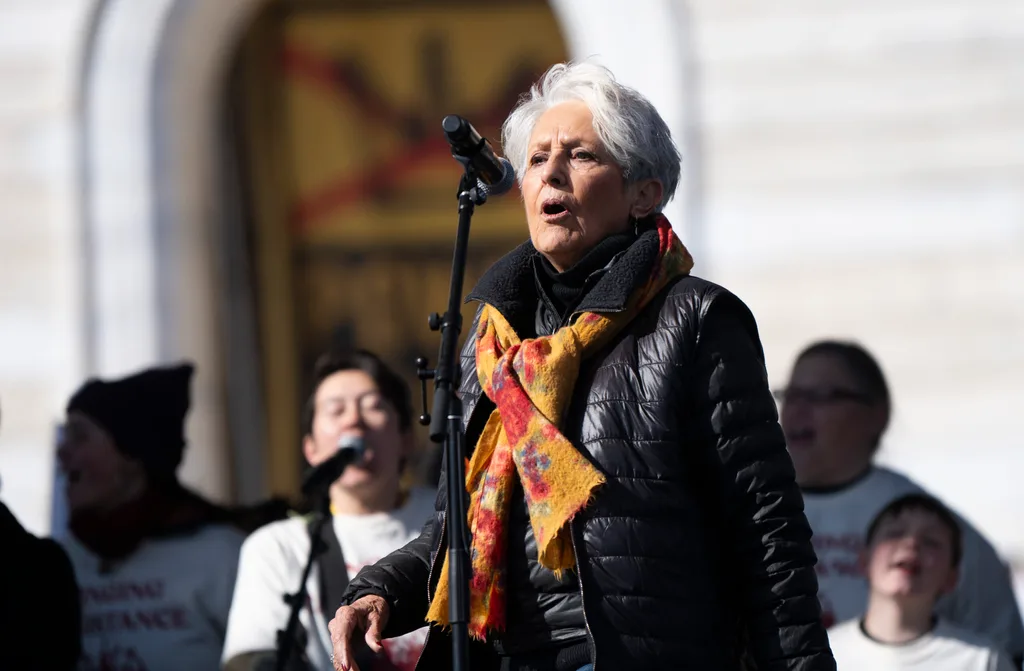
Without naming names — though the implication hardly required it — Baez questioned why so few of today’s stadium-filling female artists appear willing to publicly speak out.
“I sort of cock my head at these stadiums filled with brilliant young women songwriters, and why can’t they just take that little step?” Baez said. “Because they’re already richer than God, you know, most of them. So, that little step. Might anyone try it?”
The criticism carries particular weight coming from Baez, whose career has long functioned as a rejection of celebrity neutrality.
From marching alongside Martin Luther King Jr. during the Civil Rights Movement to protesting the Vietnam War and advocating for immigrant rights, Baez has consistently understood fame as something that comes with civic responsibility.
At 85, she appears faintly bewildered by the carefully managed caution of a modern music industry increasingly shaped by branding, marketability and PR strategy.
Still, Baez acknowledged the younger artists she believes are using their platforms meaningfully. She praised both Brandi Carlile and Maggie Rogers, specifically highlighting Rogers for appearing “front and center” at a recent rally protesting ICE raids.
Her comments arrive at a moment when celebrity political engagement feels both more visible and more restrained than ever. In recent months, artists including Billie Eilish and Olivia Rodrigo have publicly condemned ICE operations across the United States, using interviews, social media and red carpets to urge fans toward political action.
Still, Baez’s broader point is that those who do speak up are often outliers, and that pop stardom itself has gradually become depoliticised. Her generation of musicians often viewed activism as inseparable from artistry; contemporary celebrity culture, by contrast, frequently treats overt political conviction as a potential threat to commercial appeal.
It is perhaps part of the reason Baez herself has often occupied a strangely peripheral position within mainstream music mythology. While contemporaries such as Joni Mitchell and Stevie Wonder are routinely canonised as untouchable musical greats, Baez — despite her immense cultural influence — is often left out of those same conversations.
But if her latest comments prove anything, it is that Baez remains entirely uninterested in becoming a sanitised legacy act. At a time when celebrity neutrality is increasingly mistaken for sophistication, she is still willing to ask uncomfortable questions.
And frankly, she seems to believe the pop girlies should be doing the same.

Related stories
Native ad body.
Native ad body.
Native ad body.