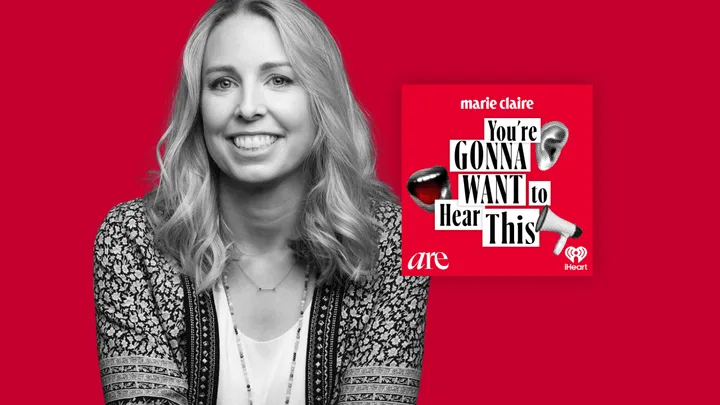
Author Hannah Richell has recalled the moment two police detectives arrived at her Sydney home and delivered the news that would divide her life into before and after. Speaking to marie claire editor Georgie McCourt on marie claire’s podcast You’re Gonna Want To Hear This, the internationally bestselling author described the “ordinary Wednesday in July” in 2014 when her husband, Matt, was killed in a surfing accident at Tamarama Beach. She’s now written about her experience in her memoir, An Ocean and a Day, out now.
Richell, then 39, had shared coffee with her husband that morning before the couple went about their separate days. Matt planned to meet a colleague for what they jokingly called a “board meeting” on their surfboards, while Richell was working on her third novel. Around lunchtime, however, her phone began ringing. Matt’s personal assistant told her a Bondi detective had contacted his workplace seeking the family’s home address.
“I put down the phone, and I just had this feeling of, ‘I need to go home,’” Richell said. After calling the childminder looking after her children, then aged three and six, she learnt two detectives were already waiting at the house. “I knew something had happened, but I didn’t know what,” she said. “I kind of ran the rest of the way home.”
As she reached the front door, Richell sensed that something terrible was waiting on the other side. “I kind of knew that as I was going to step through the threshold of that space, something bad was waiting for me,” she said. “But I had to go in because my kids were inside.” One of the detectives appeared to have been crying.
“They said, ‘I’m really sorry to tell you that your husband’s been in a surfing accident down at Tamarama Beach,’” Richell recalled. Believing Matt had been taken to hospital, she asked whether he was okay. “They said, ‘No, I’m sorry to say he died.’ And that was the moment, really, that life changed forever for us.”
Even after hearing the words, Richell could not comprehend them. “I truly did not believe, even when they said, ‘Matt has died.’ I didn’t believe it,” she said. “It was just a rupture of what felt real. I couldn’t digest it.” Because the accident had occurred in a public place and television crews had gathered at the beach, police urged Richell to contact family members before they saw the news. “I had to say the words out loud, ‘Matt’s dead,’” she said. “It was just horrific because it felt like everything was suddenly going into fast-forward.”
Listen To You’re Gonna Want To Hear This
The Moment She Told Her Children
But her most devastating task was still ahead: telling her children their father was gone. “I think it’s the hardest thing I’ve ever done, being their mother and knowing that I had to tell them something that would break their hearts, and then hold them through that experience,” she said.
Richell waited until the following morning, wanting her children to have one final night in which “the family was still intact and everything was okay”. “I woke up really early, and I went into their bedrooms and told them the worst thing I would ever have to tell them.” She remembers holding the children, but little else. “I think either shock or self-preservation, something is muffling that memory in my brain,” she said.
Now teenagers, the children speak regularly about their father, although they do not discuss the day they learnt he had died. Richell said she has always tried to leave the door open for them to process their loss as they grow. “They will continue to carry and process their grief in different ways as they age and hit different milestones,” she said. “They will miss their father in so many different ways as they grow up.” Richell began writing seven days after Matt’s death. Those early pages were not intended for publication and would eventually form part of her memoir, An Ocean and a Day, which examines not only the immediate shock of bereavement but how grief changes across the years that follow.
“I wasn’t thinking, ‘I’m going to turn this tragedy into a book.’ That was the furthest thing from my mind,” she said. Instead, writing became an instinctive attempt to survive the nights after the children had gone to sleep. “I felt so desperately sad and alone, [I began] to just pick up my pen and start letting my feelings out onto the page,” she says on the podcast. “It felt like release, really. It was just an act of survival.”
Her grief arrived as “a storm” of sadness, rage, desolation, questioning and, unexpectedly, shame. “I felt a strange shame to suddenly have the label of widow,” she said. “I was 39, and I felt so different from everyone around me.”
Becoming A Single Parent Overnight
Overnight, she had also become a single parent. “I was suddenly ticking those boxes on forms saying, ‘Yes, I’m a single parent. Yes, I’m a widow.’ Who’s our emergency contact? I don’t know anymore.” Although friends and family rallied around her, Richell said grief remained profoundly isolating. “You just feel so alone. You’re on a different plane,” she said. “I describe it in the memoir as feeling a bit like you’ve fallen into a sinkhole, and you can kind of look up and you see the world moving on, and there’s light up there somewhere, but you are down deep in the darkness.”
In the early months, Richell longed not simply for her old life, but for Matt’s physical presence. “I can remember having to line up the pillows in the bed next to me to try and almost fake that he was in bed next to me,” she said. “I just felt desperate for him.” She also struggled to accept that he was never coming home. “I think sudden death, sudden loss, it’s such a shock,” she said. “One of the things you’re battling with is remapping the world to understand that your person’s not in it anymore.”
While she tried to contain the most overwhelming moments of grief around her children, she made a conscious decision not to hide all her sadness. “I think it was really important that they did see me occasionally responding to Matt’s death with honesty,” she said. “If I’d maintained this composure, it wouldn’t have given them permission.” There were times she shut herself inside the wardrobe, fell to her knees and wailed. On one occasion, however, her children discovered her crying and came to comfort her. “The two of them just came and hugged me,” she said. “It shows how important it was that the three of us bonded together through the experience.”
Her children also reminded her that grief could coexist with silliness and moments of joy. “They taught me that sometimes there’s a time for talking and analysing and processing the feelings, and sometimes you just have to let go and be silly, or dance in the kitchen, or have ice cream for dinner,” she said. “When everything goes pear-shaped, you’ve got to give yourself a bit of grace.”
“Daddy Be Free”
Two years after the accident, Richell and her children scattered Matt’s ashes at a favourite place by Sydney Harbour. Unsure what words could adequately mark the moment, she was interrupted by her son. “He came out with, ‘Can I say something? I just want to say, Daddy, be free,’” Richell said. “It was, of course, the perfect thing to say.”
The memoir is also candid about the less frequently discussed parts of widowhood, including loneliness, sex, dating and the guilt of wanting human connection again. “I started to think, ‘Well, I didn’t die, and I’m still a relatively young woman,’” Richell said. “I was starting to crave physical contact with people, and it was very odd, and I felt really guilty and ashamed about it.”
Her counsellor offered a simple response: “Who wouldn’t want to feel something other than what you’re feeling?” Richell eventually realised she was not searching for intimacy with a stranger.
Finding Love Again
“I was really craving intimacy with Matt,” she said. “I was just missing him saying my name.” Her first date after his death was gentle and kind, but returning home left her feeling unmoored. “I went back and lay in my bed at home and felt all at sea,” she said. “‘What is this life I’m living? I don’t recognise it.’” Around five or six years after Matt’s death, Richell met the man who would become her second husband. They are now raising a blended family of five children.
“I’ve met this amazing guy who can see all these broken, messy parts of me,” she said. “He knows all about Matt. He understands that the grief is with me, as is the love, but that my heart is big enough to hold all of it now.” Rather than replacing her first love, her new relationship has taught her that the heart can expand around loss. “We step forward into this new life together,” she said. “We have our eyes wide open, and it’s a really wonderful thing.”
Twelve years after Matt’s death, Richell describes grief as “a weight that you learn to carry”. “Matt’s life changed me, but his death has also changed me,” she said. “I see life as this strange merging of the sad, the bitter and the sweet.” It has also transformed what she values. Looking back, it is not major milestones, career achievements or expensive possessions that she misses most. “It’s simple things like brushing our teeth together and smiling at each other in the bathroom mirror, or just going for a walk and sharing a moment,” she said. “That’s what our lives are pinned together by. Every day that we get to have a really steady, ordinary day now, I’m grateful for it.”
Richell said she no longer believes grief is something a person completes or leaves behind. “Maybe acceptance is just understanding that the grief isn’t really going anywhere,” she said. “But I’ve learned to carry it, and I can carry it differently now and see it almost as an honour.” For those confronting their own loss, Richell’s message is not that grief can be rushed, cured or overcome. “It takes as long as it takes,” she said. “The more you resist it, I found, the harder it was for me to bear it.”
Her memoir ultimately carries a message of hope: that loss does not erase love, even when it changes the entire shape of a life. “When something terrible happens, it can be incredibly hard, but there will be people that will step up to accompany you and be with you,” she said. “At the end of the day, what you’re most afraid of is losing the love, and actually what I’ve learnt is that the love does stay.”
Listen to You’re Gonna Want To Hear This here
Purchase An Ocean and a Day by Hannah Richell here

Related stories
Native ad body.

Native ad body.


Native ad body.