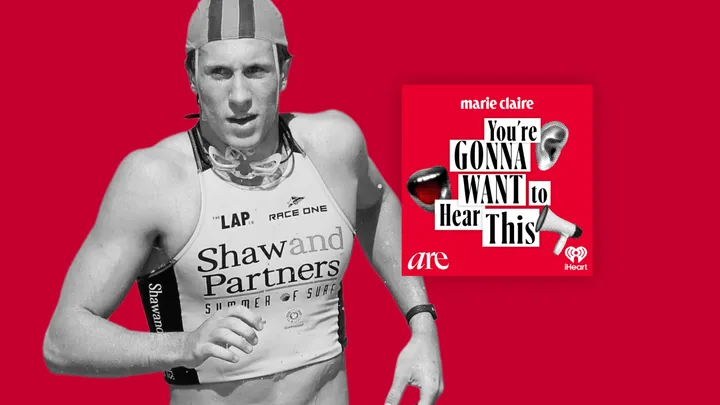
Professional Ironman Charlie Verco has relived the terrifying moments he paddled towards Australian woman Leah Stewart being attacked by a great white shark, revealing he felt “completely helpless” as the animal dragged her beneath the water before he managed to pull her to safety.
Speaking exclusively on the latest episode of marie claire’s You’re Gonna Want To Hear This podcast, the 25-year-old surf lifesaver and endurance paddleboarder shared his emotional account of the attack that shocked Australia, admitting there were moments he believed there was nothing more he could do.
“I just kept going, ‘What do I do? What do I do?'” Verco tells host Georgie McCourt. “All I wanted to do was get to the shore, but I felt an obligation to stay because if I left, there’d be no one there.”
Verco had been training for an endurance race in Hawaii, paddling from Bondi towards Maroubra, when what began as an ordinary morning in perfect conditions turned into a life-or-death rescue.
Listen To You’re Gonna Want To Hear This
“The water was crystal clear, really blue, really warm for that time of year,” he recalls. “I was about 80 metres offshore when I heard someone screaming, ‘Shark.'”
Initially, he assumed it was another false alarm.
“Most of the time when someone’s screaming shark, it’s not actually a shark,” he says. “It’s someone who’s mistaken a dolphin or kids playing a prank.” But as he paddled closer, he realised something was terribly wrong.
“I could see this thing moving really slowly and inquisitively,” he says. “Then it started pushing Leah around and I thought, ‘This is a completely different situation.'” As the attack intensified, Verco says seeing the sheer size of the shark changed everything.
“When I saw its dorsal fin and its back and tail, I felt like I was looking up at the shark,” he says. “The size of it and the power made me realise this thing wasn’t going to be scared of me.” Despite being on an 18-foot rescue-style paddleboard, Verco says he knew paddling directly between the shark and Leah would have placed him in enormous danger.
“I realised interrupting what was going on wasn’t an option because it would just be putting myself under unnecessary risk. Frankly, I was too scared.” Instead, he stayed close, signalling lifeguards while waiting for an opportunity to reach the injured swimmer.
That moment finally came after the shark disappeared beneath the surface. “There was a lot of blood in the water,” he says. “She got taken under and then luckily she popped back up.” Rather than paddle directly into the blood-filled water, Verco asked the woman to swim the final few metres towards the nose of his board.
“I didn’t want to be sitting in the middle of the blood where I couldn’t see underneath me,” he explains. As they made their way back to shore, Leah’s injuries became increasingly severe. “She became too weak to hold onto the board,” he says. “So I had to grab her by the arm, keep her head above the water and paddle backwards with one arm until she lost consciousness.”
Throughout the rescue, Verco says his mind narrowed to just two priorities.
“‘Where’s the shark?’ and ‘Get her to the beach.'”
Drawing on years of surf lifesaving training, he deliberately ignored the severity of her injuries until they reached shore.
“I had a quick glimpse at her injuries and they were confronting,” he says. “I almost put it out of my mind because it wasn’t important right then. I just had to get her to the beach.”
Once on the sand, Verco says the extraordinary work of lifeguards, paramedics and medical professionals took over.
“They already had tourniquets ready,” he says. “When I came back a short time later, she’d regained consciousness. It was incredible to see what those medical teams were able to do.”
Despite being widely hailed as a hero, Verco remains uncomfortable with the title.
“I feel there’s always a bit of imposter syndrome,” he admits. “I’m grateful for the actions I took, but I still think about what else I could have done.”
Instead, he credits his upbringing through surf lifesaving with giving him the skills to stay calm under extraordinary pressure.
“It taught me how to think rationally when you’re under a lot of stress,” he says. “I was scared, I had adrenaline, but I could still make decisions.”
The experience hasn’t diminished his love of the ocean, although he admits it has changed the way he approaches it.
“I don’t want this to stop people enjoying Australia’s beaches,” he says. “The ocean has given me so much joy throughout my life. I just think we need to be educated, make good decisions and continue improving shark safety.”
Verco has also used the attention surrounding the rescue to encourage Australians to donate blood after witnessing firsthand how life-saving blood transfusions were for the injured swimmer.
“Without that blood, it would probably be a very different scenario,” he says. “If you’re able to donate blood – especially O negative – it can genuinely save someone’s life.”

Related stories
Native ad body.
Native ad body.
Native ad body.