

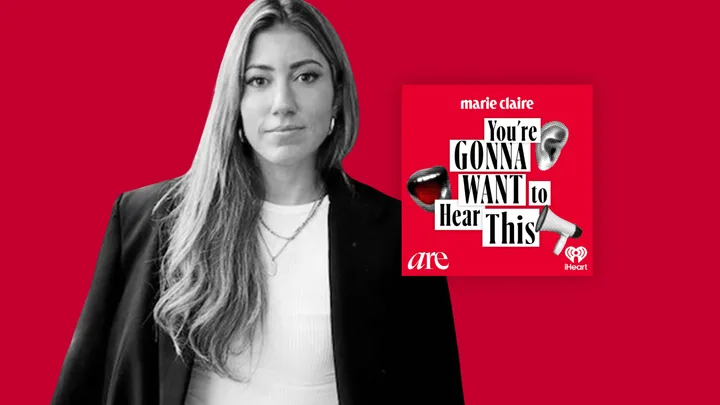
For three decades, Bek Condello believed her childhood was normal. She believed children were supposed to fear God. That questioning authority was dangerous. That doctors couldn’t be trusted. That girls didn’t need careers because their purpose was to become obedient wives and mothers. And she believed the physical punishment she endured was simply part of growing up.
It wasn’t until she sat down to write her memoir Can You Handle A Girl Like Me? that everything she thought she knew about her own life began to unravel.
“I don’t think there was one moment in my entire 30 years of life that I really fully realised it,” Condello tells marie claire editor Georgie McCourt on the latest episode of You’re Gonna Want To Hear This. “It was when I was writing my book… I had all these moments where I was like, ‘Oh my God, that’s what that was.'”
Today, Condello is speaking publicly about growing up inside the Geelong Revival Centre, a Pentecostal church she now describes as a cult. Her memoir details a childhood shaped by fear, obedience and control, where nearly every aspect of life – from education and friendships to dating, healthcare and family relationships—was governed by church leaders.
“The difference between a church and a cult is that you’re going to lose your entire identity and family and community,” she says. “When I left 13 years ago, my mother hasn’t spoken to me ever again and will probably never speak to me again.”
Listen To You’re Gonna Want To Hear This
One of the most striking revelations from the podcast is that Condello didn’t immediately recognise many of her experiences as abuse.
Looking back, she says she simply didn’t have the language to describe what was happening.
“You only know what you know,” she explains. “I didn’t have the language for a lot of the things I experienced.”
That conditioning, she says, extended well into adulthood.
“I really didn’t trust myself for a really long time,” she says. “Even now… I have moments where I think, ‘Did I make all this up?’ I know I haven’t, but I still think some of that conditioning might always be there.”
Growing up, there was no room for independent thinking.
Condello says she was never vaccinated, rarely received medical treatment and was taught to pray instead of seeking healthcare. Friendships outside the church were discouraged, dating outside the group was forbidden and girls were expected to marry young.
“My role was to be an obedient daughter and then become an obedient wife,” she says. “No one once ever asked me what I wanted to be when I grew up.”
Although she attended mainstream school from the age of 10 after pleading with her parents to let her go, she says she still missed many of the experiences most children take for granted.
Birthday parties, sleepovers, school camps, formals and holidays with friends were all off limits.
“I feel like I was robbed of a childhood,” she says. “I was robbed of my twenties and so many rites of passage.”
One moment in particular still affects her.
Watching the Barbie movie as an adult unexpectedly brought her to tears.
“I bawled my eyes out,” she recalls. “I was like, ‘This was girlhood. This is what I missed out on.'”
The podcast also explores the physical violence that existed both inside the church and at home.
Condello describes being hit by adults for behaviour that would now be recognised as ordinary childhood curiosity. Adults other than parents could discipline children, and scripture was routinely used to justify corporal punishment.
“There were moments when I was writing it where I was like, ‘That wasn’t okay,'” she says. “The more you hit children, the more you were kind of guaranteeing their place in heaven.”
Among the most confronting stories she shares is being beaten after failing to greet a pastor correctly.
At just seven years old, Condello forgot to use the pastor’s full title. Her father immediately dragged her into a nearby room and beat her while other adults walked past and ignored what was happening. Months later, the same pastor took her into nearby bushland during a church barbecue and refused to return her to her parents until she addressed him correctly.
“No one stood up for me,” she says. “No one said, ‘This isn’t okay.'”
Those experiences taught her to suppress every emotion.
“I learnt from a really young age to self-soothe,” she says. “If I cried in front of my parents, it made my mum angrier. No one ever consoled me.”
Leaving the Geelong Revival Centre did not immediately bring freedom.
Instead, Condello says disentangling herself psychologically from the beliefs she had grown up with took years. She had to learn how to trust her instincts, form healthy relationships and build a life entirely from scratch.
But despite losing her family and the community that had defined her childhood, she says she has finally found something she never experienced growing up.
“It’s only taken me the last couple of years that I feel like I’ve finally found my anchors in the world,” she says. “This is where I belong.”
Now, with her memoir published and a submission made to the Victorian Parliamentary Inquiry into cults and organised fringe groups, Condello hopes her story encourages others to recognise coercive control that can exist behind the façade of ordinary suburban life.
Her story is confronting not because it took place behind locked gates or on an isolated compound, but because it didn’t.
It happened in ordinary houses, ordinary churches and ordinary neighbourhoods. And for Condello, perhaps the greatest act of freedom has been finding the words to finally call it what it was.
Listen to the episode here
Buy Can You Handle A Girl Like Me? here

Related stories
Native ad body.

Native ad body.




Native ad body.



Share this post