After years of being legally silenced, Jess Denham speaks to marie claire about surviving childhood abuse, living with DID, the trauma of having her story told by others and why she is now fighting for change.
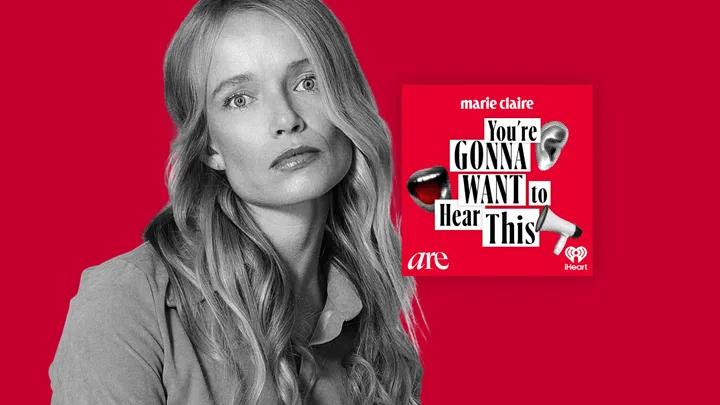
Jess Denham has spent much of her life being spoken about. In courtrooms, in headlines and in media reports. Now, in a powerful new episode of marie claire’s podcast You’re Gonna Want To Hear This, Denham is speaking in her own name, and in her own words.
Listen To You’re Gonna Want To Hear This
In conversation with marie claire editor Georgie McCourt, Denham opens up about surviving extreme childhood abuse, being legally silenced for years, and what it means to reclaim her story after more than a decade of being defined by what was done to her. “I have a voice now and I am speaking it,” she says. “I’m just doing it carefully.”
To the outside world, Denham was once known as a world champion runner. But behind closed doors, she was living under extreme control. Her father was not only her parent, but also her teacher and sports coach, while her mother was also involved in the abuse. Her parents are now convicted sex offenders, both serving prison sentences. “What you see on the outside is not necessarily what’s going on,” Denham says. “Or in my case, absolutely not what was going on behind closed doors.”
Raised on an isolated rural property and homeschooled, Denham says she had almost no outside frame of reference for what was happening to her. “I had no reference to go off,” she says. “I really didn’t have that. I didn’t have that at all.” Even running, the arena in which the public saw her excel, was shaped by fear. “I wasn’t celebrating that I was winning,” she says. “I was simply running to survive.”
Denham eventually went to police at 19, a decision she says took “absolutely everything”. She was terrified she would not be believed, and terrified that her abuser remained in the community while the case unfolded. “It took three months for me to do my statement,” she says. “That 10-year-long process of not knowing whether he would stay behind bars was absolutely terrifying each time.”
But the episode also marks a deeply significant first. For the first time publicly, Denham reveals that she lives with dissociative identity disorder, or DID. “Firstly, this is actually the first time that I will be publicly letting people know that I do have dissociative identity disorder,” she says. “It is a very misunderstood diagnosis… the stigma that comes with it.”
DID has long been sensationalised in films and popular culture, often depicted as frightening or dangerous. Denham is clear that this is not her reality. “I’m not dangerous,” she says. “This is where the stigma is.” For Denham, DID is a survival response to prolonged childhood trauma. “It was my mind’s way of surviving beyond things that were beyond what any human should survive,” she says. “Now in my adult life, I can see how certain alters and survival parts have really kept me alive. But it is also incredibly exhausting.”
She describes the daily reality of living with DID as a “constant pull-push” – from deciding what to wear or eat, to managing time, relationships and creativity. At times, she says, different parts of herself hold different abilities. She can pick up skills quickly, sometimes writes with her left hand, and says her body can even respond differently depending on which state she is in. “It is very busy,” she says. “And it’s incredibly busy for the people around me too.”
The episode also explores Denham’s advocacy work, particularly around the treatment of victim-survivors by the justice system and the media. Denham is campaigning for stronger protections around survivors’ counselling notes after her own private records were subpoenaed during legal proceedings and, she says, later leaked to a third party.
“I assumed my counselling was confidential,” she says. “That’s what you’re told. Counselling notes are not police statements. They’re not facts,” she adds. “They are your deep emotional feelings.”
Art, too, has become part of Denham’s survival and healing. As a child, she says, she found ways to create even when she was not allowed to draw. During the court process, it became essential. “I needed other forms of expressing myself that wasn’t just words,” she says. “To be honest, it kept me alive.”
For Denham, speaking now is not about being reduced to a diagnosis, a crime or a headline. It is about being seen as a whole person. “I’m surrounded by people that see more than just my trauma,” she says. “They see me as Jess.”
Her message to other victim-survivors is simple and powerful. “You’re not your worst chapter,” she says. “Your voice is valid, and you do have a voice, and there are people out there that do care, and do want to hear you, and do believe you.”
And for everyone else, Denham asks for more than sympathy. “We really have to start engaging more in the conversation around victims and survivors,” she says. “Not just listening, but actually pausing and taking a moment of what can we do better as a community.”
If this story raises issues for you, support is available. Contact 1800RESPECT on 1800 737 732 or Lifeline on 13 11 14.
Listen to the full episode of You’re Gonna Want To Hear This here
Sign the Keep Counselling Confidential petition here
*Jess Denham has given conditional consent to be named in this article. No other media outlet has permission to name Jess Denham, or to otherwise identify her or any other survivors or sexual assault complainants connected to this story.

Related stories

Native ad body.

Native ad body.




Native ad body.