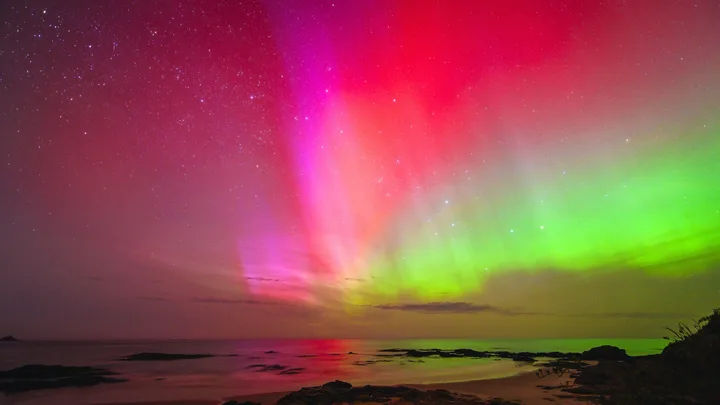
2026 is shaping up to be a remarkable year for sky-watchers, with the Bureau of Meteorology issuing an aurora alert as heightened solar activity moves toward Earth.
A major burst of energy released by the sun is expected to reach our planet from Tuesday evening into early Wednesday morning, significantly increasing the chances of vivid Aurora Australis displays across parts of Australia and New Zealand.


The event originates from a Coronal Mass Ejection, or CME, a phenomenon in which the sun expels an enormous cloud of charged particles into space. When those particles collide with Earth’s magnetic field, they can ignite the glowing ribbons of light known as the aurora, sometimes pushing sightings far beyond their usual southern latitudes.
According to the US National Weather Service’s Space Weather Prediction Centre, the incoming solar radiation storm has been classified as level four out of five on the severity scale.
“An S4 severe solar radiation storm is now in progress. This is the largest solar radiation storm in over 20 years,” the agency shared on X (formerly Twitter).
“The last time S4 levels were observed was in October 2003. Potential effects are mainly limited to space launch, aviation, and satellite operations.”
While the storm may temporarily disrupt satellite communications and affect GPS accuracy, it could also produce one of the most striking auroral events seen in the southern hemisphere in decades. The next 48 hours are shaping up to be the best window to look skyward.
The Bureau of Meteorology has issued an aurora alert for the next 48 hours from January 19, giving sky watchers across Australia reason to look up.
While sightings are never guaranteed, conditions could align if skies remain clear, light pollution is minimal and solar activity interacts favourably with Earth’s magnetic field.
The alert spans a wide geographic area, though the strongest viewing conditions are still expected in Australia’s southern states. Residents in Victoria, Tasmania, South Australia and southern Western Australia are likely to have the clearest opportunity to see the lights.
However, heightened solar activity can push the aurora well beyond its usual reach, increasing the chance of sightings further north. In particularly promising news for aurora chasers, geomagnetic storm conditions have reached G4 levels, the second-highest rating on the geomagnetic scale, with scientists noting there is even a chance of G5 activity.
For the most accurate timing, experts recommend monitoring live space-weather data as forecasts sharpen once the coronal mass ejection’s path becomes clearer.
Real-time updates are available via the NOAA Space Weather Prediction Center and the Bureau of Meteorology, which provide ongoing guidance on visibility, intensity and peak viewing windows.
Auroras are typically most active in the hours around midnight, with the strongest viewing window typically falling between 10pm and 2am local time.
The NOAA Space Weather Prediction Center has identified peak viewing windows, though the strength of tonight’s geomagnetic activity means displays could begin earlier in the evening and linger closer to dawn.
| Time Zone | States / Territories | Local Time |
|---|---|---|
| AEDT | NSW, VIC, TAS, ACT | 11:00 pm – 3:00 am |
| ACDT | South Australia | 10:30 pm – 2:30 am |
| AEST | Queensland | 10:00 pm – 2:00 am |
| ACST | Northern Territory | 9:30 pm – 1:30 am |
| AWST | Western Australia | 8:00 pm – 12:00 am |
The spectacle is being driven by a powerful geomagnetic storm, triggered when a solar flare sends charged particles hurtling from the Sun during an event known as a coronal mass ejection.
As these particles reach Earth and interact with its magnetic field, they collide with gases in the upper atmosphere, causing them to glow in luminous bands of green, pink and violet. The phenomenon, known as the Aurora Australis or Southern Lights, is the visible result of this solar activity meeting our planet’s atmosphere.
The strength of the geomagnetic storm is crucial. The more intense the disturbance, the farther north the lights can travel, increasing the chance that regions beyond their usual polar range may witness the display.

Related stories

Native ad body.

Native ad body.



Native ad body.