From Elon’s AI tool Grok being used to make sexualised images of women and children, to the now-viral clip of author Anna Funder calling for copyright protections to stop the scraping and stealing of creative work, much of what has followed the AI boom – sparked by ChatGPT’s 2022 release – has been downright depressing.
But it’s not all bad news. Advanced machine learning is a breakthrough technology with enormous potential and, in the hands of these women, it’s being leveraged as a force for good.
Grace Brown CEO & Co-Founder of Andromeda Robotics
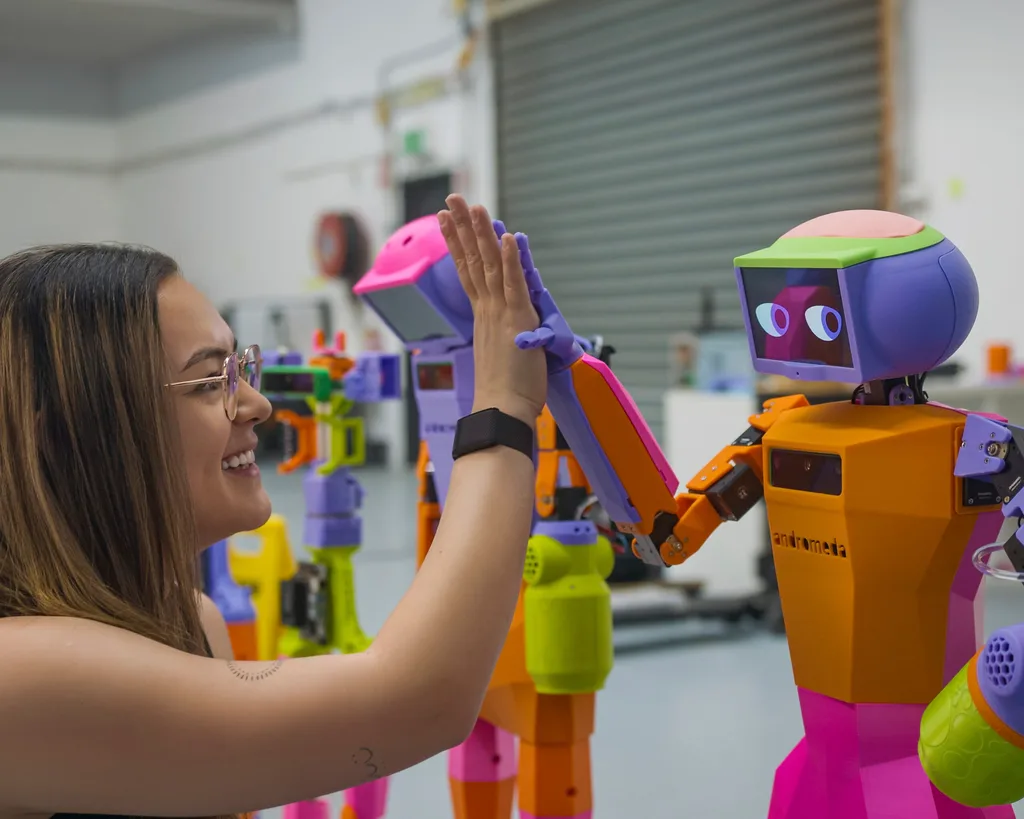
“I was watching a lot of Pixar movies and became fixated on the idea of a character that could offer presence and companionship, not to replace people but to be there when people couldn’t be,” remembers Grace Brown of the moment she started to dream up Abi, an AI-powered companion robot for residents in aged care.
She was studying engineering at the University of Melbourne during lockdown and living alone in a dorm room with almost no human contact.
But the moment the 25-year-old knew she was really onto something came when she saw her humanoid robot – brightly coloured and capable of blowing bubbles, playing a mean game of bingo and conversing fluently in more than 90 languages – change the emotional state of a real person.
“There’s a weight to that. It raises the bar instantly,” says Grace, who has since transformed the early-stage concept of Abi into Andromeda, a venture valued at $US100 million and which is redefining the future of aged care. “From that moment on, ‘cool tech’ stopped being the goal,” she says. “Meaningful impact became our North Star.”
It’s a worthy mission. In Australia, it’s said that 40 per cent of people living in aged care will never receive a visitor.
But Abi is also helping solve more complex challenges. Grace recalls one resident with severe cognitive decline who once spoke English but now can understand and communicate only in Chinese.
No other residents or staff spoke the language, leaving him linguistically isolated. “Abi was the first interaction he’d had in his native language in a very long time. After just their first visit, he and Abi began reading Chinese poetry together.
Other residents, even those who didn’t understand the language, started gathering to sit and listen. It became a shared moment of presence rather than conversation.”
The seemingly limitless potential of Abi to do good is part of why Grace has recently moved to San Francisco, placing her closer to investors and at the centre of a start-up ecosystem with second-to-none software engineering and innovation talent. (In a full-circle moment, two of her first hires in the US were character animators who have worked on Pixar films.)
“People assume the danger is that robots will become too human. The real danger is building technology that’s powerful but emotionally careless,” says Grace.
“Robots shouldn’t just be intelligent, they should be designed with restraint, empathy and an understanding of what makes life meaningful. That’s the work we’re actually doing.”
Raphaelle Taub CEO & Co-Founder of Matricis.ai
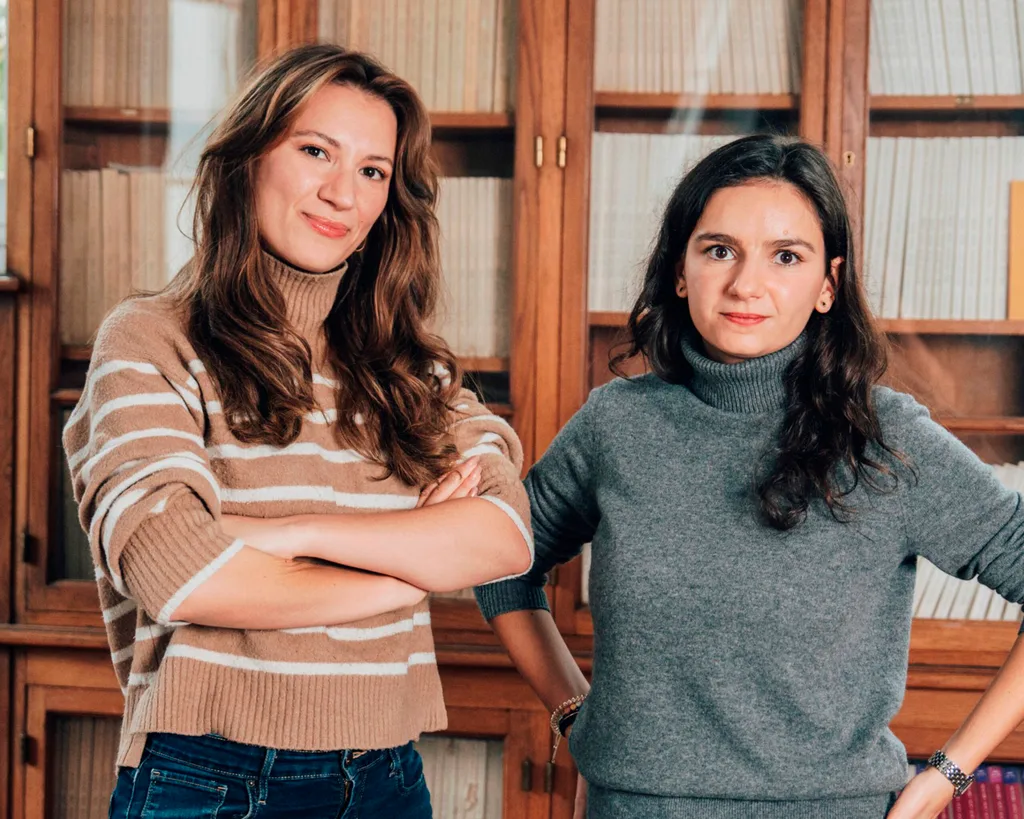
Endometriosis affects one in 10 women, but despite its prevalence it takes an average six-and-a-half years to be diagnosed in Australia.
“It’s a vicious cycle,” says Raphaelle Taub, co-founder and CEO of Matricis.ai. “Many women don’t realise their symptoms may be a disease, so they delay seeking care. When they do, endometriosis is still often under-recognised, and patients aren’t referred early enough to the right exams. Even when MRI is performed, up to 60 per cent of cases are missed.”
It was this reality, as well as Matricis co-founder Elise Mekkaoui’s experience with the condition (it took four years of medical wandering before her diagnosis), that led the Paris-based pair to found Matricis.
The AI-powered tool is trained on the world’s largest dataset of endometriosis MRIs annotated by expert clinicians, using advanced imaging and computer vision to help radiologists detect the disease earlier and more accurately, reducing missed diagnoses and shortening the path to treatment.
“For the patient, the experience is exactly the same,” says Raphaelle. “She has a standard MRI, but the result is clearer, more reliable and often faster.”
A physicist by training, Raphaelle has learnt that being entrusted with people’s health carries a responsibility that cannot – and should not – be taken lightly.
“The start-up motto ‘move fast and break things’ does not work when human lives are involved. That’s why we hold ourselves to very high safety and clinical validation standards,” she says. In gynaecology, she notes, trust is even more critical.
“Patients are deeply involved in decisions about their care. A reliable AI can foster better conversations between patients and doctors by providing a shared, objective reference. That’s what we aim to enable.” While endometriosis is their first case study, the pair have no shortage of ambition.
“More than 550 million women worldwide are living with gynaecological diseases,” says Raphaelle, pointing to a field shaped by decades of neglect. “Endometriosis is just the beginning for us.”
Jenny Wang Founder of Alta
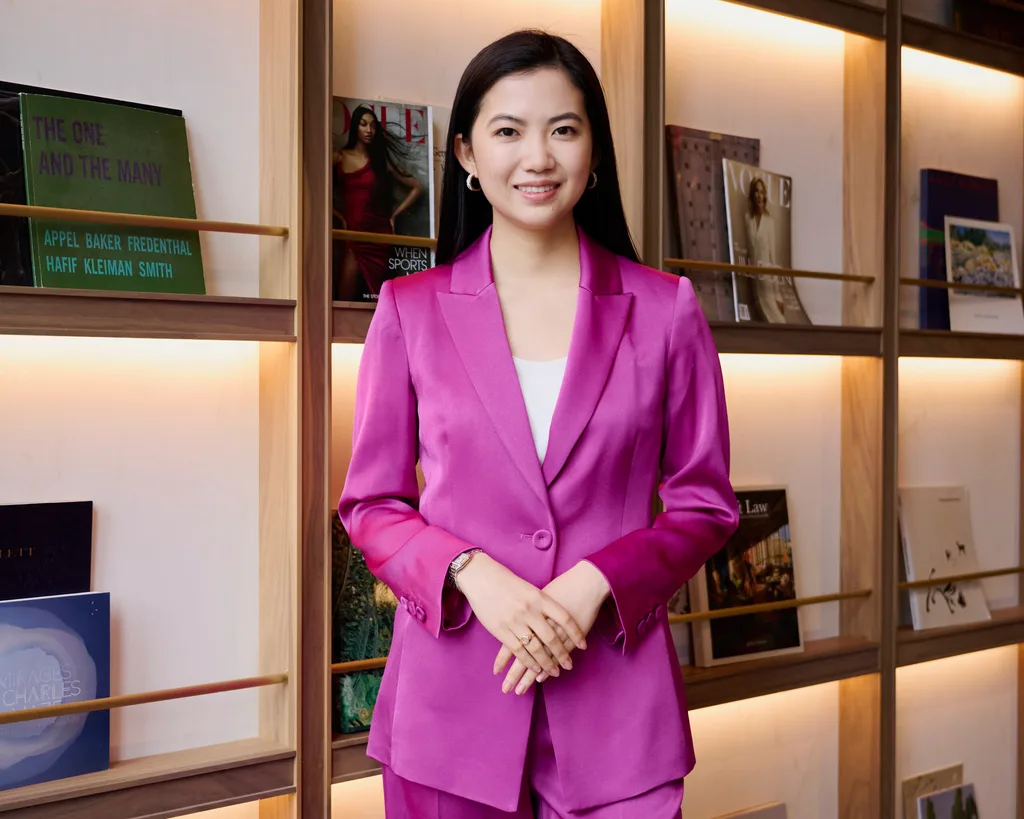
“When I was in college a decade ago, I desperately wanted a digital closet,” says Jenny Wang, echoing the wish of nearly every teenage girl since Clueless was released in 1995. But the apps that existed were too hard to love.
“The photos were ugly, lopsided shots of clothes on the floor or wrinkled bedsheets, and the process demanded far too much manual effort,” explains the 29-year-old, who studied computer science at Harvard before going on to work at various tech companies.
Collaging outfits, tagging pieces, writing captions and then somehow visualising it all proved as stressful, if not more so, than standing in front of her wardrobe and realising, “I have nothing to wear!”
That began to change in 2022, when advances in large language models like ChatGPT made it possible to imagine a different approach.
Using AI, Jenny saw an opportunity to make onboarding “as magical as possible”, from identifying items directly in a user’s camera roll to auto-tagging pieces and generating polished flatlay images that make a closet feel like its own ecommerce store, as well as creating outfit combinations and enabling virtual try on through avatars.
Fast forward to now and Alta, Jenny’s app that does just that, is generating more than 100 million outfits for users annually.
Backed by fashion heavyweights including Australian super sourcer Gab Waller, LVMH-backed venture capital firm Algaé Ventures and Michelle Obama’s stylist Meredith Koop, the platform learns in real time, refining its understanding of a user’s personal style and offering shopping recommendations that complement what they already own.
“Each new day is an opportunity to improve our AI styling and to make the app even more delightful to use,” says Jenny, who is now working with her team to develop hair and makeup recommendations that align with outfits and can be visualised on each user’s Alta avatar.
Fleur Anderson Program Director at Enterprising ME
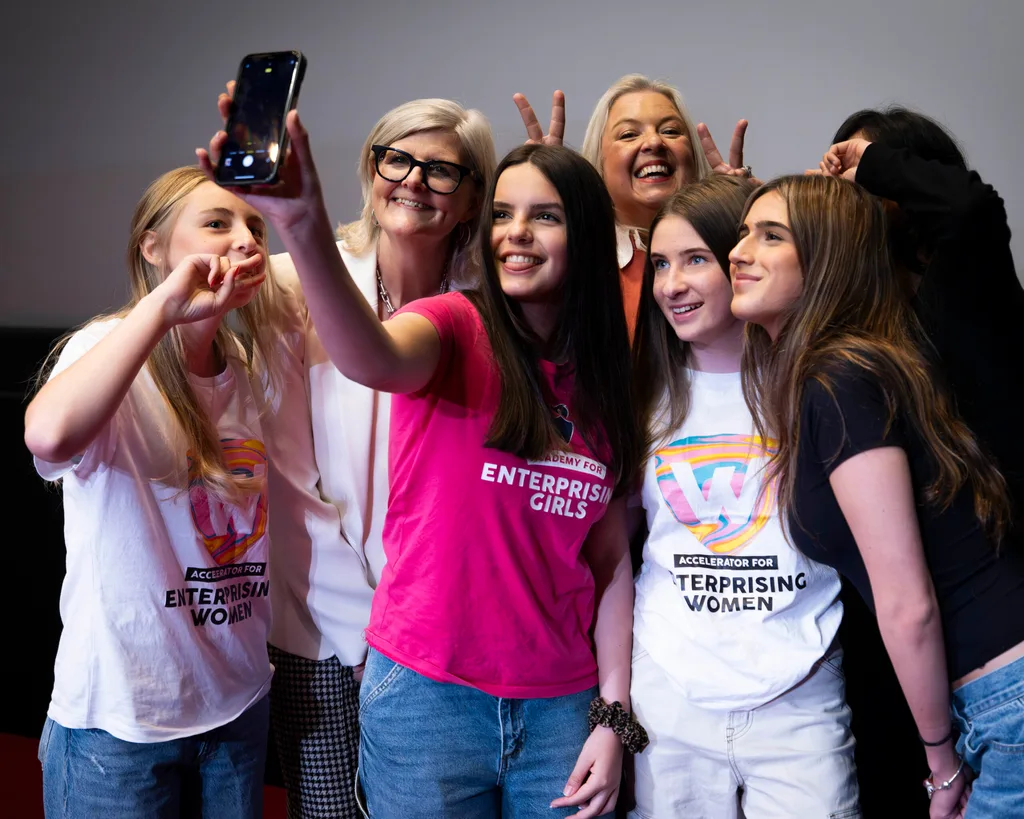
In her role as director of programs for the Academy for Enterprising Girls and Enterprising ME, Fleur Anderson kept hearing the same thing again and again: I want a mentor, but I don’t know how to find one.
“If you’re not in a capital city or don’t already have strong networks, mentorship can feel out of reach,” explains the former vice-president of the federal parliamentary press gallery.
So her team set out to build an AI mentor – one that could distil the collective wisdom of the Enterprising Women community and make it available anytime, anywhere, in a safe and trusted space.
“Naming her Carla was an absolute lightbulb moment,” remembers Fleur, adding, “Carla Zampatti embodied everything we want women to feel permission to be: ambitious, resilient, elegant and unapologetic.”
When discussions took place with Zampatti’s family, a more formal version of her name was initially proposed. To everyone’s delight, the late designer’s son and CEO of the Carla Zampatti brand, Alex Schuman, responded simply: “Why wouldn’t you call her Carla? Mum would love it.”
Purpose-built as a resource for female entrepreneurs, Carla is trained on more than 663 minutes of interviews with female founders, 300 toolkits and reports, and 750 minutes of original video content. “Her guidance isn’t scraped from the internet,” Fleur explains.
“We’ve built strong guardrails so the advice is practical, realistic and grounded in what actually works in Australia.” The model has also been designed to address gender bias in AI.
“Many platforms default to confidence-boosting responses, even when ideas aren’t viable. Carla doesn’t do that. She challenges bias, redirects and supports women with evidence-based guidance because false reassurance doesn’t help anyone build a business.”
Launched in November last year, the program is still in its early stages, with Fleur particularly excited about expanding Carla’s accessibility for culturally and linguistically diverse women.
But what she’s proudest of is that they’ve “never tried to make Carla pretend to be human”, instead positioning her clearly as an AI mentor that is thoughtfully designed, respectful and transparent.
“Ironically, at the launch and sitting beside Alex and the Governor-General Sam Mostyn, there was a moment where Alex quietly said, ‘She’s just like Mum.’ That’s something I’ll never forget.”
Michaela Loukas 2025 NSW Young Scientist of the Year
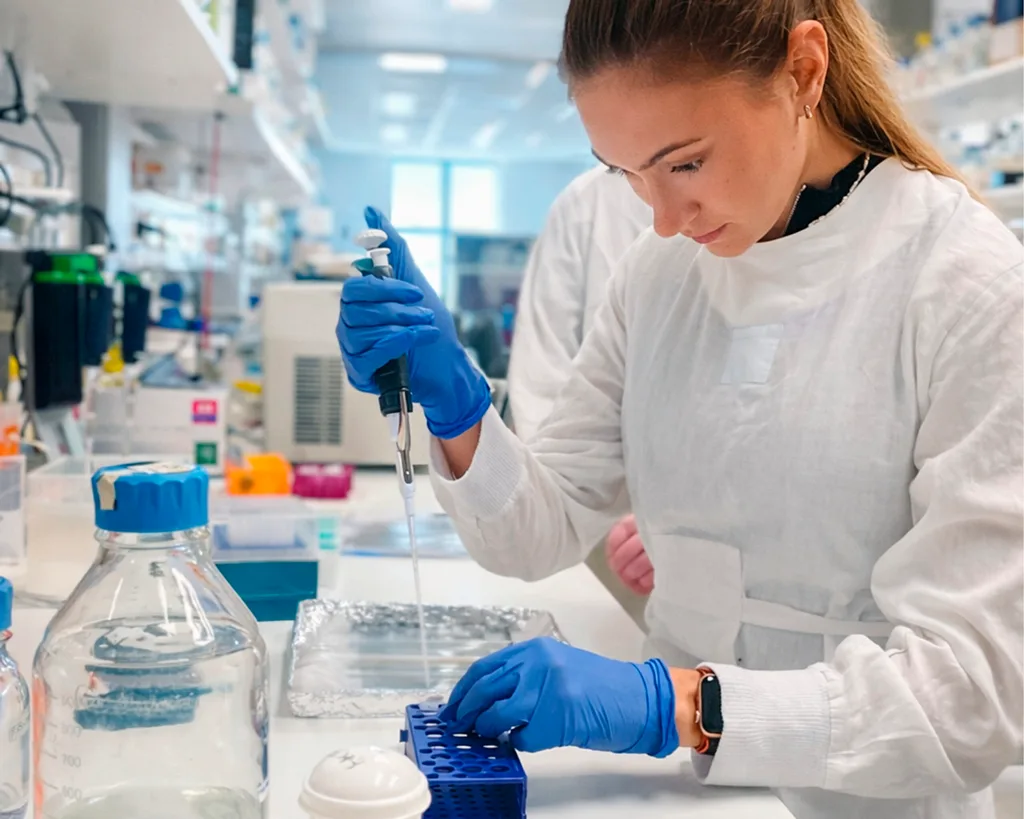
“I don’t have a name for her yet,” Michaela Loukas with a laugh of the AI breast cancer detection model she created as part of her HSC science course and which is – astoundingly – able to identify malignant tissue with 98 per cent accuracy.
“Part of the reason I focused on breast cancer,” the 18-year-old explains, “was that, yes, it was the database that was most accessible. But when I was starting my research, there was nothing like this that existed. In Australia, there’s one test considered the gold standard for molecular-level breast cancer detection, but it doesn’t leverage AI – it uses a statistical algorithm instead. And it costs $5000.”
A family friend who did that test had to wait weeks for the results after her biopsy was sent to the US; for Michaela, that period represented the difference between “catching the cancer early or it metastasising”.
As news of her tech’s potential has spread, “Venture capital firms have been reaching out to me on LinkedIn, asking, ‘What’s the plan with the model? Can we invest?’” But further development (and naming) of what she calls “my baby” will have to wait, although her research is currently being peer reviewed by a science journal.
“It’s something I’ve been thinking about a fair bit with my mum, and we’ve both agreed that university comes first.”
This year, she begins a double degree at UNSW, combining engineering with a specialisation in bioinformatics and advanced science majoring in genetics.
Michaela’s perspective on AI as an educational tool is a lot more upbeat than one might expect from a brainiac just named the 2025 young scientist of the year by the Science Teachers’ Association NSW.
“I’m going to be completely transparent: I leveraged ChatGPT a fair bit in years 11 and 12,” she says of her use of prompt engineering – the process of writing effective and detailed instructions for a model – to edit and ensure her work was to the highest standard.
“I’d feed it all this information about the HSC syllabus and I would write two, three pages worth of really specific prompts,” she says, adding, “I personally believe that that’s where AI can be used for good … to speed the work up and make processes more efficient.” It is also why she believes AI should be approached with curiosity rather than just caution.
“People should be excited about using it to really maximise and even further their potential and what they’re able to produce.”

Related stories

Native ad body.

Native ad body.


Native ad body.