NEED TO KNOW
- Hailey Bieber recently spoke with journalist Andrew Ross Sorkin during The New York Times’ 2026 DealBook Summit, with her answers sparking debate online.
- Social media users questioned Bieber’s responses regarding Rhode’s business strategy and billion-dollar valuation, with many thinking she could have gone further into explaining her strategy.
- Speaking to Rhode’s success, Bieber said she held a sense of “optimistical delusion,” a phrase she has since defended on Instagram.
- The interview also sparked debate about the distinction between traditional journalism and celebrity-led content, with some defending Sorkin’s questioning and others supporting Bieber.
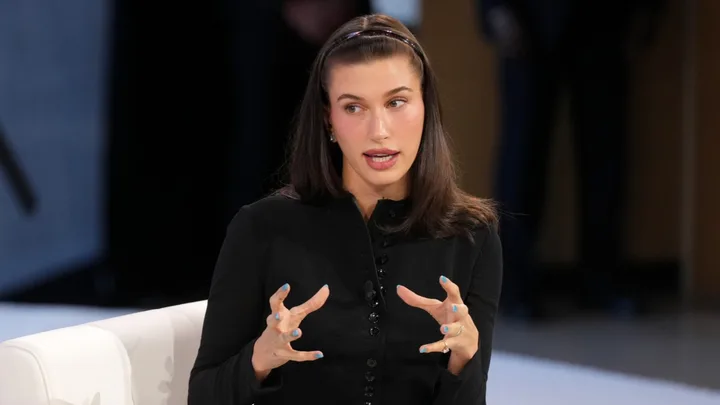
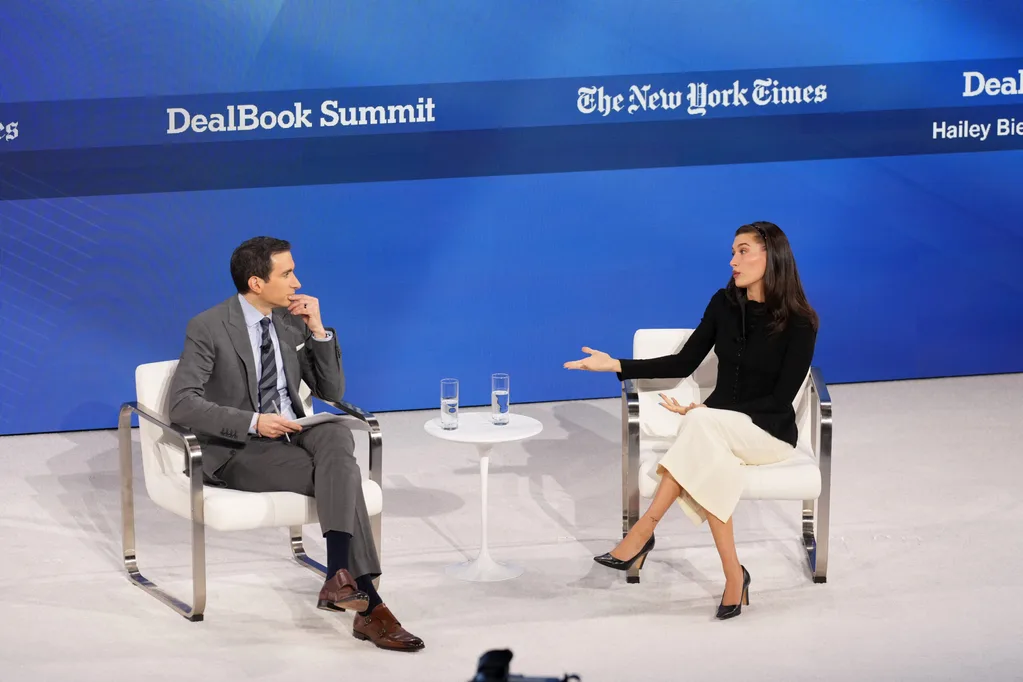
On Wednesday, November 18, Hailey Bieber sat down with Andrew Ross Sorkin, columnist and founder of The New York Times’ daily business and policy report, DealBook, for a wide-ranging conversation about her beauty empire, Rhode, and her relationship with social media at the annual DealBook Summit.
Bieber was among a weighty lineup of speakers, including Elon Musk, OpenAI’s Sam Altman, Microsoft CEO Satya Nadella and New York City Mayor Zohran Mamdani. The annual summit brings together some of the most influential figures spanning business, finance, politics and culture for a series of live, on-stage interviews, having previously hosted the likes of Kim Kardashian, Serena Williams, Gwyneth Paltrow and Call Her Daddy’s Alex Cooper.
Initially, much of the discourse surrounding Bieber’s appearance centred on her vesitary homage to Carolyn Bessette-Kennedy, whereby Bieber wore a black wool-blend jacket from Yohji Yamamoto’s Spring/Summer 1998 collection, the same design Bessette-Kennedy was photographed wearing to a fundraiser alongside John F. Kennedy Jr. in June 1998.
However, the conversation has since swelled beyond Bieber’s outfit to encompass a broader scrutiny of her business acumen, with a flurry of social media users questioning the beauty mogul’s apparent inability to answer seemingly straightforward questions about her own beauty empire.
What Did Hailey Bieber Say During Her New York Times Interview?
RELATED: An Investigation Into Hailey Bieber’s Extensive Face Mask Collection
Sorkin opened the approximately 20-minute interview by introducing Bieber as something of a cultural arbiter, whose influence extends beyond the beauty industry into the broader economic landscape.
“We spend a lot of time at DealBook talking about people who shape the economy, and our next guest shapes the economy but increasingly, some of the most consequential business stories, I think, begin with people who really also shape culture. And few people understand that intersection better than our next guest, [Hailey Bieber].”
He continued, “In 2022…[Bieber] launched a beauty brand called Rhode, and less than three years later e.l.f. Beauty acquired Rhode in a deal worth up to $1 billion…There’s a lot of people who had celebrity and had followers but didn’t create a brand like this.”
Speaking directly to Bieber, Sorkin asked, “if you could sort of take us back in time, I think we all want to try to understand, maybe through osmosis, what you think you understood that everybody else hasn’t.”
Bieber attributed Rhode’s success to its authenticity, suggesting that consumers had connected with the brand precisely because it felt like a natural extension of herself.
“My hope with why I think people really resonate with the brand is because they can feel that Rhode is me and I am Rhode and it’s really just such an extension of my personality and the things that I love.”
She also touched on the importance of world-building, explaining how her ambitions for Rhode extended beyond the products themselves.
“I wanted to build a whole entire thing around the brand, from the products being great, to the packaging being great, to the branding being great, to the storytelling being great.”
Sorkin subsequently questioned Bieber’s strategy, suggesting that, at times, she appeared to portray Rhode’s success as something almost fortuitous rather than the product of deliberate business decisions.
Bieber agreed with this, saying, “I think the consumers are really smart and I don’t think they connect well to things that just appear out of thin air.”
She elaborated on how she believes skincare had long been synonymous with her personal brand, revealing that she had spent approximately two years sewing the seeds prior to Rhode’s launch in an effort to cultivate consumer trust.
The conversation then turned to Bieber’s initial ambitions for the company, with Sorkin questioning whether she had always foreseen Rhode reaching a billion-dollar valuation.
“A billion dollars was the number that I said I would not sell it for less than that…But that felt like a crazy, like, that’s like shooting for the star star star star stars,” Bieber said.
Sorkin pressed her on what had given her the confidence to believe such a valuation was attainable, asking, “Really? Why did you think that you could do that?”
“Delusion,” she replied. “You have to have a certain sense of optimistical delusion.”
Beyond the business of beauty, Bieber also reflected on her complicated relationship with social media. Despite having relied on the platforms to cultivate both her public persona, her brand’s aforementioned “world-building”, and her burgeoning beauty community, she acknowledged their potentially damaging psychological effects.
“It can be distorting to the mind, especially those filters that change your face — they make your lips bigger, your nose smaller,” Bieber said. “That definitely can be harmful and misleading, 100 percent. But it’s part of the world we’re living in; it’s not going anywhere.”
She also spoke about the hostility she has weathered online, revealing the extent to which negative commentary had affected her mental health. “I had people telling me to kill myself in the comments every single day,” she said.
“The way people were making me feel was that maybe it would be better if I wasn’t here anymore, because that’s how intense I felt other people’s feelings were toward me.”
Looking to the future, Sorkin questioned Bieber about her ambitions beyond Rhode. While she revealed that she already had another venture in mind, Bieber remained tight-lipped about its particulars, instead doubling down on her commitment to Rhode for the foreseeable future.
“I’m definitely in the very early stages of thinking about what I want to be doing and where it’s going next, but I’m also really, really clear about wanting to stay incredibly involved in Rhode and I’m not going anywhere anytime soon.”
Sorkin also revisited an earlier admission from Bieber, where she said se didn’t like confrontation. “The other thing that I was fascinated by- you said, I guess you were 24 when you said you said you couldn’t you can’t stand confrontation.”
“You’re really pulling all the quotes, I’m like ‘when did I say that?'” Bieber replied.
Sorkin continued, “I go back and I look, and you’ve just gone through this whole process, and so I wonder, I imagine you have to hire people and maybe fire some people too. So have you have you gotten over the confrontation bit?”
While Bieber stopped short of directly addressing whether she had overcome her aversion to confrontation, she explained that, as Rhode had grown, she was no longer involved in “that side of things anymore.”
So, What Was So Controversial About Hailey Bieber’s Answers?
Beyond the superfluous criticism that inevitably cleaves to celebrity interviews, some of Bieber’s fans appear to believe she failed to fully capitalise on the opportunity.
On Instagram, social strategist Holly Hayes (@hollyflhayes) was among a growing chorus of commentators dissecting Bieber’s answers, suggesting the interview had presented a rare opportunity for the Rhode founder to demonstrate her business acumen beyond the cultural cachet of her celebrity.
“Hailey Bieber had the perfect opportunity to prove that she is more than just the face of a billion dollar brand and I think she completely missed it,” Hayes said in her video. “I wanted her to show the receipts, because that interview was her opportunity to prove everybody wrong who’s just called her another celebrity with a beauty brand.”
Her criticism also stemmed from Hailey slightly side-stepping a question posed by Sorkin: why do some celebrity-founded brands enjoy meteoric success while others struggle to establish a foothold? After all, the graveyard of celebrity beauty brands is ever-expanding, with casualties including Kim Kardashian’s KKW Beauty and SKKN by Kim, Scarlett Johansson’s skincare line The Outset, Addison Rae’s Item Beauty and Serena Williams’ Wyn Beauty cosmetics.
Hayes argued that Bieber had an opportunity to distinguish herself from the growing litany of celebrities who have just slapped their names to beauty ventures. “[Bieber] had a point to prove here that she wasn’t just another nepo baby, she wasn’t just another celebrity with a brand, she was actually an entrepreneur in her own rights. So why would she not use this interview to really challenge that narrative?”
She continued, “When the journalist questioned her billion dollar ambitions, I wanted her to push back and say because I’m worth over a billion dollars, because my brand is shaping culture, because my husband has shaped culture, music, style. That’s why I think my brand is worth over a billion dollars.”
A similar sentiment was expressed by content creator Emma-Louise Boynton (@emmalouiseboynton), who took issue with suggestions that Sorkin’s line of questioning had been unnecessarily harsh or dismissive of Bieber’s achievements.
“Why do people think Hailey Bieber shouldn’t have to answer basic business questions about her billion dollar business at a live business event,” she began.
“While there are Reddit threads and videos claiming that Sorkin was too challenging of Bieber, that he was dismissive of her brand, that he was using an old-school gotcha-style journalism. He was anything but.”
Boynton went on to argue that the proliferation of influencer-led content, often characterised by curated conversations and top line questions, has blurred the distinction between promotional interviews and traditional journalism.
“Contentification of everything has meant that our feeds are saturated with sound bites of interviews where celebs and founders alike are being asked pretty generic, peppy questions…none of this is inherently bad, it’s just not journalism,” she said.
She continued, “The job of a journalist is to ask probing, pressing questions, not to try and flatter the person in front of them.”
Boynton also suggested that the interview could have benefited from further questioning of Rhode’s business strategy.
“I would have loved to see him press her more on the minutiae of Rhode’s world-building, something she alluded to at the beginning of the interview but didn’t really go into much detail about.”
She concluded, “It’s not sexist for a journalist to ask someone why they thought they could sell their first early-stage beauty startup for a billion dollars.”
Others, however, were more defensive of Bieber, arguing that her casual, conversational manner of speaking should not be conflated with a lack of intelligence or business acumen. After all, Sorkin is a seasoned journalist whose delivery is characteristically concise and direct, and whose questions would have been prepared in advance.
Bieber, comparatively, was responding to his questions in real time, which could have easily contributed to the perceived disparity in their respective articulacy.
Moreover, Sorkin appeared genuinely interested in Bieber’s answers, asking her questions that seemed to emerge organically from her responses, including her observations about the ASMR phenomenon.
While we have little doubt that viewers will continue to pore over Bieber’s choice of language (she has since taken to her Instagram Stories to clarify that “optimistical” is, in fact, a real word), the broader discourse surrounding the interview seems to speak to the increasingly blurred distinction between impartial journalism and content creation.
Perhaps audiences have become so accustomed to celebrity interviews characterised by warm, cursory conversations that a journalist’s genuine curiosity and willingness to probe beyond the pleasantries can feel unusually confrontational, even when the questions, and indeed the answers, are entirely reasonable.

Related stories
Native ad body.

Native ad body.




Native ad body.