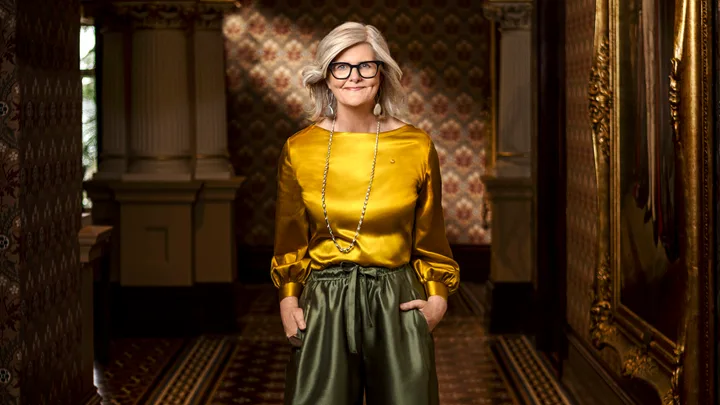
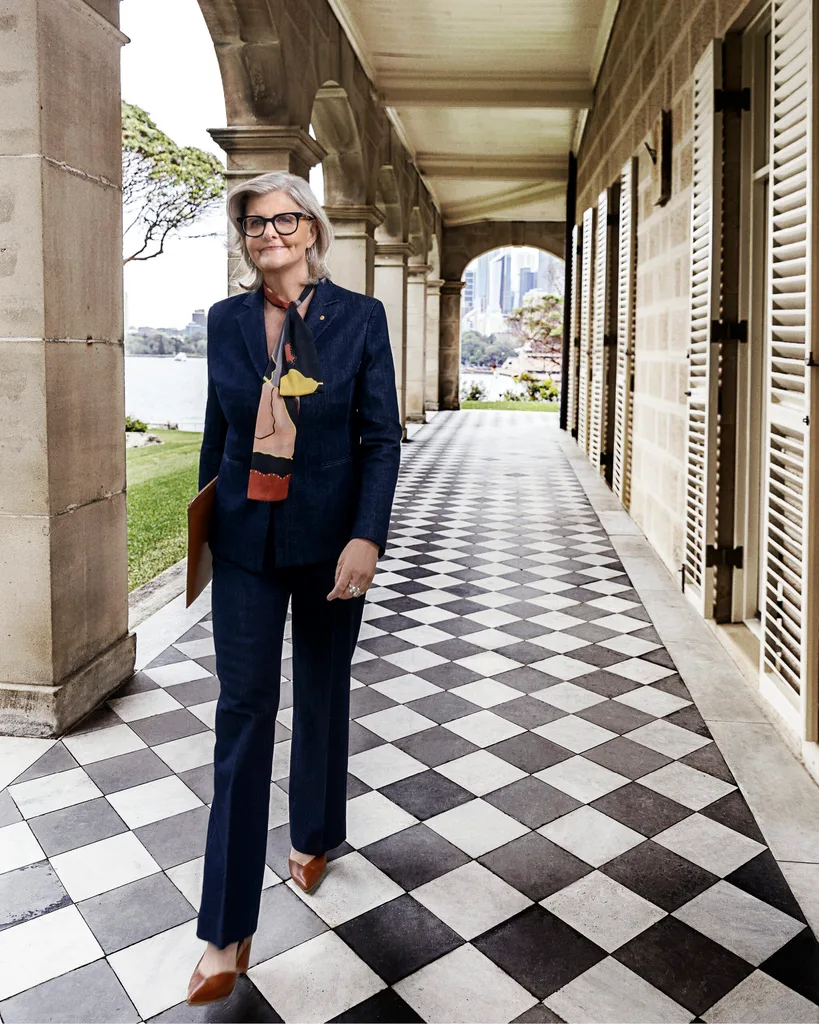
Sam Mostyn arrives at the marie claire office in Sydney wearing a sleek Italian-cotton denim suit by Australian label Eupheme, a stack of miniature Constitutions tucked inside what she refers to as her “Mary Poppins” bag.
She asks if I might like one for my daughters. When I say “yes”, she asks how to spell their names, stops to check the letters, and writes a message about curiosity and courage in blue ink before signing it, formally, Governor-General of Australia.
This is not an ordinary day in the office for me. It is both entirely official – several members of her security team are with her – and unexpectedly intimate. I barely see them, even though I know they’re there.
She orders a flat white – disarmingly unfussy – as I overcomplicate things with a decaf oat cappuccino (I know, why bother, right?).
“I love these conversations,” she tells me as we sit down. She listens without interrupting, answers without rushing and takes care with each question I throw at her. The title she carries is heavy with history and constitutional gravity, yet in person she is warm, self-aware and quick to laugh, particularly when I confess that, until preparing for this interview, I hadn’t properly understood how someone actually becomes Governor-General – beyond knowing it’s not a role you apply for on LinkedIn.
“You’re certainly not alone,” she says. The process is both simple and extraordinary. The Prime Minister chooses a candidate, refers that choice to the Crown and, historically, the recommendation is not rejected.
There is no public campaign, no nomination form, no lobbying tour. In Mostyn’s case, it began with an invitation to Kirribilli House on a sweltering January afternoon. She assumed it was about a report she had just completed on women’s economic equality (Mostyn has long been a leading advocate for gender equality).
“So, I took the report with me,” she says. Instead, after a few minutes of small talk, came a question that would recalibrate her life: would she allow herself to be considered for the role of Governor-General? (It’s important to note that up until this point, there had only ever been one woman in this role, Dame Quentin Bryce, who was appointed back in 2008.) “I remember thinking, ‘Is this happening?’ And then, ‘Why me?’” she recalls. (An aside, even the GG herself experiences impostor syndrome. Yes, none of us are immune.) “I kind of clicked into, ‘Haven’t you thought of some others? I thought there were other people.’” The Prime Minister needed only to know whether she was prepared to be considered.
She and her husband, Simeon, were given 24 hours. They could not seek advice, nor could they discuss it beyond their immediate family. “It was highly confidential,” she says. “Hard to sleep. I kept imagining what it would mean.”
In the middle of those conversations, with the constitutional weight of the office pressing against the practical reality of security, relocation and life rearranged, her daughter asked a question that has stayed with her: “Will it make you happy?” “When she said it, I just remember my shoulders dropped,” Mostyn tells me.
“I thought, ‘That’s the question, isn’t it?’” It was not a question about the job being easy or comfortable – because they all knew it would be neither. “I don’t think she was asking if I would be joyfully happy or if every day would be easy,” she clarifies. “It was a profound question that a child can ask a parent. ‘I just want you to be a happy person – and will this help make you happy?’”
We speak often about service and sacrifice when we talk about leadership, but rarely about happiness as a serious decision-making tool, particularly for women. “You don’t do these things for any other reason than, in some sense, deep purpose or happiness,” Mostyn says. “Other things you’re going to give up, the difficulties you might face – is there something that counterbalances that about your own sense of deep, personal happiness?”
In that moment, she realised that service is where she feels most alive. “This is where I’m most happy, other than family joy. I’m happy when I’m serving. I’m happy when I think I can make a difference.” She pauses. “Despite how hard it would be, I knew at some level I could be happy in the role.”
Yet, even then, despite all of her achievements and experience, she had prepared herself for rejection. She assumed – as so many women do – that the job wouldn’t be hers. “I had talked myself into believing that when the call came, it would be one way,” she admits. “I’d say, ‘Thank you for thinking of me, I’m very grateful I was in the mix.’” When the second call came confirming she’d got the job, she was speechless. That instinct to pre-emptively shrink or rehearse disappointment as self-protection is something she recognises as familiar among women in leadership.
“Generally, I think we’re preparing ourselves for what we think is, ‘It’s not going to be me. Nice to be asked,’” she says. She would like to see more women move beyond that reflex. “I’d like to think there are more women who begin to think, ‘Actually, knowing myself, knowing what I can do, I should be confident enough both to put myself forward and also think that it just might be me.’” Mostyn is acutely aware that, for many Australians, the role still carries the imprint of masculine tradition. “I knew I wouldn’t represent what some people thought the Office of Governor-General should look like,” she says.
The idea of Commander-in-Chief has long been coded male, and some critics were quick to question whether a woman without a military background could embody it. “There’s still an underlying assumption that power looks a certain way,” she reflects. “But leadership is not confined to one archetype.”
As the nation’s 28th Governor-General, she occupies a role historically shaped by military and judicial men.
Her background – corporate governance, climate advocacy, mental health reform, women’s sport – subtly shifts the profile of national authority. Mostyn grew up as the eldest of four girls in what she describes as a deeply loving, service-oriented family, the daughter of an army officer and a mother who had been university-educated but chose to devote herself to raising her children and supporting her husband’s postings. Mostyn was school captain in primary school and later a councillor at high school.
She was, by all accounts, an extremely high achiever. “I think I had classic eldest child syndrome,” she says with a laugh. “I was the nerd. The good kid.”
One sister once told her she’d been “born 30” – serious, responsible and always putting her hand up. There was frequent moving in her early years – new schools, new friendships to navigate and a sense that she needed to set an example for the younger ones. When her father was deployed to Vietnam, her mother moved with Mostyn and her three siblings to Glenelg, a beachside suburb of Adelaide, to live with their grandmother.
“I think maybe all those things had a profound effect on me,” Mostyn reflects. “Watching what she was doing and how much she gave.” There is, she points out, no formal honour for the spouses whose lives are reshaped by service. “There isn’t an Australian honour award for an army wife.”
At 60, Mostyn has lived many lives. Long before she entered Government House, she built a reputation as one of the country’s most influential corporate and civic leaders. Trained in law (she has Bachelor of Arts and Bachelor of Laws degrees from the Australian National University), she held senior executive roles at Optus, Cable & Wireless and, later, insurer IAG. She served on major corporate boards (Transurban, Citibank Australia and Virgin Australia).
She chaired Aware Super, Beyond Blue, the Foundation for Young Australians and the Climate Council, shaping national conversations around sustainability, mental health and intergenerational equity.
Earlier, she had served as a senior adviser to Prime Minister Paul Keating, sharpening her understanding of how institutions function. In 2024, she was appointed a Companion of the Order of Australia (AC) for eminent service to social justice, gender equity, business and sustainability.
Like I said, an extreme high achiever. Her influence within sport, in particular, has been exceptional. In 2005, she became the AFL’s first female commissioner, serving until 2016 and playing a central role in the establishment of the AFLW competition.
Following her tenure as commissioner, she served as a director of the Sydney Swans for six seasons from 2017. The Mostyn Medal, awarded to the best and fairest player in the AFLW Sydney Premier Division, bears her name. She also co-founded the Minerva Network, mentoring elite female athletes as they navigate life beyond sport. “Sport reflects our community,” she once noted.
“If it’s not inclusive, neither are we.” What a career. But also, what a woman. What has surprised Mostyn most since stepping into constitutional office is the scale of access – not to power, but to people. “I have the ultimate privilege in this country to be in communities and meeting brand new people every single day,” she says. “I never underestimate that for the person who’s meeting the Governor-General. In that moment, I have to give my absolute best self and show them that I care deeply about them and their community.”
The role has taken her from suburban community halls to Buckingham Palace drawing rooms. When she met King Charles III ahead of her appointment, she was struck by his attentiveness. “He was deeply interested in Australia – not in a formal way, but personally,” she says. “He asked about the communities I was meeting, about climate, about our First Nations stories.” Sitting across from the monarch as his Australian representative carried a weight of history. “You think about the line of history, about all those who have served before you,” she admits. “But ultimately, the conversation is about Australia – about who we are and what we’re building.”
Her office is apolitical, but that doesn’t mean she’s immune from scrutiny. “Anyone who steps into high public office knows there is a lot of criticism,” she says. Not to mention the fact that social media means judgement now arrives instantly and often anonymously. “You are often faced with a barrage of criticism – justified or otherwise, generally otherwise.” Much of it is gendered. “I had to decide not to let that outweigh the genuinely good people who say, ‘Just keep doing what you’re doing.’” There is no anger in her voice, only resolve. “The anonymous, vicious attacks – that’s not how we strengthen democracy.”
Following the Bondi Beach terror attack back in December 2025, she and Simeon made a simple decision. “We just have to show up,” she says. “This is where the Governor-General, with no politics and no policies – I can’t give money, I can’t legislate – shows up and stands alongside those communities.”
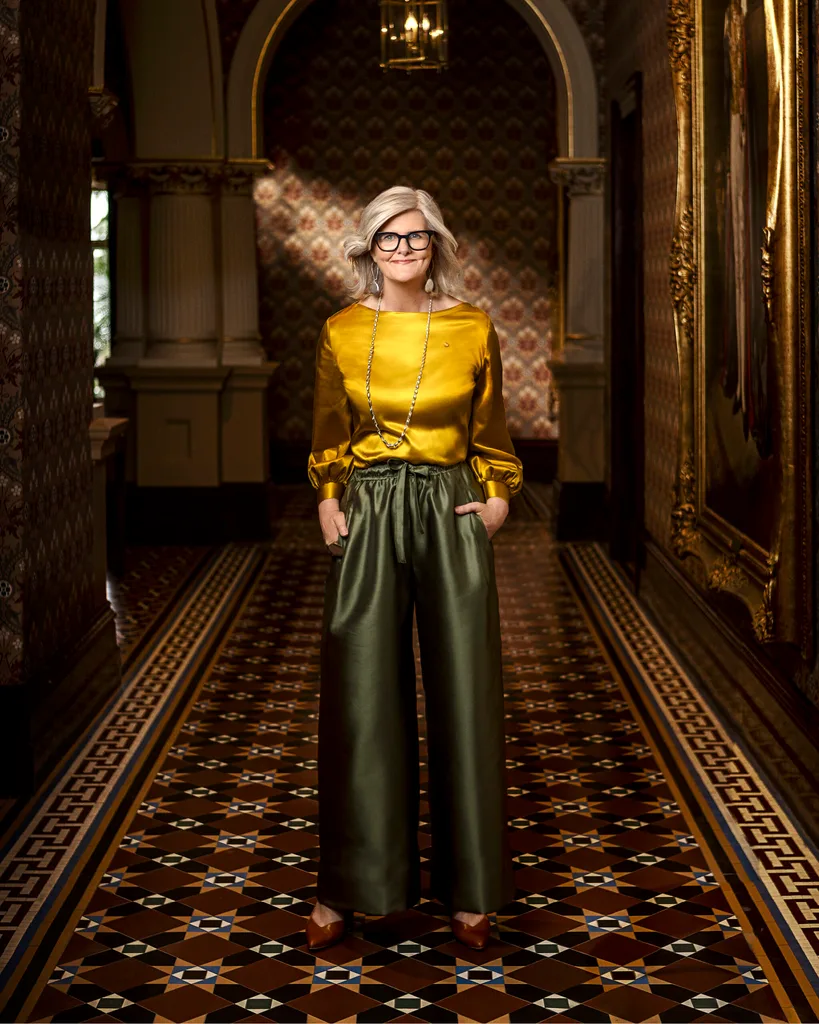
What she witnessed reaffirmed her faith in the country. “Two things can be true at the same time,” she says. “The very darkest thing can be happening, and light emanating everywhere. At our very worst times, we are finding our best.”
As the mother to a 26-year-old daughter, motherhood threads through everything she does. She and Simeon treated parenting as a shared enterprise. “We never defaulted to traditional roles,” she says. “We talked about it constantly. Who travels? Who stays? Who adjusts?” The negotiations were ongoing and intentional. “A husband is not your financial plan,” she says. “Find the person who is your partner and have those conversations early.”
There were the inevitable trade-offs. Career highs that collided with school events. Flights taken with a knot in her stomach. The day she received a call at Heathrow that her daughter had broken her ankle at daycare. “I felt like the worst mother in the world,” she has said.
She told her daughter she’d be there as soon as she could and flew home. When she walked through the door, her daughter looked up and said simply, “Oh, you came back.” It became less about perfection and more about doing what you say you will. “You keep your promises,” she reflects. “If you say you’ll be there, you be there.” She admits, “I don’t think [mother’s] guilt ever completely leaves – you just learn to hold it alongside everything else.”
Over time, motherhood became less about eliminating that feeling and more about modelling something larger. “I wanted her to see that loving your work and loving your family are not opposites,” she says.
“You can care deeply about both.” When she once apologised for going into work during school holidays, her daughter asked whether she liked her job. When Mostyn said “yes”, her daughter replied, “Well, don’t tell me you’re leaving for something you don’t like. If you’re not with me, I want you to be happy.” “Watching her become her own person has been the great privilege,” she says. “Far greater than any title.” As our conversation finishes, she shows me a friendship bracelet given to her on the day she was sworn in. Neon beads spell out: Wham Bam Sam. GG Slay. She does not wear it every day, but on difficult ones she slips it on and glances down for reassurance.
“When you’re having tough days – or happy days – you just look down and know I’m with you,” her daughter, who made the bracelet with her best friend, told her. Before she leaves, she returns to the theme she hopes Australians will carry with them: curiosity. “Be curious about our Constitution. Be curious about how our parliaments work. Don’t become apathetic,” she says. “Everyone has a role to play.”

Related stories
Native ad body.
Native ad body.


Native ad body.