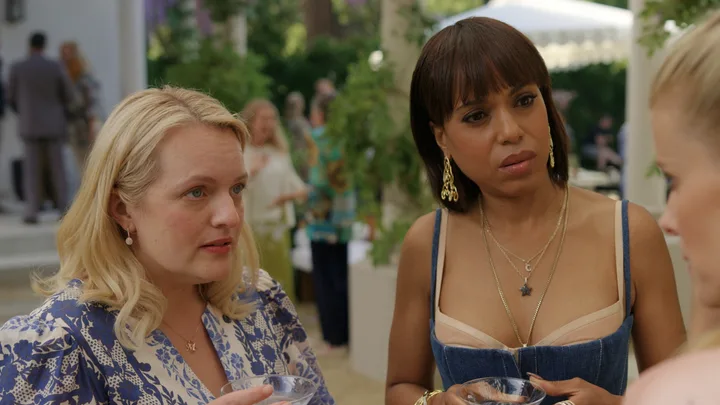
At a moment when prestige television favours scale over subtlety, Imperfect Women opts for something more contained and deliberate, trading spectacle for the slow unravelling of friendship, ambition and the quieter forces shaping women’s lives. You can’t say it doesn’t warn you; the title alone does most of the work.
It begins with Nancy (Kate Mara) dead. What follows is less a question of who, and more of how well anyone really knew her.

From there, the story shifts into the aftermath, with Eleanor (Kerry Washington) pulled into a police interview to account for the final hours of her closest friend, before the narrative begins to fold backwards.
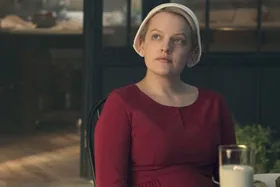
For Elisabeth Moss, who plays Mary, the project began with an immediate recognition. Having first encountered the novel in 2019, she was drawn not only to its sensorial pleasures, but to its structure. “It was delicious,” she says, describing the kind of addictive, water-cooler storytelling that lingers long after the final page.
What held her most, however, was the shifting perspective.
“You become deeply invested in one character, and then the perspective recalibrates,” she explains. “It reframes everything you thought you understood.”
The effect is both familiar and effective. Just as you settle into one version of events, the series quietly withdraws it. Certainty is offered, then reconsidered. Everyone has a version of the truth. None of them are especially reliable.
Realising that required a cast capable of holding that tension. Kerry Washington was Moss’s first and only choice, and for Washington, the feeling was reciprocal. “I was dying to work with Lizzy,” she admits.
“And then I read the book and saw the world they were building. I thought, I want to do this. This is extraordinary.”
What unfolds in Imperfect Women is an interplay between surface and subtext that feels knowingly constructed. The world is elevated, almost rarefied, but beneath it something more volatile hums. Nancy’s life, in particular, begins to fracture under scrutiny. Secrets circulate, histories linger, and no one is quite as composed as they appear, which is, of course, the point.
Once Moss and Washington were in place, attention turned to the rest of the ensemble. “Who could Nancy be?” Washington recalls. The answer came quickly: Kate Mara. “We realised she was the only person who could do this,” she says, citing Mara’s ability to pair composure with something more secretive beneath the surface. “Every single actor was our first choice,” Washington adds, a rare alignment that lends the series its cohesion.
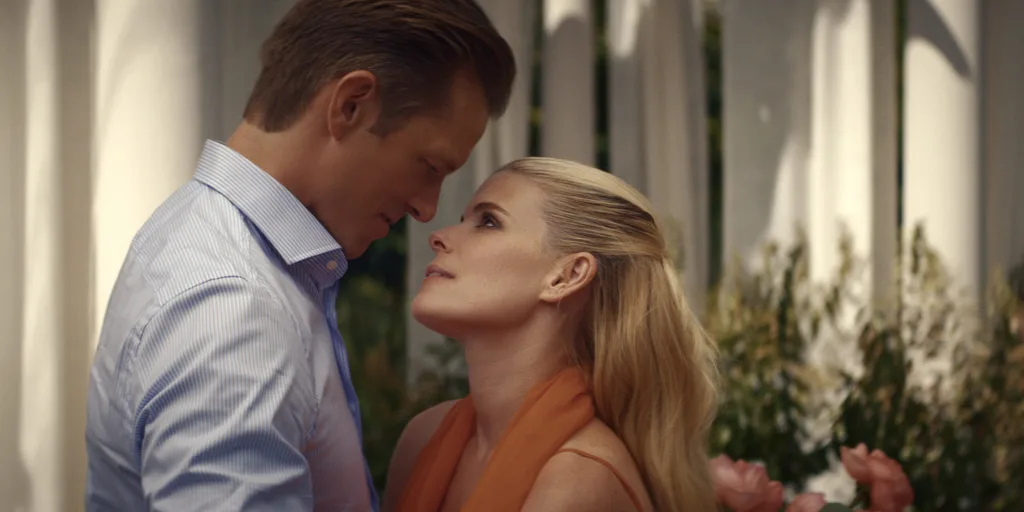
At its centre is a decades-long friendship that resists simplification. Eleanor, Mary and Nancy are bound less by similarity than by time, their lives diverging across class, marriage and ambition. Intimacy here is not stable or especially reassuring. It is porous, shaped as much by what is withheld as what is shared. The series understands, quite well, that knowing someone and understanding them are not always the same thing.
Translating that kind of history to screen might typically require extensive rehearsal and preparation. In this case, it did not.
“We did nothing,” Moss says, laughing. “It was half luck, half years of watching each other’s work.”
“You come to understand someone through the way they move through the world,” she adds.
For Washington, that connection is rooted in respect. “Admiration creates the conditions for risk,” she says. It is within that space, where trust begins to outweigh performance, that something more interesting starts to take shape.
There is also a shared reality that binds them. All three leads are working mothers, negotiating the competing demands of labour, care and selfhood. The overlap between life and art is not overstated, but it is there.
Which is perhaps why Imperfect Women feels most convincing when it leans into that tension, where nothing is fully resolved, and very little is said outright.
The first two episodes of Imperfect Women debuted March 18 on Apple TV, with the remaining episodes airing weekly on Wednesdays.

Related stories
Native ad body.

Native ad body.


Native ad body.