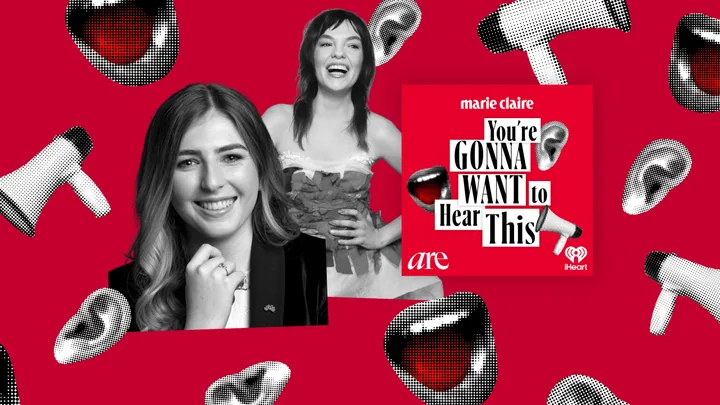
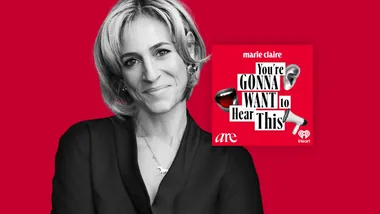
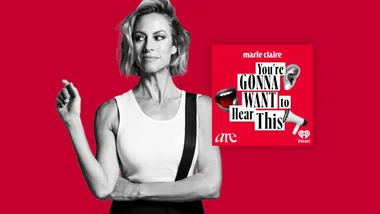
In the latest episode of You’re Gonna Want To Hear This, marie claire hands the mic to two of the most compelling young voices in Australia right now: Georgie Stone and Chloe Hayden. The result is funny, warm and sharply intelligent – a conversation about identity, school, labels, media representation and what it means to grow up knowing you don’t quite fit the mould the world has handed you.
Introduced by marie claire editor Georgie McCourt as an episode for “anyone who remembers what it felt like to be a kid at school and to know that you didn’t quite fit”, the discussion quickly becomes something bigger than a conversation about adolescence. It is about survival, visibility and how to simply exist as yourself.
Listen To You’re Gonna Want To Hear This
Stone, actor, writer and advocate, reflects on knowing who she was from a very young age. “I was around two or three years old when I first told my mum that I was female,” she says. “But I didn’t know the word. I didn’t know that I was trans because I didn’t know what that was. I just knew that I was female.”
For Stone, discovering the word “transgender” at seven was transformative. Not because it changed who she was, but because it gave shape and language to an identity she had always understood internally. “Having that word really helped kind of fill out my understanding of myself,” she explains.
Hayden, actor, author, advocate and marie claire cover star, speaks just as powerfully about the importance of language – particularly for autistic children who are so often denied it by adults afraid of “labels”. In one of the episode’s most resonant moments, she dismantles that idea completely.
“Every single person has a label,” Hayden says. “Before my label was autism, my label was weird, strange, loser, unusual.”
When Hayden was diagnosed with autism at 13, she says it was both “the best day” and “the worst day” of her life. Best, because it gave her clarity. Worst, because what she found online was terrifying: harmful stereotypes, misinformation and fear. But over time, she came to understand that the label wasn’t the problem – the ignorance around it was.
“I started to learn that this label didn’t have to be scary,” she says. “I wasn’t a bad typical person. I was a perfect autistic person.”
It is this interplay between identity and representation that gives the episode its emotional core. Both women speak candidly about growing up without seeing themselves reflected back in nuanced, hopeful ways — and how damaging that absence can be.
For Hayden, Disney was an early refuge. She talks about seeing herself in characters who were different, strange, magical and misunderstood. For Stone, princesses offered a language for girlhood before the wider world could. Later, like so many children, she found meaning in Harry Potter – not just in Hermione, but in the idea of a hidden place where the outsider becomes the hero.
That makes what both women have gone on to do in their careers feel even more significant.
Hayden’s portrayal of Quinny in Heartbreak High has become a touchstone for autistic viewers around the world, while Stone’s role as Mackenzie in Neighbours made history as the first transgender character in an Australian drama played by a trans actor. In the episode, both reflect on the power – and pressure – of helping create characters who can change lives.
“I grew up never seeing myself represented,” Hayden says. “And when autism was represented, it was Rain Man, it was The Good Doctor… so being able to play a character that would have been life-changing for me growing up is so exciting.”
Stone echoes that sentiment. The trans characters she saw as a child were often “villainous”, “tricksters” or trapped in tragic storylines. “I’d see that on screen and be so scared to grow up,” she says. “I thought, that’s going to be me.”
So when she had the chance to help shape Mackenzie, she made the character everything she had longed to see herself: ambitious, kind, flawed, academic, scared, funny, real. “It was such an honour,” Stone says, “to create this multi-realised, nuanced but wonderful young girl that people got to see and enjoy and see themselves in.”
Still, neither woman pretends representation is simple. One of the most interesting parts of the episode is their honesty about the pressure to represent an entire community, and the impossibility of doing so.
Hayden describes autism as a “hex code” – a spectrum made up of infinite variations. “My experience of autism is going to be immensely different to someone else’s experience of autism,” she says. “There is space for everyone in advocacy.”
Stone agrees, noting that she has always been conscious of the privilege that made her media visibility possible. Not every trans person has her experience, and not every story is treated as “palatable” by the media. But that, she argues, is exactly why there must be room for more voices, not fewer.
The conversation also touches on activism, joy and what it means to live publicly in a moment when queer and disabled communities are increasingly under attack. “The fact that we are existing openly and proudly is an act of protest,” Hayden says. Stone agrees: “It is a radical act of protest to just exist and live your life.”
For all its depth, though, the episode never loses its sense of play. There are quick-fire questions, Titanic obsessions, feminist microaggressions and a lot of laughter. That balance is what makes the conversation feel so generous. It is serious without becoming heavy, political without losing its humanity.
And by the end, both women arrive at versions of the same message. Hayden puts it simply: “Who you are is exactly who you’re supposed to be.” Stone’s closing thought is just as powerful: “You are enough.”
This episode is not just about transness or autism, or even school and identity. It is about what happens when people are finally given the language, the space and the visibility to tell the truth about themselves. And for anyone who has ever felt like the odd one out, that truth lands exactly where it should.

Related stories
Native ad body.
Native ad body.
Native ad body.