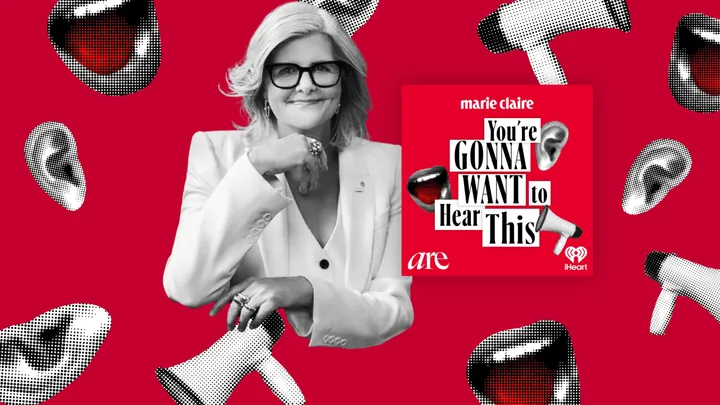
Australia’s Governor-General, Sam Mostyn, has spent her career in boardrooms, sporting bodies and advocacy spaces. But on this week’s episode of You’re Gonna Want to Hear This, she sits down with Marie Claire editor Georgie McCourt for something far more personal: a conversation about happiness, misogyny, leadership – and the 24 hours that changed her life.
When Prime Minister Anthony Albanese called to ask whether she would consider becoming Governor-General, Mostyn had just one day to decide. The conversation at Kirribilli House – with only the PM’s dog, Toto, as witness – was followed by a tightly held, 24-hour family debate. They could tell no one.
It was her daughter who asked her the question she still remembers. “Will it make you happy?”
That question, Mostyn tells McCourt, made her shoulders drop. Happiness became the decision-making metric. “Happiness comes from serving other people,” she says.
For Mostyn, the role is not about authority. It is about showing up – particularly in moments of national grief. When the Bondi terror attack unfolded, she instinctively told her husband, “We just have to show up.” With no politics and no policy levers, she sees the Governor-General’s role as one of presence: standing alongside communities, reflecting the nation’s “light and shade” back to itself.
In the aftermath of Bondi, she witnessed both darkness and extraordinary light – strangers protecting children, communities creating acts of kindness, volunteers rallying. It reinforced her belief that care and compassion are not “soft” leadership traits. They are, in fact, some of the hardest things to practise consistently.
Listen To You’re Gonna Want To Hear This
Confidence Isn’t What You Think
Throughout the episode, Mostyn dismantles the mythology of confidence. Determination and confidence, she discusses with McCourt, are not the same thing. Many women, she notes, assume they won’t get the job – even when they are eminently qualified.
She admits she did exactly that when the Prime Minister first approached her: surely there was someone “more appropriate.”
But confidence, she suggests, is less about certainty and more about bringing your full self to the table – and staying in the room when it’s uncomfortable.
That lesson came early in her career, when a senior Aboriginal elder told her she wasn’t truly listening – she was simply waiting to speak. It changed how she approached debate. Today, she practises active listening and often replaces “no” with “yes, and…” – a technique borrowed from improv that keeps conversations open rather than shutting them down.
It’s a philosophy that shaped her advocacy for AFLW, equal pay and women’s inclusion in leadership spaces.
The Misogyny That Still Lingers
The episode does not shy away from the reality of misogyny. Mostyn recounts being told early in her legal career that she couldn’t appear in court wearing trousers – the judge would “not hear” her. She recalls corporate debates where women were paid less because they supposedly “didn’t need” the income if they had a husband.
And even now, in 2026, she says she faces attacks suggesting a woman cannot do this job.
What saddens her most is not personal criticism, but the deterrent effect on younger women. Anonymous, often sexualised attacks create a culture designed to keep women from stepping forward.
Yet she is clear: she does not see this as a battle between men and women. She speaks warmly about the many men – including young men she meets through programs like The Man Cave – who reject that misogyny and want healthier models of leadership.
A New Form Of Power
Perhaps the most compelling section of the conversation is her reframing of power. If leadership were designed around real lives – around caregiving, partnership and shared responsibility – it would look radically different, she says. We would stop asking women what they sacrificed and start questioning the rigidity of the systems themselves.
One of her bluntest pieces of advice, offered to her own daughter and to young women across the country, is this: “A husband is not your financial plan.”
Financial independence, equal partnership and shared values are non-negotiables.
And then there’s the bracelet.
On difficult days, Mostyn sometimes wears a beaded friendship bracelet made by her daughter. It reads: “Wham Bam Sam Gigi Slay.” It is both hilarious and deeply tender – a reminder that leadership is sustained not just by public duty, but by private love.
A National Unity Project
As the episode closes, Mostyn speaks about what she most wants Australians to hear: care for our democracy. Be curious about how it works. Don’t take it for granted.
In a world saturated with outrage and disinformation, she believes Australia is engaged in a “national unity project” – one that requires care, kindness and respect.
It’s a surprisingly intimate conversation with a woman who occupies the country’s highest constitutional office.
Listen to the full episode in the player or on your preferred podcast platform.

Related stories
Native ad body.

Native ad body.

Native ad body.