
“It’s been five hours. My mum’s sitting next to me. She’s hearing all the details [about the rape] that she’s never heard before, and I’m talking about the most horrific thing that’s ever happened to me. And, at the end, the detective’s like, ‘You should really consider reporting this.’”
It was the first time Sarah Rosenberg found herself jaw-on-the-floor shocked by the sheer apathy sexual violence victims are met with in the Australian criminal justice system. Especially considering that – as far as Rosenberg was concerned – “reporting this” was exactly what she was doing. It would take her more than 20 hours of police interviews across three months to get her full statement down.
The second of these moments came during the trial in 2022. The then-26-year-old Rosenberg “watched on in horror” as the case the prosecution had almost 18 months to prepare for was bungled to the point that she had not even been told the correct start date.
As a result, she was given just 15 minutes to make it to Sydney’s Downing Centre on the first morning of the trial. Many of the case’s key witnesses were never called to give evidence, and the proceedings – scheduled to be a month long – ended after only seven days.
The jury found the defendant not guilty on all six counts (among them intentional choking, suffocation and sexual intercourse without consent). “It was a complete stage production. We were all characters and no-one knew any of their lines,” she remembers with a half-laugh of disbelief. “We were prepared to fall on the burden of proof. We were not prepared to fall on a lack of prosecution. Everyone just stood there, going through the motions.”
Later, when the trial was investigated by the Bar Association for incompetency and corruption, Rosenberg’s family asked for a meeting with the NSW director of Public Prosecutions, Sally Dowling. “We were trying to [get her to] understand the trauma that her office had caused us,” Rosenberg says, her voice full of frustration.
But, ultimately, she and her family left feeling dismissed and disheartened by Dowling’s reaction. “That was the third moment,” Rosenberg remembers, shaking her head. “It was atrocious.”
Three strikes. She was outraged. “The whole way through I was documenting everything,” Rosenberg remembers. “I had all of this information; I had all of these receipts.”
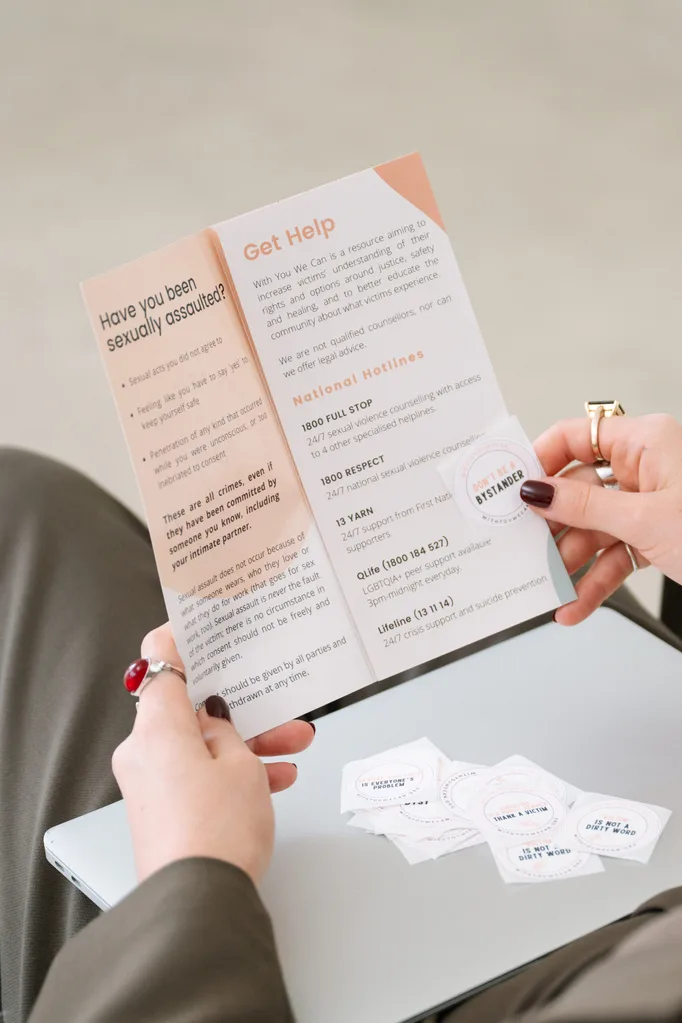
So she sat down at the cafe near her house and set to work converting her notes into a practical guide to help victims of sexual violence navigate the police and legal processes. “I would sit there for hours working, then come home and keep going,” she remembers of the early days of her organisation, With You We Can.
A free knowledge hub, With You We Can is an online resource that goes into granular detail using easy-to-understand language, to explain everything from how to approach a police station to preparing for court appearances, while also correcting common misconceptions, often shaped by television shows such as Law & Order: SVU.
“It’s the bare minimum that victims be provided with information about what’s expected of them as they go through the process,” says Rosenberg, who now also consults on various government projects, is a member of the Australian Law Reform Commission’s expert advisory group and recently travelled overseas in her capacity as a Westpac social change fellow.
“The highlight was visiting the University of Glasgow, Scotland, where they’re piloting independent legal representation based on the programs I’ve been running in Australia. That was really exciting.”
Her excitement is well-founded: Rosenberg has championed independent legal representation since her own trial, when she was blocked from accessing legal support to protect her rights and privacy, while the defendant was represented by one of the country’s most experienced lawyers.
Last year, the Albanese government announced an additional $21.4 million to improve sexual assault victims’ experiences of the criminal justice system, which will see the independent legal representation pilots already operating in Victoria, Western Australia and the ACT extended until June 2028, and expanded into all other Australian jurisdictions this year.
Reflecting on what this will mean for future victims, Rosenberg says, “It would have changed everything for me. Not only would I have had my rights upheld and felt prepared enough to reflect the fact that I’m a chief witness and the whole case is reliant on me, but I would have had someone guiding me.
Instead, I was at work waiting for phone calls, rushing to the stationery cupboard when an unknown number rang, not knowing what was going on. It also just would have meant that I came out of that process with my dignity intact.”
It’s something Rosenberg is still grappling with. “My mum would love me to stop doing this,” she reveals. “She wants me to shave my head, change my name, ride off on a Harley-Davidson into the sunset … But I’m not ready to give up yet.”
She pauses, then continues with a sense of resolve. “I also just feel like, if I can’t do it, who the fuck can? I’m this white girl from the eastern suburbs [of Sydney]. I carry every label of privilege you can imagine. My mother was a bloody lawyer and still everything that could have gone wrong went wrong. For me, it’s more than just a duty. I honestly don’t think I could live with myself if I didn’t do something with this.”

Related stories

Native ad body.

Native ad body.

Native ad body.