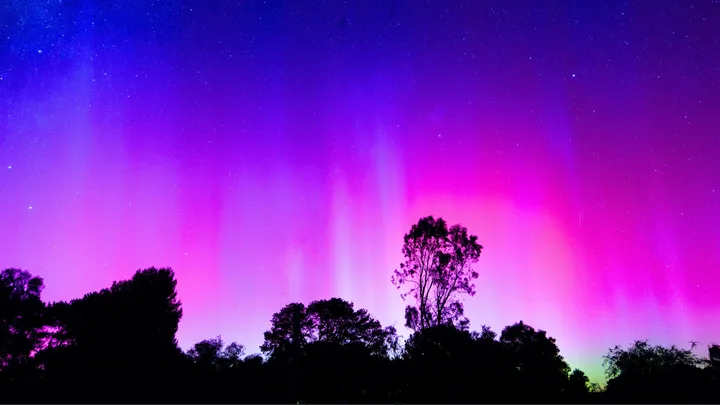
A rare celestial display is set to grace southern skies tonight, March 19, as the Aurora Australis makes a striking return.
Often referred to as the Southern Lights, the Aurora Australis is one of nature’s most spectacular phenomena. If you’ve ever dreamed of witnessing it, space weather forecasts are offering a promising window.
A geomagnetic storm is expected to peak on Thursday, and according to NOAA, it has been classified as a ‘G2’ (or moderate) event.


While aurora sightings are typically confined to Australia’s southernmost regions, storms of this intensity can push the display further north than usual, widening the reach of this otherwise elusive phenomenon to Sydney, Brisbane and Perth.
The spectacle has been driven by a powerful burst of solar activity, with a fast-moving coronal mass ejection sending charged particles towards Earth. When these particles collide with gases in the atmosphere, they ignite an ever-changing fresco of greens and violets, rippling across the night sky in luminous bands.
It is both a scientific marvel and something that feels especially rare to witness in Australia, given the Northern Hemisphere is treated to far more frequent displays.
Ephemeral by nature, the aurora resists certainty, but that unpredictability is precisely what makes it so compelling. March is also widely considered one of the best times of year to see the aurora.
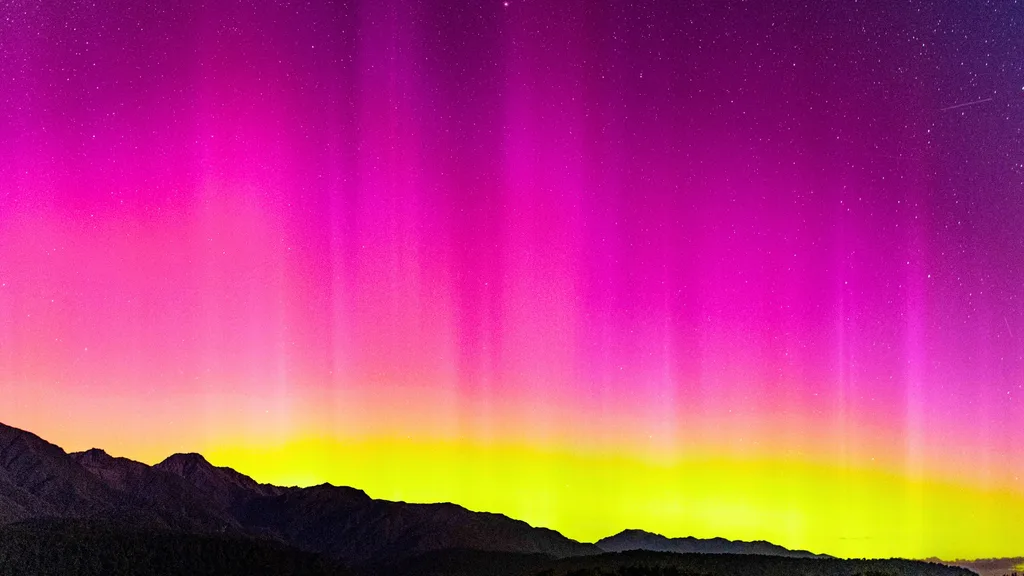
Around the spring and autumn equinoxes, Earth’s position in space allows its magnetic field to more easily connect with incoming solar wind and coronal mass ejections. With the sun sitting directly over the equator, both hemispheres experience equal day and night, and that subtle shift in orientation makes it easier for charged particles to interact with our atmosphere.
Ahead, everything we know about the celestial phenomenon set to unfold tonight.
The Aurora Australis is expected to be visible across parts of Tasmania, Victoria, South Australia, Western Australia, and southern New South Wales.
While sightings are never guaranteed, promising conditions include clear skies, low light pollution, and heightened solar activity aligning favourably with Earth’s magnetic field. For the best chance of catching the display, head to a dark, open space away from city lights and settle in with an unobstructed view of the southern horizon. If you’re hoping to photograph it, bring a tripod and shoot with a long exposure and high ISO.
For the most accurate timing, experts recommend monitoring live space-weather data as forecasts sharpen once the coronal mass ejection’s path becomes clearer.
Real-time updates are available via the NOAA Space Weather Prediction Center and the Bureau of Meteorology, which provide ongoing guidance on visibility, intensity and peak viewing windows.
The incoming coronal mass ejection (CME)—the geomagnetic surge triggered by recent solar flare activity—is expected to reach Earth at around 8pm AEDT. From there, the optimal viewing window typically falls between 60 to 90 minutes after sunset, when skies are fully dark and activity begins to intensify.
| Location | Sunset Time | Best Viewing Window |
|---|---|---|
| Tasmania | 7:50pm AEDT | 9:00–11:00pm AEDT |
| Melbourne | 7:50pm AEDT | ~9:00–11:00pm AEDT |
| Adelaide | 7:40pm ACST | 8:45–10:30pm ACST |
| Perth | 6:55pm AWST | 8:30–9:30pm AWST |
| Sydney | 7:15pm AEDT | 8:30–10:30pm AEDT |
| Wellington, NZ | 7:50pm NZDT | 8:30–10:30pm NZDT |
The expected surge in geomagnetic activity is being driven by an incoming coronal mass ejection (CME), launched from the sun on March 16 during an M2.7 solar flare. These vast bursts of plasma and magnetic energy can interact with Earth’s magnetic field, triggering geomagnetic storms that, under the right conditions, produce vivid aurora displays.
Solar flares are sudden bursts of energy released from the Sun’s surface, sending light, radiation and charged particles out into space. They happen when magnetic fields near sunspots twist and snap, heating surrounding plasma to extreme temperatures and releasing energy across the spectrum, including visible light, X-rays and radio waves that can reach Earth.
Solar activity moves in an 11-year cycle, and as the Sun approaches its next peak, these events are becoming more frequent. Flares are ranked by strength from A-class, the weakest, through to X-class, the most powerful, with each level marking a significant jump in energy. Tonight’s aurora is linked to an M-class solar flare.

Related stories

Native ad body.

Native ad body.




Native ad body.