
Decades into global pop stardom, Kylie Minogue finds herself in the midst of yet another cultural ascension, though to characterise it as a “comeback” feels faintly reductive. Kylie Minogue does not return so much as recur—call it the prerogative of Australia’s reigning Princess of Pop.
Since the release of Tension and its 2024 follow-up Tension II, she has, once again, sung her way back into the collective consciousness.


Yesterday, Minogue was announced as the headliner for the 2026 AFL Grand Final entertainment, reaffirming her status as a national fixture. Days earlier, Chanel unveiled a global campaign for its Chanel 25 handbag, starring Margot Robbie and directed by Michel Gondry. The film reimagines Minogue’s 2001 hit music “Come Into My World”—originally directed by Gondry himself—with the singer appearing in a brief, full-circle cameo.
Set within a looping, kaleidoscopic cityscape, the campaign echoes the meticulous choreography of the original clip while positioning the handbag as a contemporary iteration of Chanel’s house codes. More broadly, it gestures toward Minogue’s own fluency across eras: perpetually recontextualised, never out of step.
If her legacy could be distilled into a single image, it might be the now-mythologised gold lamé hotpants from “Spinning Around”: bought for loose change at a London market and styled with a halter by Stella McCartney, they have since entered fashion folklore.
But Minogue’s visual language extends far beyond a single look. Ever the chameleon, she has constructed a succession of distinct identities, shaped in part by her longtime collaborator William Baker. Across decades, her wardrobe oscillates between playful and minimal, camp and couture.
Her proximity to high fashion, meanwhile, is neither incidental nor decorative. Long before she was dancing atop a bar in 2000, she had already forged deep ties with luxury fashion. John Galliano designed the wardrobe for her 1991 Let’s Get to It tour, while figures like Azzedine Alaïa and Jean Paul Gaultier appeared across her videos and stage costumes.
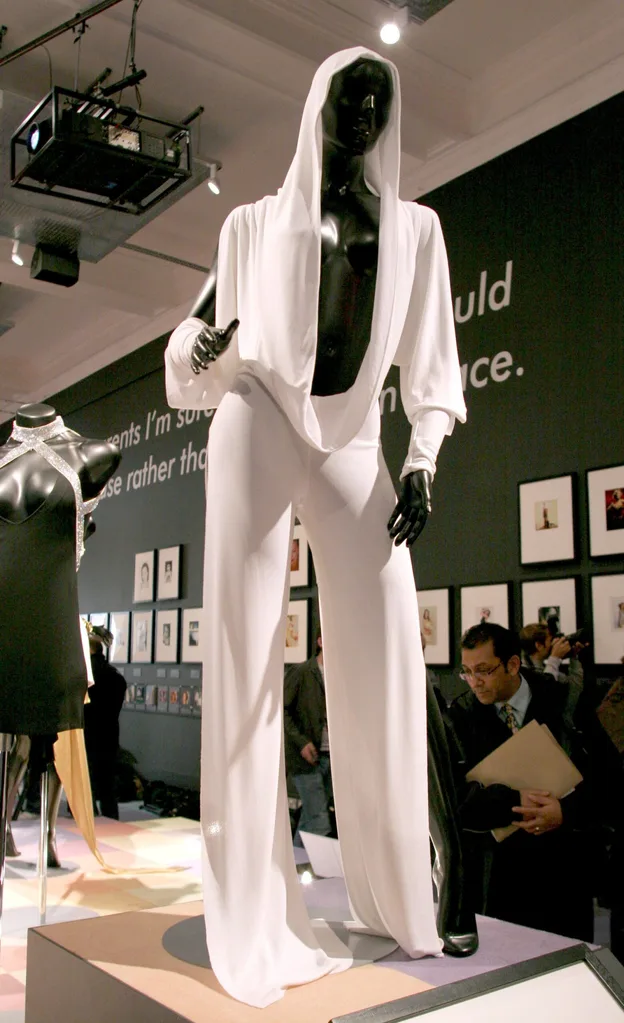
In “Can’t Get You Out of My Head,” she channelled the futuristic sensuality of Grace Jones in a white hooded jumpsuit that remains etched into the pop-cultural archive.
If the music industry has historically exhibited a certain unease with ageing female performers, Minogue approaches the matter with characteristic lucidity. Reflecting on the cross-generational success of her recent music, she noted the faint surprise of its rotation on youth-oriented radio, before telling Radio Times that “it’s not cool to be ageist.”
Not that Minogue has ever been especially preoccupied with public permission. Soap star, fashion muse, cancer survivor, gay icon, dancefloor constant, and a form of Australian cultural diplomacy unto herself—her descriptors proliferate, though none quite capture the sheer span of her influence.
From the early-2000s saturation of “Can’t Get You Out of My Head” to the algorithmically primed renaissance of “Padam Padam”—Grammy-winning, no less—her catalogue continues to regenerate across contexts. Little surprise, then, that she remains the highest-selling Australian-born solo artist of all time, with more than 80 million records sold worldwide.
And come September, as she takes to the AFL Grand Final stage, she will be met with collective reverence: footy fans and Minogue’s long-time listeners’ alike, united in anticipation.

Related stories
Native ad body.

Native ad body.



Native ad body.