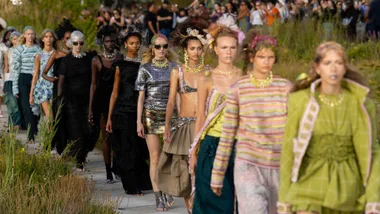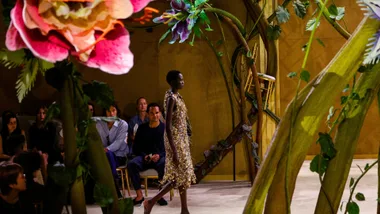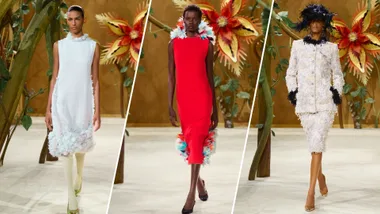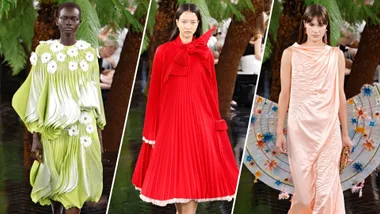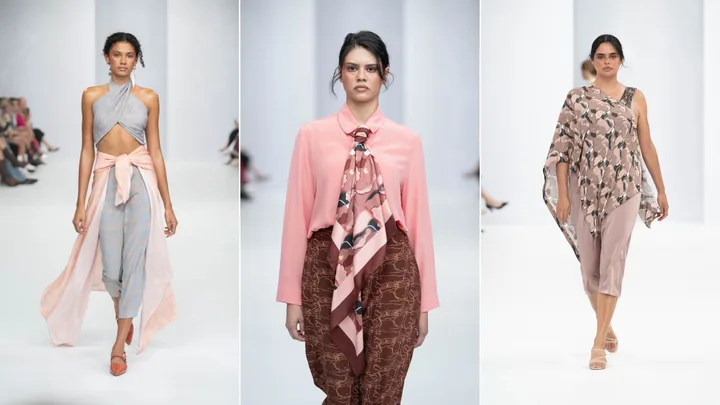
As mid-May arrives, Australian Fashion Week 2026 kicks off, ushering in a bold new chapter for the nation’s leading fashion event.
After 13 years at Carriageworks, the Australian Fashion Council (AFC) has moved fashion week to the sweeping vistas of the Museum of Contemporary Art, framed by the Harbour Bridge and Opera House—an iconic backdrop as monumental as the creativity on display.
After a Welcome to Country under the warm autumn sun, the week’s first collections came from Buluuy Mirrii and Van Ermel Scherer, merging tradition with innovation.
Toni Matičevski followed with an ethereal showcase, Beare Park staged a striking Opera House spectacle, and Carla Zampatti closed the day with an evening soiree, complete with floodlights and a plush carpet rolling out along the boardwalk beside the Park Hyatt Hotel.
As the first international fashion week to present resort collections, AFW continues to highlight Australia’s unique place on the global calendar, marrying local creativity with both commercial and cultural impact.
Beyond the runway, street style is having its own moment. The MCA’s iconic setting proved ideal for street style snaps, swapping Carriageworks’ industrial grit for Sydney’s landmark vibrance. Guests navigated the city’s mercurial May weather, rain giving way to sun, yet their style remained unshaken—a testament to the energy and optimism fuelling the week ahead.
From legacy labels to emerging talent, AFW 2026 offers a snapshot of Australian fashion at its most inventive. As the week unfolds, it promises to celebrate craftsmanship and design ingenuity while capturing the mood of a city in love with fashion, on both streets and runways.
For editors, buyers, and style devotees, this is where inspiration meets spectacle, and where Australia’s fashion future is on full display.
Ahead, we round up our favourite highlights from Australian Fashion Week 2026.
Day 5
Ngali
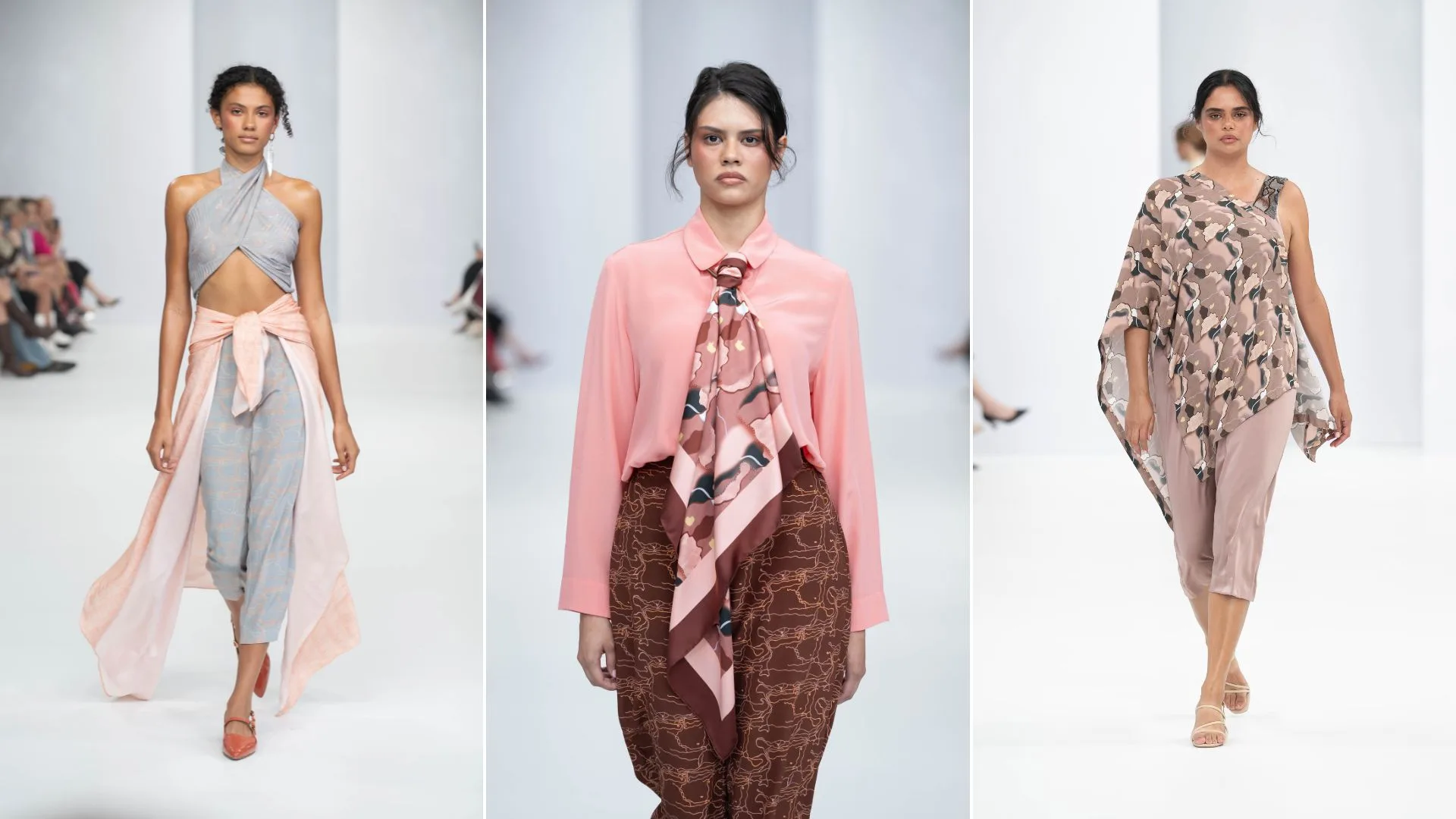
Ngali closed out Australian Fashion Week on Friday afternoon with a show that felt less like a runway presentation and more like a meditation. Staged at the Museum of Contemporary Art Australia, Wander with Wonder was built around the label’s signature silk scarves — reimagined as draped dresses, wrap silhouettes, ponchos, and skirts that moved with quiet, effortless authority. Guided by the Yindayamarra principle of walking gently and with intention, founder Denni Francisco delivered a collection that wore its cultural grounding lightly but meaningfully, each piece carrying the creative expression of First Nations artists — including Gija artist Lindsay Malay, whose East Kimberley landscapes are rendered into print across the silk — translated into fabric with genuine depth.
Underneath the beauty was a quietly radical message: that fashion doesn’t always require something new. Wander with Wonder championed the joy of reinterpreting what you already own — tying, wrapping, layering, and restyling the same silk scarf into something entirely unexpected. In a week chasing novelty, Ngali’s show stood apart for its restraint, its storytelling, and its reminder that the most enduring fashion is rooted in something that actually means something.
Day 4
Lee Mathews
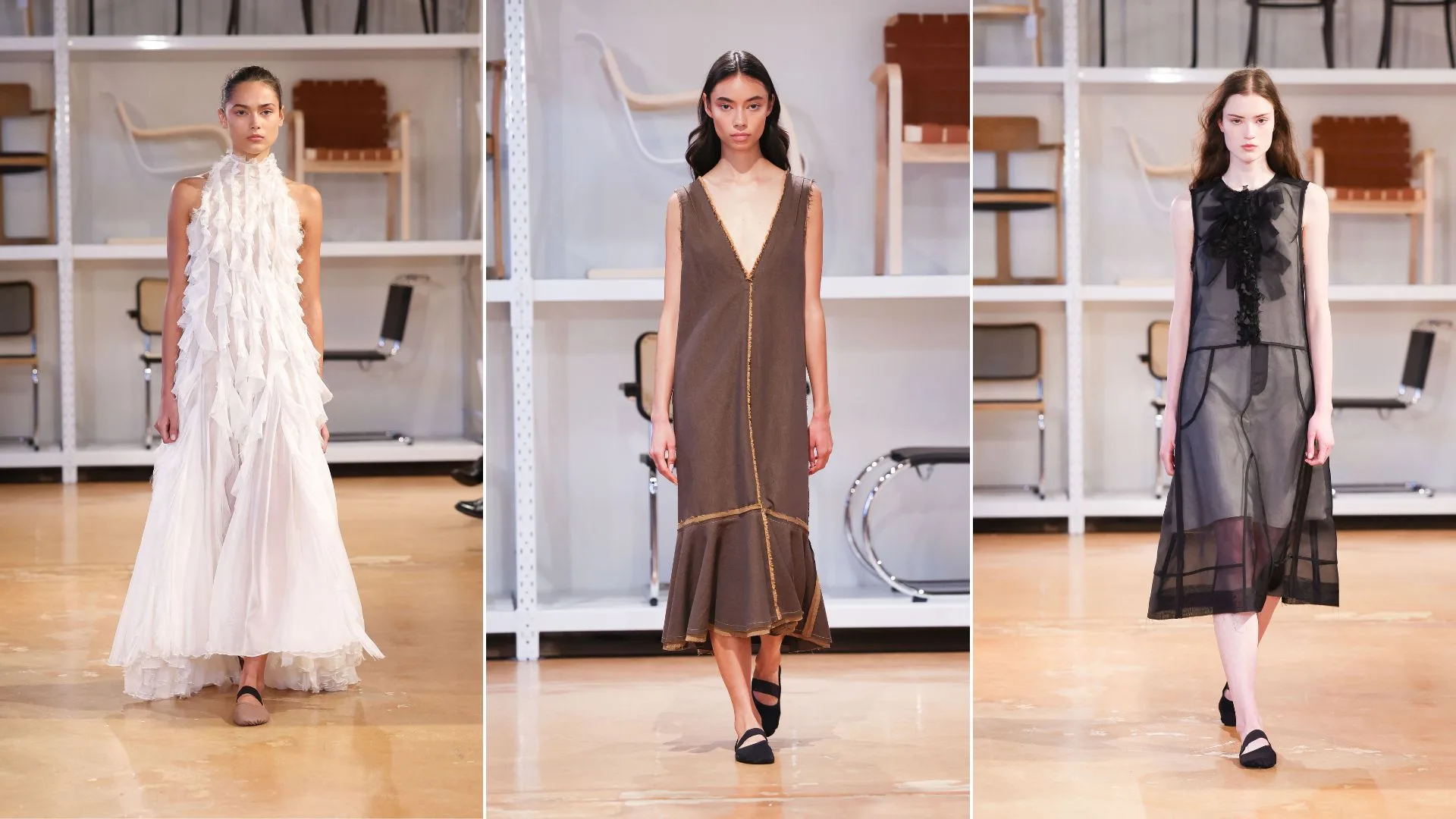
Lee Mathews presented Resort 27 among the modernist furniture and collectible design of Anibou — a fitting backdrop for a collection preoccupied with process over product. The pairing was deliberate: just as Anibou’s legacy pieces from the likes of Artek, Thonet, and USM reward close looking, Resort 27 asks you to notice the hand behind the making. Raw hems, exposed finishes, layered fabrication, and intentionally unresolved construction make the garment’s evolution visible rather than concealing it — pieces that feel in dialogue with the objects around them.
The colour palette drew from the paintings of Helene Schjerfbeck — muted mineral tones, chalky neutrals, oxidised shades, and hints of scarlet moving quietly through the collection and into the accessories. It’s a restrained, considered body of work that rewards the same slow attention the setting demands. RATIONALE returns for a second year as skincare partner, a pairing that makes sense for a label this committed to craft and ritual.
L’IDEE WOMAN
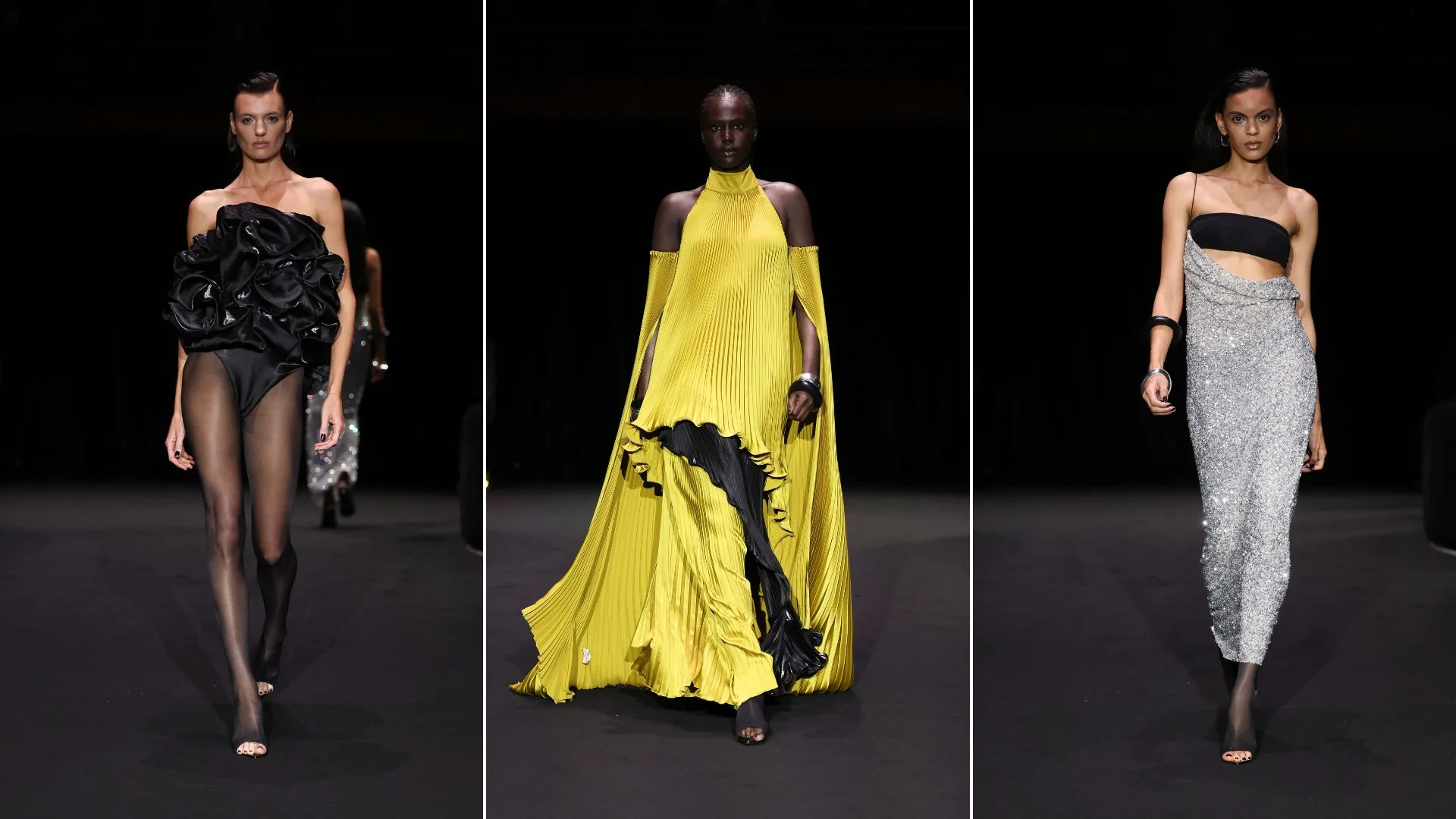
L’IDÉE WOMAN returned to Australian Fashion Week four years after its debut with a statement show that made its ambitions clear from the opening look. Taylor Hill walked first, followed by Shanina Shaik — a casting coup that announced the label’s global credentials before a single pleat had caught the light. Rather than a straight seasonal presentation, the 30-look show wove signatures from the archive with key pieces from Fall/Winter ’26, building a coherent picture of what L’IDÉE WOMAN is and where it’s headed.
That identity is built on sculptural pleating developed in partnership with one of the world’s oldest pleating houses, and Resort ’26 put the technique front and centre. Drawing from the icons of the 1970s disco era, the collection moved through liquid shine, high-gloss textures, statement sequins and rhythmic pleat structures that shifted with every step — occasion-wear that felt architectural rather than merely dressed up. Creatively directed by Pip Edwards, the show had a confidence and momentum to match the clothes, signalling a new era for a label that clearly has more to say.
Day 3
Esse
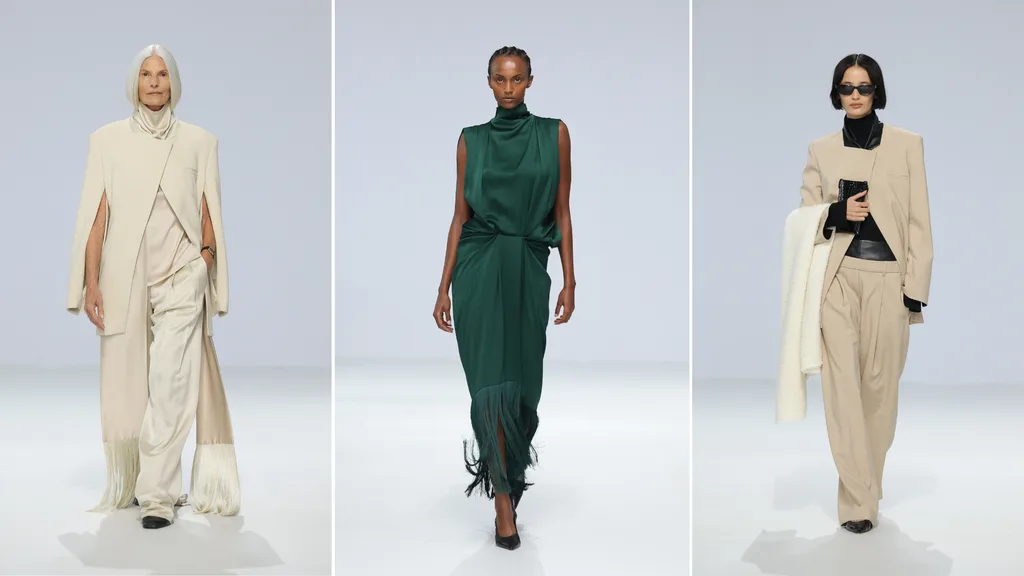
At a moment when fashion often mistakes visibility for meaning, Charlotte Hicks offered a compelling counterpoint: restraint as discipline, precision as power.
At the Museum of Contemporary Art Australia, Hicks presented The ESSE Editions, refining the brand’s signature language of elevated essentials into something sharper and more assured: fluid tailoring, sculptural silhouettes, and softly dispersed fringing designed not for spectacle, but permanence.
There was a quiet confidence to the collection’s pragmatism, resisting trend cycles in favour of pieces that felt deeply considered and instinctively wearable.
Yet beneath the minimalism sat a rigorous commitment to craftsmanship and sustainability, with nearly every garment produced locally in Sydney. In Hicks’ hands, responsible fashion felt neither performative nor austere, but genuinely luxurious.
Nagnata
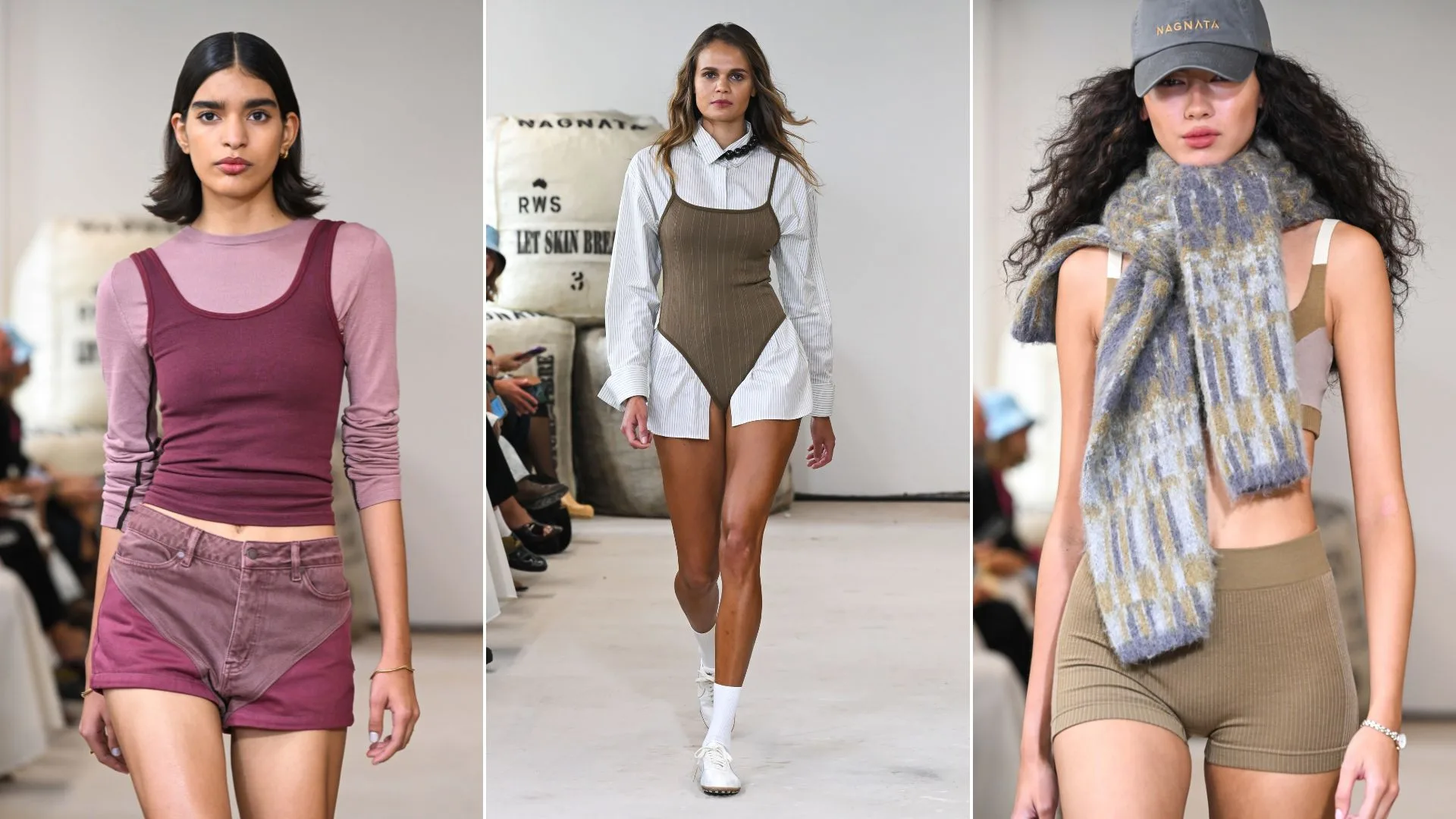
NAGNATA opened Wednesday morning on Oxford Street with a show that set a high bar for the week. FUTURE = FIBRE — the brand’s Movement 21 Collection — was staged in a raw warehouse space grounded by wool bales and stencilled with brand mantras, with a soundscape composed around the frequency of Om. Dancers moved throughout the presentation as an extension of the collection itself, their choreography, the sound, and the garments existing within the same emotional language. It was immersive without being overwrought.
The collection itself marked a more personal evolution for founder Laura May Gibbs, shaped by her first year of motherhood and a return to inner practice. Refined silhouettes, softened tailoring, textured knitwear, vegetable-dyed denim and fine rib layering reinforced NAGNATA’s commitment to natural fibres and responsible production — with the debut of denim bags extending the brand’s Return To Earth philosophy into accessories for the first time. Where last season looked outward, this one looked inward, and it was all the stronger for it.
Day 2
Alix Higgins
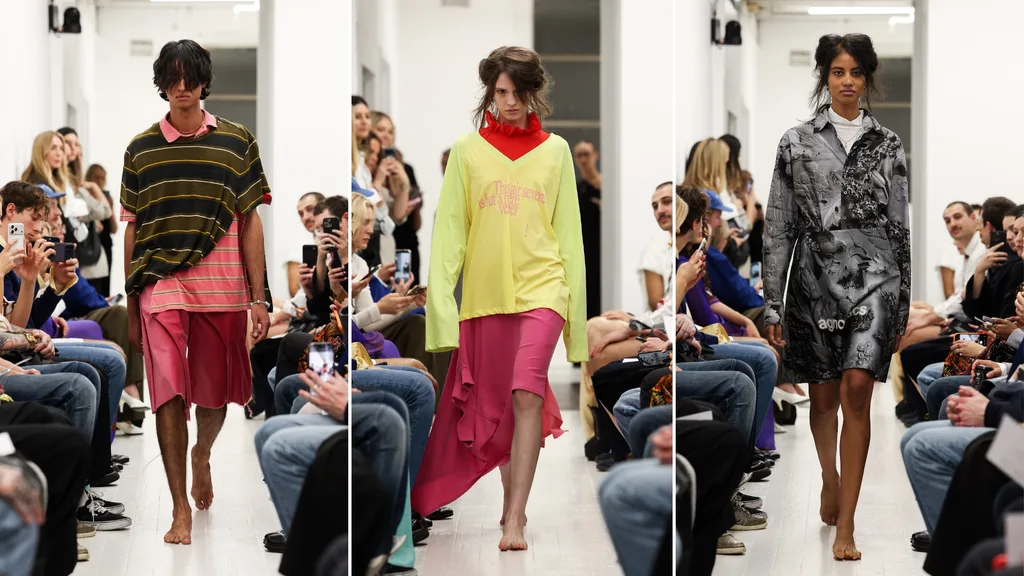
At China Heights Gallery in Surry Hills, Sydney-based designer Alix Higgins unveiled An Opening Voluntary, a collection steeped in ceremony, romanticism, and deliberate imperfection.
The presentation explored the tension between refinement and disruption through reconstructed silhouettes, layered textiles, and emotionally charged styling that felt both deeply personal and theatrically composed.
The title itself was drawn from a phrase Higgins discovered instinctively before learning its meaning: a piece of organ music performed at the beginning of a church service. That sense of ritual and considered beginnings became the conceptual spine of the collection.
Historical references, found garments, and reworked prints were layered together and filtered through Higgins’ distinctly contemporary lens, creating looks that felt intuitive rather than overly polished.
Hair direction, led by Kevin Murphy Hair Director and Shark Beauty ambassador Daniel Jianing Liu, extended this philosophy into beauty. Inspired by the Gibson Girl, the late 19th-century feminine archetype illustrated by Charles Dana Gibson, Liu reinterpreted the era’s sculptural bouffants through a modern, slightly punk sensibility.
Rather than recreating period beauty literally, the looks introduced tension through undone textures, irregular shapes, and intentionally disrupted finishes.
Each model carried an individual variation of the aesthetic. Some styles were fully pinned and sculpted, while others fell into imperfect ponytails or loose, airy forms that resisted uniformity. Kevin Murphy products including Anti Gravity Spray, Killer Waves Curl Enhancer, and Doo Over Hairspray were used to create volume and texture without stiffness, maintaining a tactile, lived-in quality.
The styling was completed using the new Shark Beauty Glam Hot Tool Air Drying & Styling System, with the Silki Ceramic Straightener attachment employed unconventionally to build soft structure and movement rather than sleekness. The result was beauty that felt fluid, romantic, and subtly undone, mirroring the collection’s exploration of controlled imperfection.
Hansen & Gretel
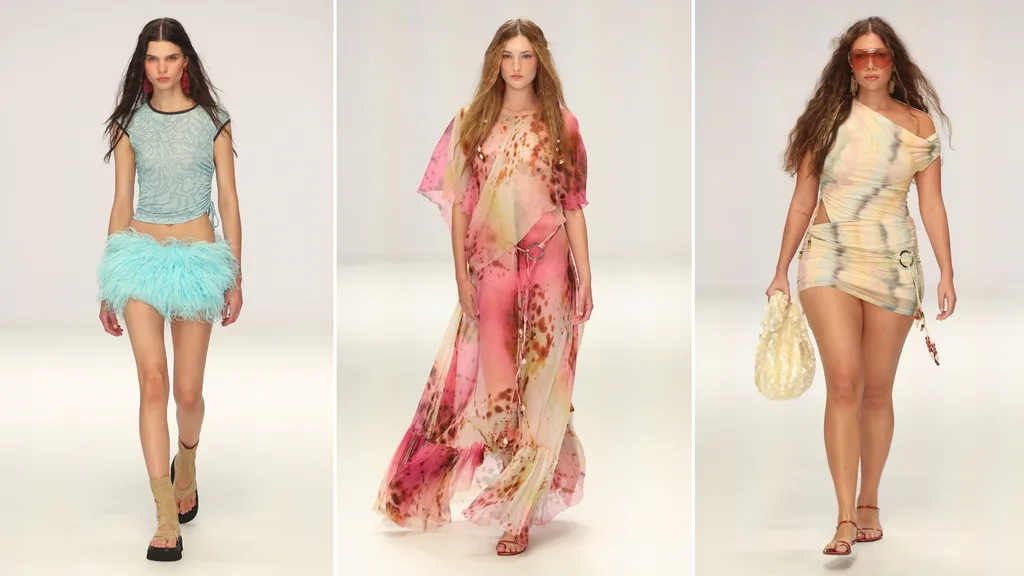
What does a love letter to Australia’s coastline look like? Hansen & Gretel’s Resort ’27 collection, TIDE, made a compelling case. Staged against Sydney Harbour at the Museum of Contemporary Art, the runway was framed by melting ice sculptures embedded with shells and starfish, heightening the collection’s oceanic mood.
Fluid silk gowns dissolved through shell-inspired ombré tones, while washed denim, pearl appliqué, hibiscus prints, and crystal embellishments evoked salt air and refracted light at dusk. There was an instinctive softness to the silhouettes, tempered by the label’s signature “femininity with bite.”
Beauty mirrored the same undone sensuality, with Shark Beauty Hair Director Madison Voloshin creating windswept, salt-textured waves threaded with shells and loose braids using the Shark Glam Hot Tool Air Drying & Styling System. The softly irregular texture felt intentionally lived-in, complemented by flushed, sun-dappled skin.
Speaking to the inspiration behind the look, Voloshin said: “For the Hansen & Gretel runway, the hair channels a seductive force — effortlessly magnetic, naturally beautiful, and intentionally undone, like it’s been swum in and left to dry in the ocean air. The Shark Beauty Glam tool was key to bringing that texture to life, using the Silki Ceramic Straightener attachment over soft plaits to create subtle, irregular waves that feel organic rather than styled.”
Courtney Zheng
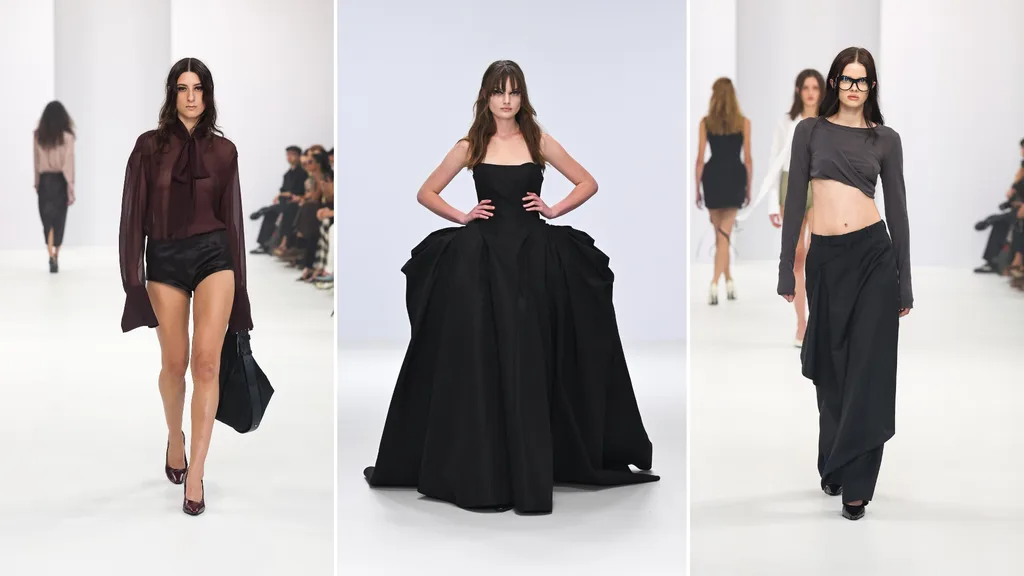
At AFC Australian Fashion Week, Courtney Zheng presented her first standalone runway collection, Beauty as Resistance, a Resort ’27 offering charged with urgency, intimacy, and a distinctly punk sensibility.
Remarkably realised within an accelerated creative timeline — the collection was assembled in little over a month — the show never betrayed haste. Instead, it unfolded with instinctive cohesion, each look dissolving seamlessly into the next.
The collection framed fashion as both emotional armour and communal gesture. Fluid tailoring, sheer camisoles, and plunging wrap jackets balanced sensuality with restraint, while distressed textures, faded band tees, burgundy ponyhair micro shorts, and moto references introduced a rawer, deliberately unresolved edge. Shevoke frames reinforced the collection’s understated attitude, lending even its more sensual looks a certain severity.
There were traces of ’90s minimalism in the elongated silhouettes and restrained palette, yet the collection’s emotional tenor felt far more personal than nostalgic. Beneath the dark romanticism was a growing confidence in Zheng’s visual language, one unafraid of contradiction: polished yet scrappy, severe yet playful, erotic yet controlled.
Aje
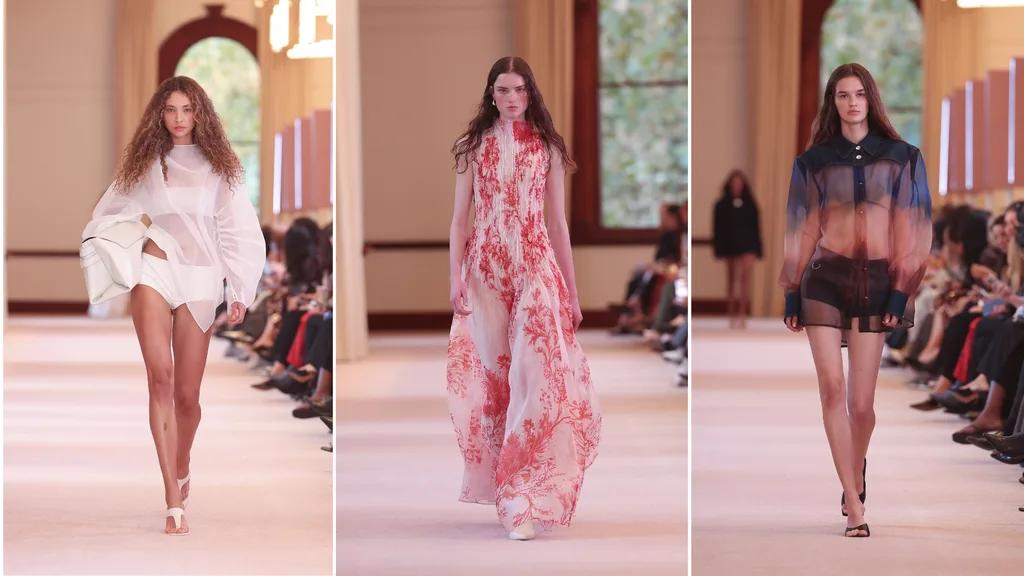
At sunset on Sydney Harbour, Aje unveiled Resort 27, Siren, beneath the warm rose glow of its first indoor runway presentation. While the phrase “office siren” may dominate contemporary trend discourse elsewhere, founders Edwina Forest and Adrian Norris reinterpreted the notion through a distinctly Australian lens, drawing on surf culture, rural landscapes and the undone sensuality that has long defined the brand.
The collection unfolded as a meditation on contrast: sculptural draping met hardened textures, while sheer organza, sequinned separates and raffia-fringed crochet introduced movement and tactility. Low-slung vegan leather trousers paired with wetsuit-inspired tops nodded to the coastline, while metal-tipped straps and fluid ruffles carried a romantic Western inflection.
Though sharper in mood than recent seasons, the collection also signalled a return to the brand’s earliest instincts, with Norris reflecting that several looks echoed designs created nearly two decades ago, now rendered with greater precision and refinement.
Bianca Spender
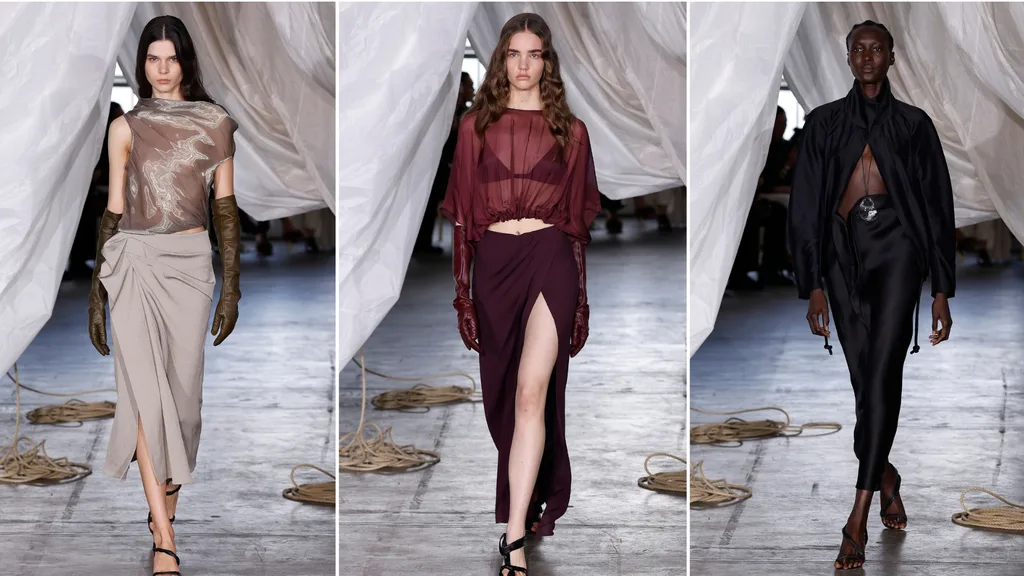
Bianca Spender’s Resort 27 collection is a study in quiet rebellion, where restraint and precision define elegance.
Anchored by the Hellebore—a winter-blooming rose symbolising resilience—the silhouettes oscillate between architectural columnar shapes and softly voluminous drapery, with sculpted funnel necklines juxtaposed against sheer skirts. Textural contrasts—from tailored taupe suiting to fluid silk chiffons, chocolate metallics, and parachute nylon—articulate a dialogue between structure and release.
Set within an industrial warehouse punctuated by Lauren Brincat’s suspended installation, the runway choreography accentuated movement and spatial interplay. Hair and makeup celebrated inherent texture and a subdued, ethereal luminosity, echoing the collection’s elegant minimalism.
Henne’s Denim After Dark
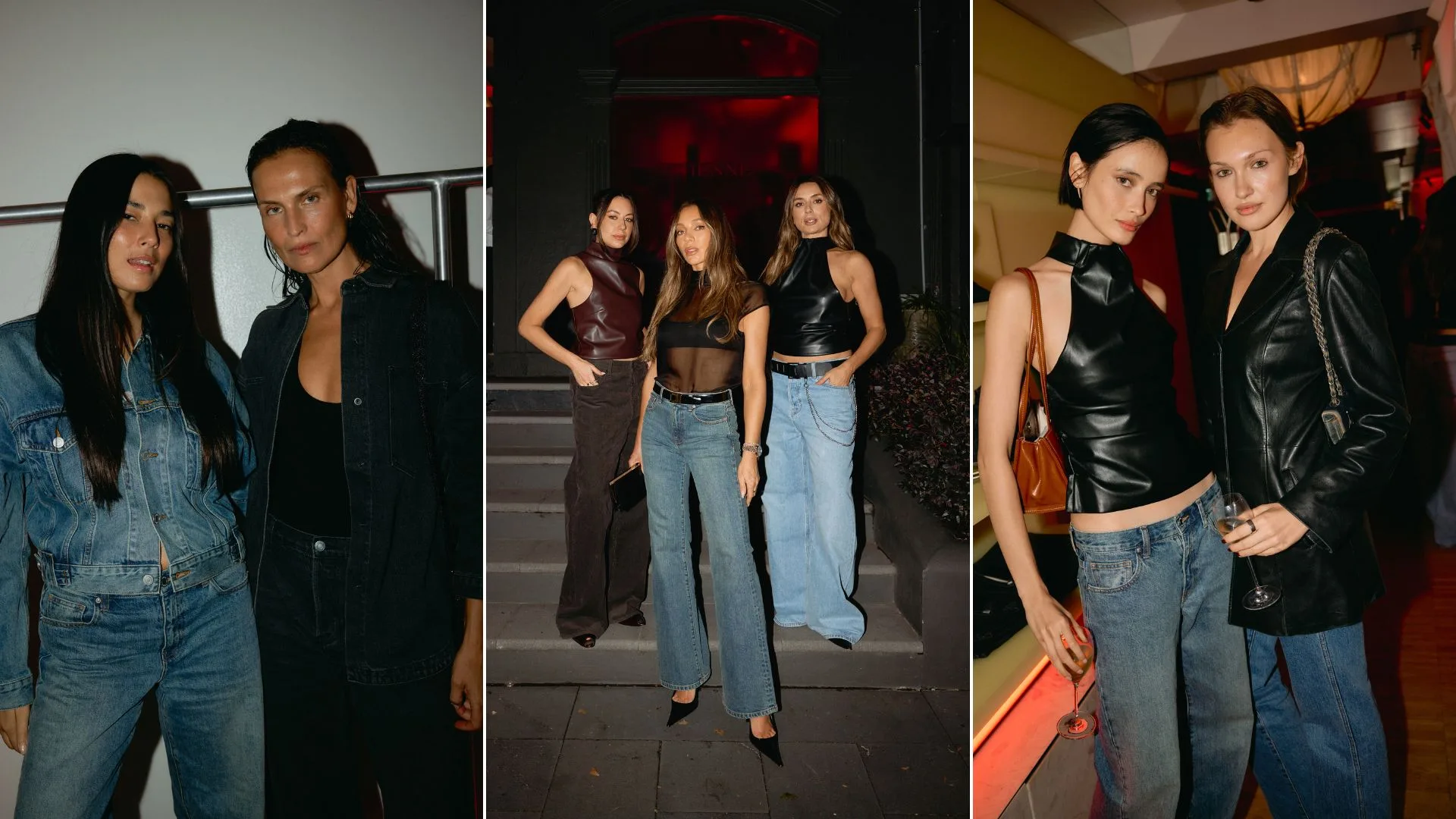
Australian fashion label Henne stepped outside the official Australian Fashion Week schedule to host Denim After Dark, an intimate off-schedule party at its Paddington boutique in Sydney celebrating the launch of its latest denim collection, Denim Defined.
The late-night affair transformed the boutique into a party setting, with guests (including Pip Edwards, Indy Clinton, Jessica Gomes and Montana Cox) indulging in burgers, fries, spicy margaritas and cherry martinis as they previewed the new range — which reimagines the wardrobe staple through refined fits, timeless washes and elevated detailing designed to evolve with wear.
Day 1
Carla Zampatti
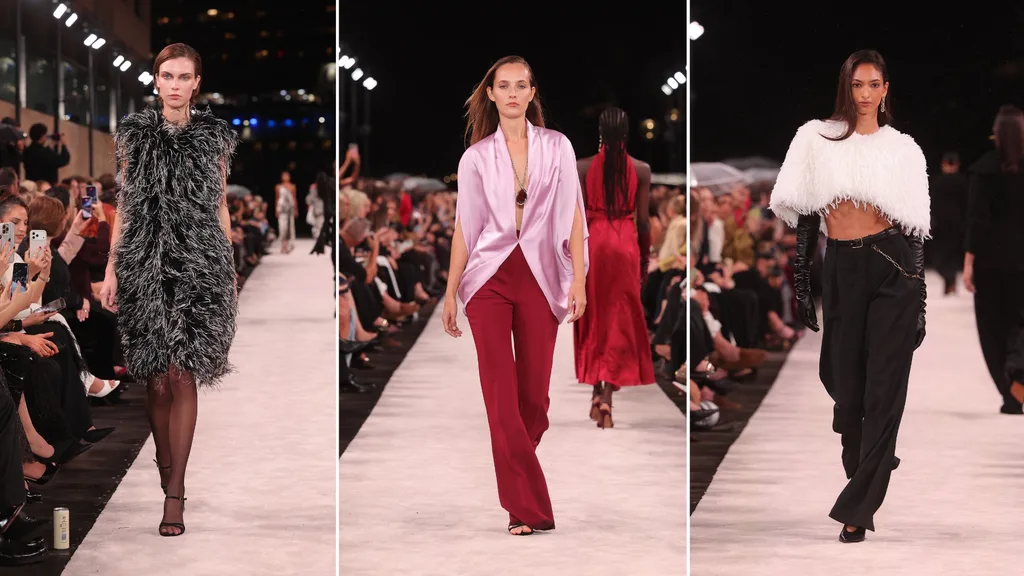
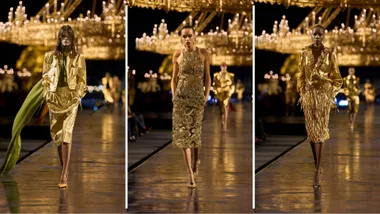
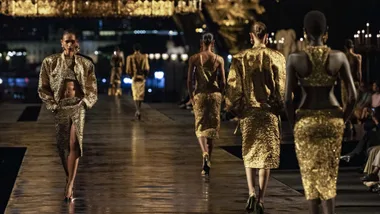
Carla Zampatti’s AFW 2026 presentation, under the discerning eye of Tanya Eamon Beattie, was a study in heritage reimagined. Celebrating the brand’s 60th anniversary and the 30th edition of Australian Fashion Week, Beattie’s sophomore collection navigated nostalgia with a forward-looking sensibility.
Refined separates—a feathered crop top, candied pink blouses, and silken co‑ords—articulated a modern, empowered femininity, while traditional evening wear was reinvigorated through plunging backs, shortened hemlines, and a luminous play of sequins.
Staged along a carpeted catwalk against the iconic backdrop of the Sydney Opera House, the show underscored Beattie’s vision: to honour the brand’s storied legacy while evolving its design vocabulary toward contemporary elegance. The result was a collection that felt simultaneously timeless and audacious, a quiet assertion that Carla Zampatti is designed for the modern woman.
Beare Park
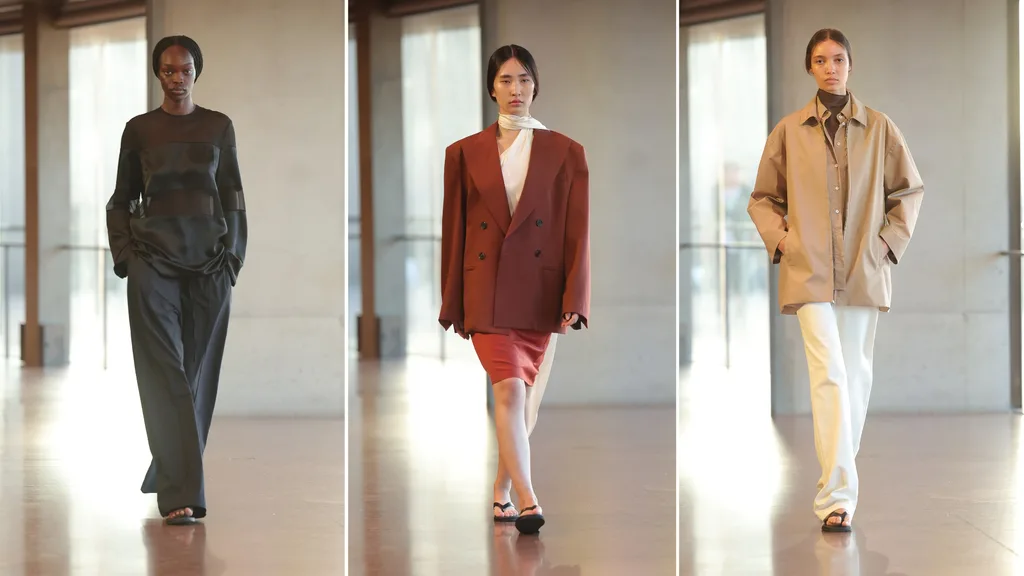
Drawn from the devotional lyricism of Sinéad O’Connor’s In This Heart, Beare Park’s Pre-Fall 26 collection explored longing, instinct, and emotional permanence through a refined, deeply personal lens.
Conceived during a period of creative transformation for designer Gabriella Pereira, the collection balanced architectural tailoring with fluid drape, sheer silks, crisp cottons, and metallic ash dupion silk that shifted softly in the afternoon light.
Rendered in burnt sienna, tobacco, ivory, and nightshade tones, the collection unfolded within the Sydney Opera House, with styling by Nichhia Wippell.
Maticevski
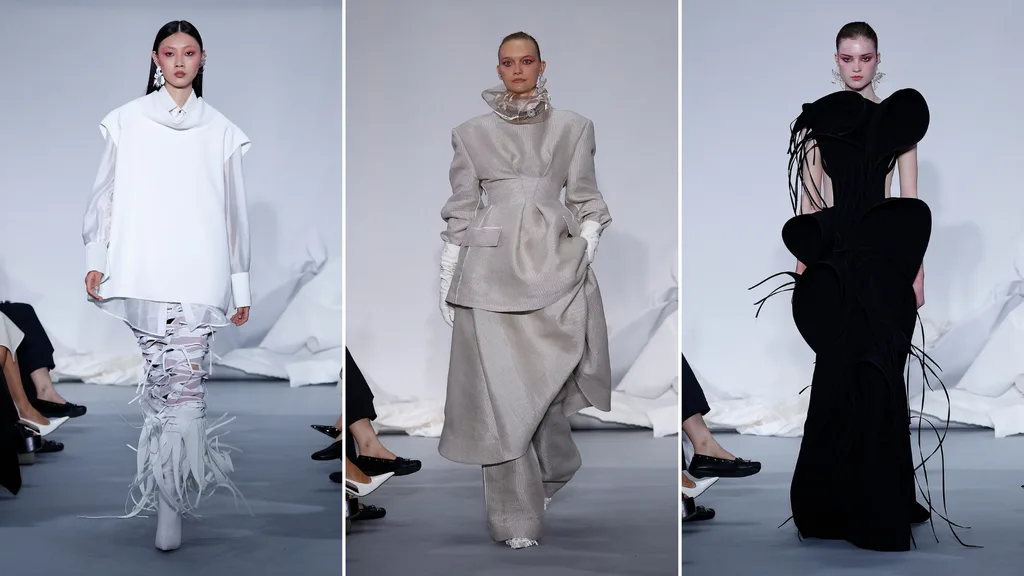
On TikTok, fashion enthusiasts claim you can tell when a designer truly loves women. If that’s true, Toni Maticevski must be obsessed.
Winter 2026 revealed his devotion in every line and curve, with cascading fringe, sculptural embellishments, and diaphanous swathes that seemed to float across the body, while tailored components, widened shoulders, and pointed hips articulated a silhouette both controlled and fluid.
Presented at The Collider in Haymarket with Gemma Ward opening the show, Maticevski returned to the AFW schedule with a salon-style showcase that placed craftsmanship in sharp focus. Each garment reflected the brand’s mastery of structure, movement, and precision.
Buluuy Murrii
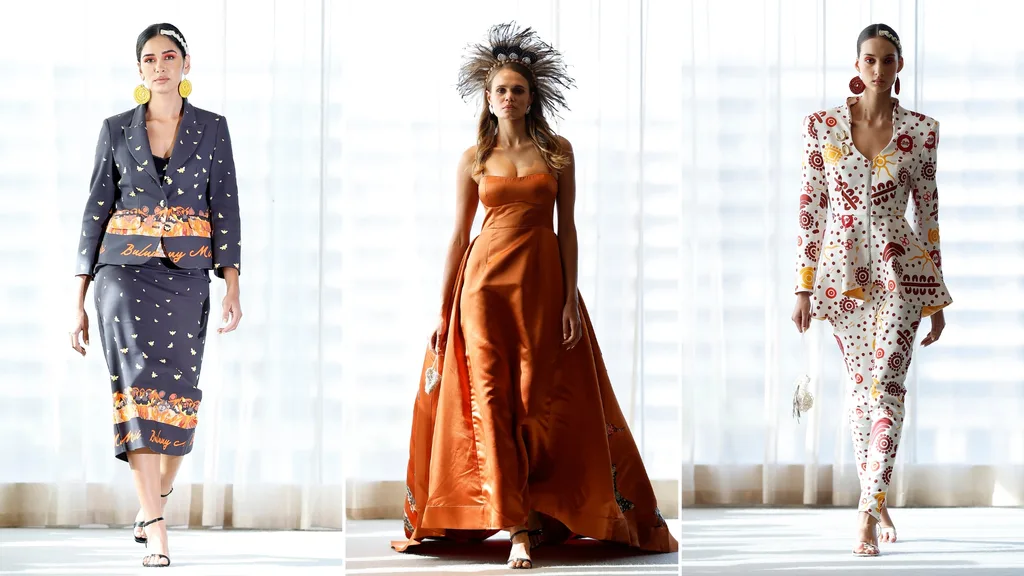
Colleen Tighe Johnson, the designer behind Buluuy Mirrii and a creator for over 15 years, opened Australian Fashion Week with Love from Gamilaraay, a collection that brings a deeply personal and cultural vision to the runway.
Celebrating Gamilaraay culture, language, land, waterways, skyways, animals, and people, the collection is an act of remembrance, strength, and storytelling, honouring the beauty and resilience of the Gomeroi people.
Drawing inspiration from the Mehi River and the skies of Gamilaroi Country, Johnson translates Gomeroi artworks into textile prints on luxury fabrics, weaving heritage into couture-level craftsmanship.
Memories of growing up in Moree, surrounded by grandmothers, sisters, and community, informed the collection — from hand-sewn clothing to local events and dances — infusing each look with pride, confidence, and cultural resonance.
Spanning 25 looks, the collection balanced statement gowns and embroidered detailing with louche separates and refined suiting, blending resort ease with theatrical elegance.
Van Ermel Scherer
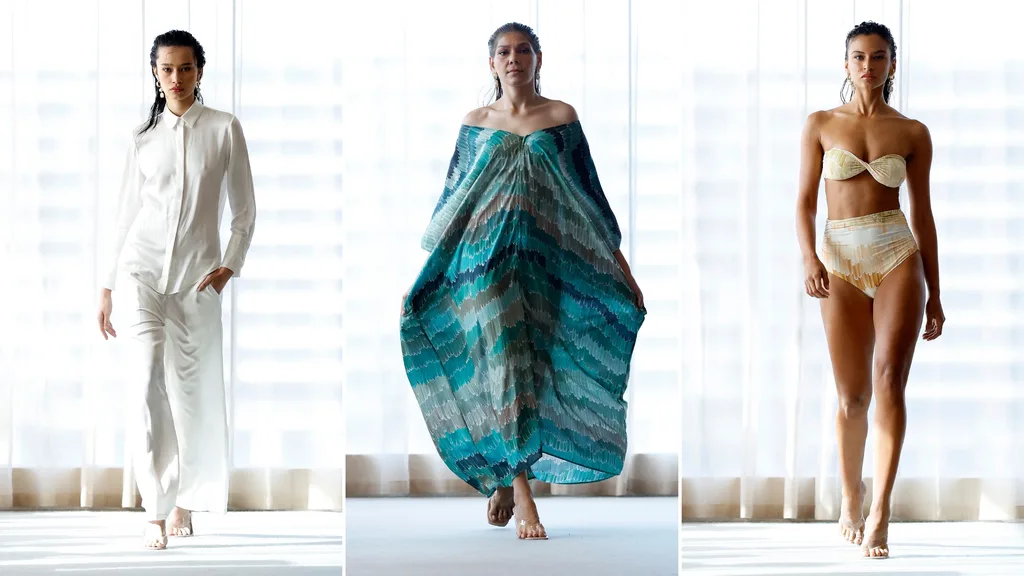
Van Ermel Scherer’s Australian Fashion Week debut opened with Jennifer van Ermel Scherer, mother of designer Verity van Ermel Scherer, wearing a silk crepe kaftan printed with Lizzy Stageman’s dot painting Warranha Inaar (Strong Woman).
The Resort 2027 collection of 24 looks featured flowing kaftans, bold swimwear, and tailored monochrome separates, punctuated by rain-inspired prints Marrunga Yubaa (Embrace the Fall) in turquoise, emerald, sea-green, and earthy ochre.
Founded in tribute to Verity’s late grandmother, Mattie Frith, a Stolen Generations survivor, the label blends heritage with contemporary design. Each look combined precise craftsmanship with cultural storytelling, celebrating feminine strength, resilience, and artistry.
The Beauty Device Fashion Week Insiders Are Using Between Shows
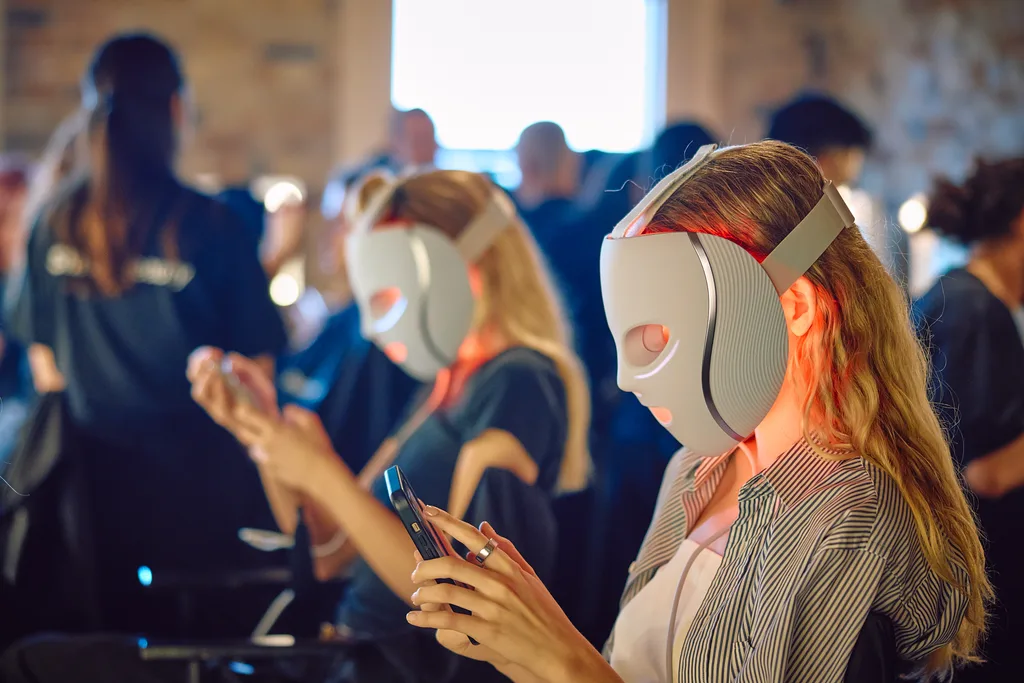
If there’s one beauty device quietly becoming the MVP of Australian Fashion Week, it’s the Shark CryoGlow Under-Eye Cooling & LED Mask. Spotted backstage on models between fittings and touch-ups, the futuristic mask combines dermatologist-developed LED light therapy with an under-eye cooling function designed to visibly depuff, firm and boost radiance. “It’s become my secret weapon during long shoot days,” says marie claire Beauty Director Sally Hunwick. “The cooling under-eyes instantly make you look fresher, brighter and more awake – even when you’re running on very little sleep.”
Always read the label and follow the directions for use

Related stories
Native ad body.
Native ad body.
Native ad body.