Before the Islamic Revolution of 1979, Iran was a different country. It was never a paradise – during the last Shah’s rule there was corruption, foreign interference, and the persecution of political opponents – but women lived, half a century ago, with more autonomy than they do today: freedom in appearance and daily life, access to education and public life, and the ability to move, work, and speak without their very existence being treated as a crime. After the regime change, everything narrowed. Strict laws and codes turned clothing, movement, and even a woman’s presence in public space into something to be monitored. The body became a site of control – under constant surveillance.
In 2022, the death of 22-year-old Mahsa Amini, after her arrest by the Morality Police, opened a wound that could no longer be hidden. The protests that followed were met with bloodshed: thousands were killed or arrested, and many voices were silenced. And yet the chant “Woman, Life, Freedom” refused to disappear – becoming the language of collective memory, and of a generation unwilling to live quietly.
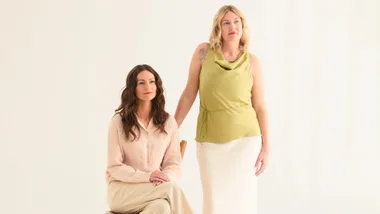
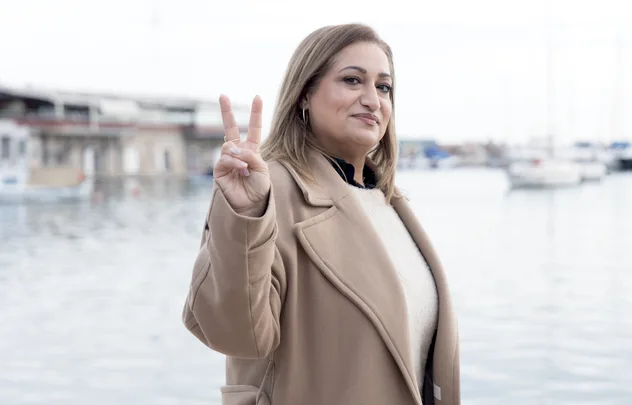
Today, four Iranian women living in Greece speak to marie claire about what came before – and what came after.
Yasmin Alizadeh
“I left Iran when I was seven, with my mother and father. There were many reasons, but the main one was simple: my father wanted a better future for me – far from the stereotypes and restrictions that shaped everyday life. At the same time, his work as a journalist had already brought trouble. A political article, published without approval, made our departure feel less like a choice and more like a necessity.
As a child, what I remember most is confusion. We sold everything in our home so we could start again from scratch. No one explained exactly what was happening. To me, ‘we’re leaving’ sounded like a trip. I remember getting on the bus to Turkey and seeing people crying around me. I kept wondering why. I didn’t understand then. I understood later.
I grew up in Rasht, a green city near the Caspian Sea. I have memories, but I haven’t been back. Until 2017 I was a political refugee – my parents still are. Since I obtained Greek citizenship, technically I can return, but the fear remains: the checks, the questions, the uncertainty.
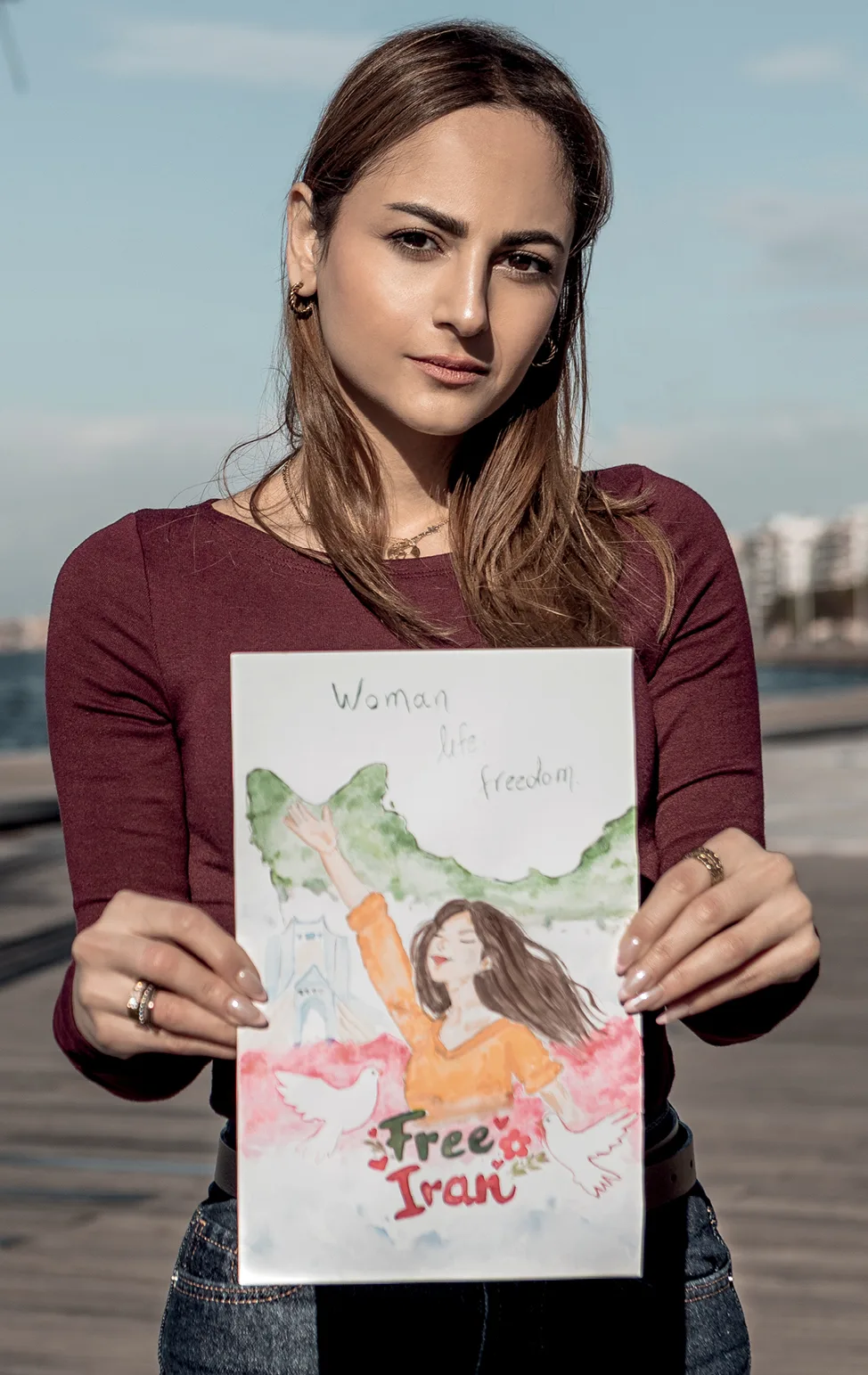
What stays with me most are the images of school. The teacher dressed in black, the hijab covering everything. Even we – children – wore headscarves. Schools were segregated: girls only, boys only. I remember the heat, playing at recess, and the urge to lift the scarf for just a second to breathe. It wasn’t allowed. The reprimands came immediately. For a child, that is oppression. I cried. I didn’t want to go to school.
I remember women at the sea entering the water fully clothed, coming out drenched. I remember my mother being stopped on the street because her fringe was showing. These images don’t leave you.
Almost all my family is still in Iran. My grandmother often tells me she’s afraid she’ll die without seeing me again. That sentence hurts the most. And yet the Iranian people are warm and joyful. Even under oppression, they find ways to feel happiness – if only in private. Women, especially, live with permanent fear: what they’ll say, how they’ll dress, who will stop them on the street. And yet they are strong. They fight every day, even if the world doesn’t always see it.
It angers me when people in Europe equate the people with the regime. Iran is not its regime. Speaking publicly, I don’t fear for myself – I fear for those I’ve left behind. And yet I can’t stay silent.
Feminism exists in Iran as a word, but reality is far away. A woman needs permission to travel, to work, even to decide about her own body – in other words, she doesn’t have basic human rights. The Woman, Life, Freedom movement showed that if change comes, it will come from the new generation.
In Greece, I feel visible. It’s my second homeland. Here I grew up, studied, built a family. I have a son with my Greek partner. And yet, as I get older, the urge to return – even briefly – grows stronger: for the smells, the tastes, the people.
I love both my homelands, even though both have wounded me. It’s like black coffee: bitter, but you can’t stop loving it. For me, freedom is like oxygen. It isn’t something you ask for. It has to exist. Because without freedom, you simply don’t breathe.”
Zandark–Anna Gorasi
“My father was a professor of French Philosophy – that’s where he found the name Zandark. Later I was baptised Anna. And I have a story that hurts, one that doesn’t fit neatly into a few lines.
I still keep old photographs. I carry them as proof that Iran wasn’t always like this. Photos of my mother and father – women free, ordinary, dressed however they wanted. They’re both gone now, but when I look at those pictures I see a Persia that feels almost impossible today. I see my aunt with her husband and child. I see my sister’s wedding, and me – eight or nine – standing among women dressed so differently then. Now they marry in hijab. Outside, you must wear hijab. Everything changed.
As a child I was full of life. I played volleyball. I played violin. There was music. There was movement. And then… they started closing everything down. Music in secret. Cassettes in secret. Small joys, hidden. And the headscarf – if it slipped even slightly, they could tear you apart. There is religious police. Morality Police. They grab you, arrest you.
I remember the last stretch at school when we felt we still had a drop of freedom – before they tightened everything. We took photos laughing, like children who didn’t yet know what was coming. But it came. Suddenly everything changed. After the revolution, you had to wear the ‘must.’
I got into Medicine. I studied at a beautiful university – and yet daily life was a prison. I wore the minimum I could, but the minimum there was a black chador: black from head to toe. It erases your body, it erases your joy. Even a photo, even a moment, could be illegal. We took photos at dawn – six in the morning – so we wouldn’t get caught. Everything was fear.
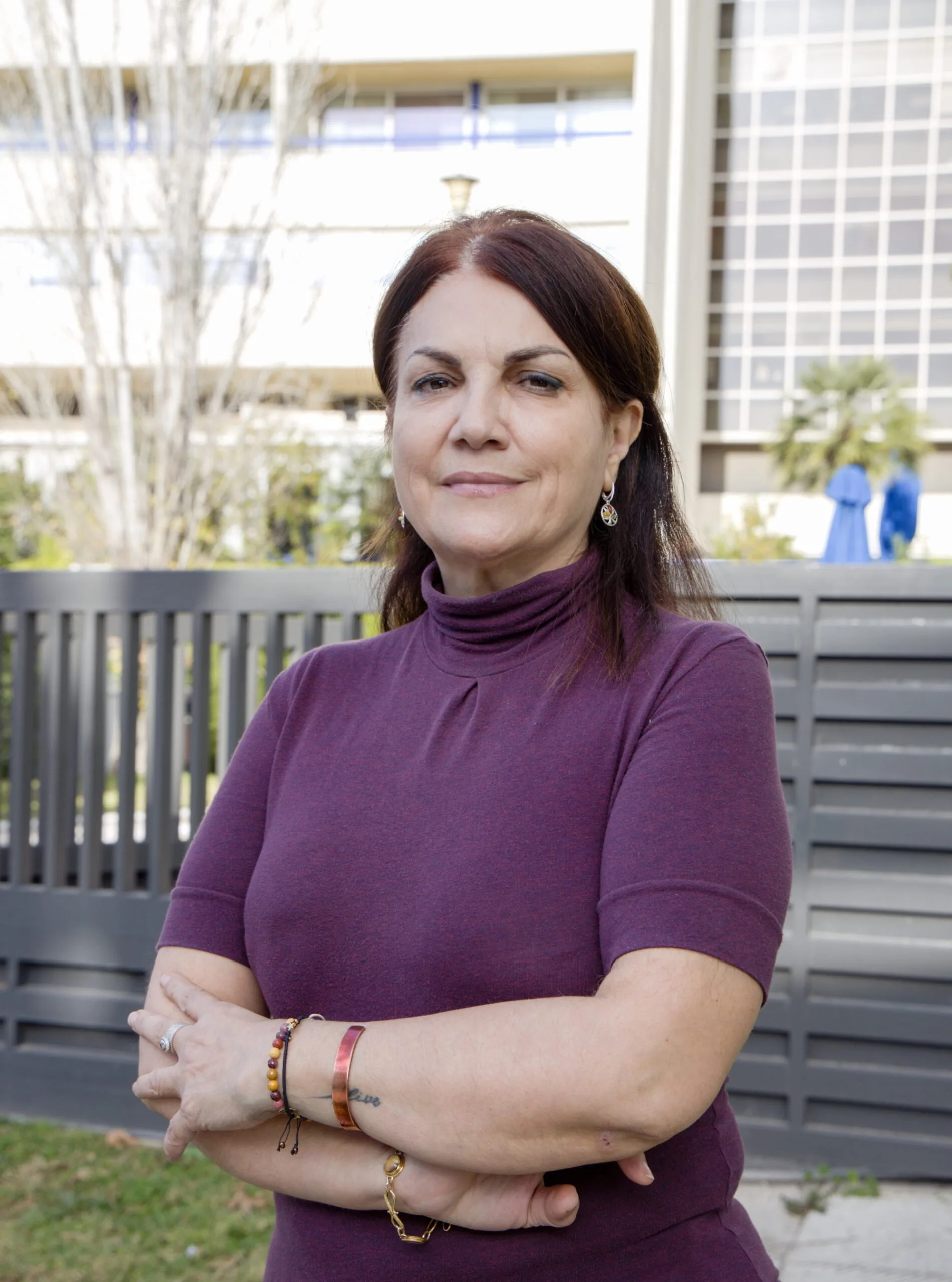
Later I became a gynaecologist. I had a career. A home. What some would call a good life. I married young – at 20 – and stayed married 15 years. I had two children, now grown, living in America. I had everything, but when you don’t have freedom, you have nothing.
And there was something else. When I married, women were forbidden to speak with men. You didn’t get to know someone – you married them and then you got to know them. At medical school we sat apart – girls on one side, boys on the other. Not even to look, not even to laugh freely. Not to hold your partner’s hand outside. Even married couples couldn’t walk hand in hand. Kissing? Unthinkable.
At some point I began seeing the outside world through cracks – satellite television, videos, glimpses. And a simple thought formed in me: I haven’t lived as a woman. I wanted to fall in love. I wanted to live. I wanted to walk without fear.
But to leave Iran you have to be a free woman – and you’re not. You need permission. A signature. A man’s agreement, even when the life is yours. My first husband didn’t want me to leave. Divorce was a battle. And when I finally left, I came to Greece not because it was my dream, but because a new life opened here.
I married again – a Greek man – and had twins, but we divorced. I worked. I fought. I sat exams again: DIKATSA (DOATAP), language tests, paperwork – in Greek. It took me three years to practise as a gynaecologist again. I worked in a health centre, did rural service – Syros, then Mykonos. I had a practice. I had work. And you know something? I didn’t experience racism – only once did something happen. Mostly, people stood by me.
And yet, Iran never left me. For years I travelled back and forth to see my mother. Each time, life there felt more expensive, more difficult, more suffocating. And every time before travelling I did my ‘preventative’ things – social media, phone, fear – because they can catch you for anything. A strand of hair. A leg. Or accuse you of being an agent. You don’t know.
I’ve lost people. A friend’s 16-year-old nephew was killed. Another man – about fifty – stepped out to buy something, there was a crowd outside and they shot him. I know their names. Their faces. They’re not just ‘news’ to me. They’re mine.
And then came the moment I understood, physically, what the Morality Police means. I was in Iran wearing a long garment, but there was a small slit at the side. I didn’t realise my leg showed as I walked. They grabbed me. They put me in a van. Religious Police. They told me to write my story – who I was. I said yes, terrified, because in two days I was meant to return to Greece and I knew: if they keep me, everything ends.
And there – just as I stepped up into the van- I bolted. I ran. I don’t know where the energy came from. I was 50-plus, not a child. But I ran like my life depended on it. I crossed streets without looking. Panic. They couldn’t follow as fast as they wanted; they hit a red light and I turned, disappeared. I hid in an ice-cream shop, behind the counter. I stayed there for half an hour, motionless, just to be sure they weren’t coming. Then I took a taxi, went to my mother, locked myself inside. From there: straight to the airport. I didn’t go out again, not even to the door.
For two nights I didn’t sleep. What if they took a photo? What if they stopped me at the airport? What if they didn’t let me leave? You can’t imagine that fear.
And when I finally set foot in Greece, it felt like my breath returned. I said to myself: ‘Ah Greece, Greece.’ Because here I found a new life. Opportunities. Support. Here I can be a person.
When people ask what I would say to women living in Iran today, I say only this: we are all trapped – women and men – but women carry it heavier. There, you wake up in fear. You live in fear. I want it to change. But I don’t believe it will change unless the world helps – unless there is pressure, unless people stand beside us. Because alone, against this, it’s like holding your breath under water.”
Soudabeh Balesini
“I left Iran in 1996, when I was 21. I was studying Sociology and Child Psychology, and with fellow students we conducted research in institutions for children who had been removed from their families or who had delinquent behaviour. Through this work we spoke openly about something that, at the time, was considered… dangerous: women’s rights in divorce and, above all, child custody. In Iran, custody was almost always granted to the father. Mothers had no voice.
Our work was based on scientific data, but for the authorities that was enough. First came the warnings. Then the punishment: I was expelled from university for a year. That’s when I became truly afraid. And I decided to leave.
It wasn’t only theoretical. It was deeply personal. I am a child of divorce. My parents split when I was six and although custody was granted to my father, we never lived with him. He formed a second family and we were raised by our grandmother and uncle. My mother fought for years to have us with her, and she succeeded only when I was 10. That injustice marked me. I understood early that something was deeply wrong.
I was six, shortly after the revolution, when I remember my aunt rushing into the house, panicked, gathering books – literature, political books, even Kazantzakis. A friend of hers had been arrested because she had books at home. We put them into sacks and hid them in storerooms and in the forest. That’s the first time I remember fear. And that’s when I understood what it means to fear knowledge.
At university, my need to speak only grew stronger. We had a student magazine where we published our findings. Deep down I wanted to become a writer. Religious-control bodies called us in constantly – they were everywhere. ‘These things aren’t liked,’ they told us. Then came the expulsion. I knew it was only the beginning.
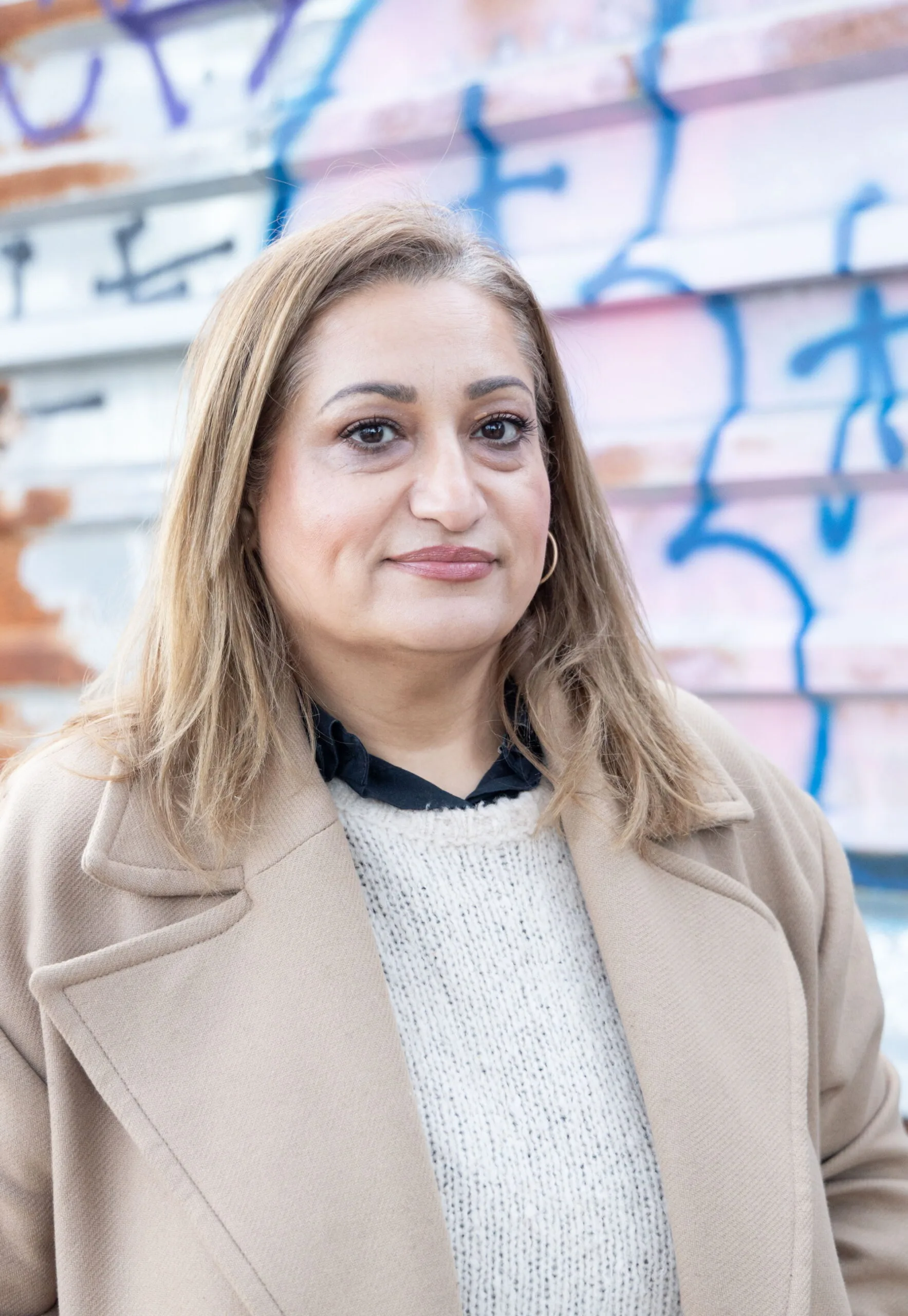
I left for Denmark, where my father and brother were. Greece was meant to be a stopover. It became my home. Here I was shaped. Here I learned to belong. When I left, I felt relief—alongside guilt. I left my mother behind. It took us 14 years to see each other again. Fourteen years without a hug. Back then there weren’t even video calls. When I saw her again, the emotion was overwhelming – and so was the shock. I couldn’t believe how much time was gone.
In Greece I learned the language on my own – reading signs, listening to television, living daily life. And in that way, through language, I found my voice again. In 2013 I began volunteering as an interpreter for unaccompanied children. I still remember the first time I walked into a hospital room and spoke to two small children in their language. They ran and hugged me. That’s when I knew what I wanted to do: become an interpreter. Since 2018, I’ve done it professionally.
Today I feel I belong to two worlds. I’ve kept the best parts of my Iranian identity and adopted many things from the Greek one. A homeland is like the mother who gave birth to you. The country you choose to live in is like the partner you choose.
What I don’t miss from Iran is oppression: the compulsory headscarf from the age of six, the Morality Police, the fear. Being stopped in the street and asked who I am and who I’m walking with. For me, freedom is breath. In Iran it’s like living under water, holding your breath. You measure your words, your movements, your life. Here, I breathe.
And yet my thoughts are always with the girls who stayed behind. When I see them on the streets, I feel pride and emotion. They are unbelievably brave. And bravery isn’t only staying and resisting; it’s also leaving—leaving parts of yourself behind in order to survive.
For the future, I want to believe the regime will fall. But I’m afraid it will fall with a lot of blood. That is what frightens me most. If I could say something to the girls of Iran, it would be only this: I’m sorry I’m not there. I’m sorry I’m not with you.”
Ada Rouhi
“I was born in Tehran after the Iranian Revolution. I’m 46 and I grew up inside a regime of restrictions that, no matter how used to them you become, you never truly choose. For the last five years I’ve lived in Greece. We came as a family—me, my husband and our son—for one reason: our child’s future.
My son wanted to pursue IT. In Iran—especially at high school and university level—there was no longer a strong educational system in that field. After international sanctions, around 15 years ago, many international schools closed. Options narrowed dramatically. He knew early on that his future there would be limited. He wanted to leave, to live somewhere with opportunities, to build a better life.
Greece was, at first, a realistic solution within the European Union. It was the most affordable place for us to buy a home and for our son to finish high school. Today he studies in London—and that alone confirms we made the right decision. I still remember our first day in Greece. We loved it immediately. There was no culture shock—quite the opposite. The food, the people, the culture: everything felt familiar. Greeks are very similar to Iranians. Even the cuisine is close. I felt I could belong.
As a woman in Iran, I always had to wear a headscarf. Nothing extreme—just a simple scarf—but I never liked it, especially in summer. And the problem wasn’t only the scarf. It was the lack of choice. You couldn’t say, ‘I want to wear this.’ You couldn’t wear a dress if your legs showed. You had to wear trousers, or a very long skirt. It wasn’t a choice. It was an obligation. My husband never had an issue with what I wore. The regime forced us. I grew up that way. I lived that way from childhood. You get used to it—but by force.
In Greece, from the first moment, I dress freely. I don’t wear a headscarf. And yes, everything is better.
We weren’t afraid of one specific thing before we left, but there was always the shadow of war—a permanent fear that never fully disappears. When Mahsa Amini was killed, we were already in Greece. My parents are still in Iran. That period was very hard. Many people were killed. I was terrified for my family. Thankfully my parents don’t go out much.
If I could go back in time, I would make the same choice. I would come to Greece again. There was no longer a good life there.
From Iran, I miss nothing—only my parents. We visit every year. Recently we haven’t even been able to communicate with them. For days there has been no internet—only landlines. I can’t call them; they have to call us. I feel phones are monitored. You can’t say whatever you want. If the situation changed, I would like to return. But while it stays like this, I don’t want to go back.
I love the weather in Greece. In Iran there is heavy pollution. Here, quality of life is much better. My days are simple and ordinary: I go to the gym almost every day, I cook, I learn Greek at a language school. There’s also an Iranian community here—friends, gatherings, weekends together. Sometimes I’ve felt foreign, or that people look at me differently, but overall I feel good here.
I love that Greeks live on the balcony. They speak from one balcony to another. They’re full of life—human. They make me smile.
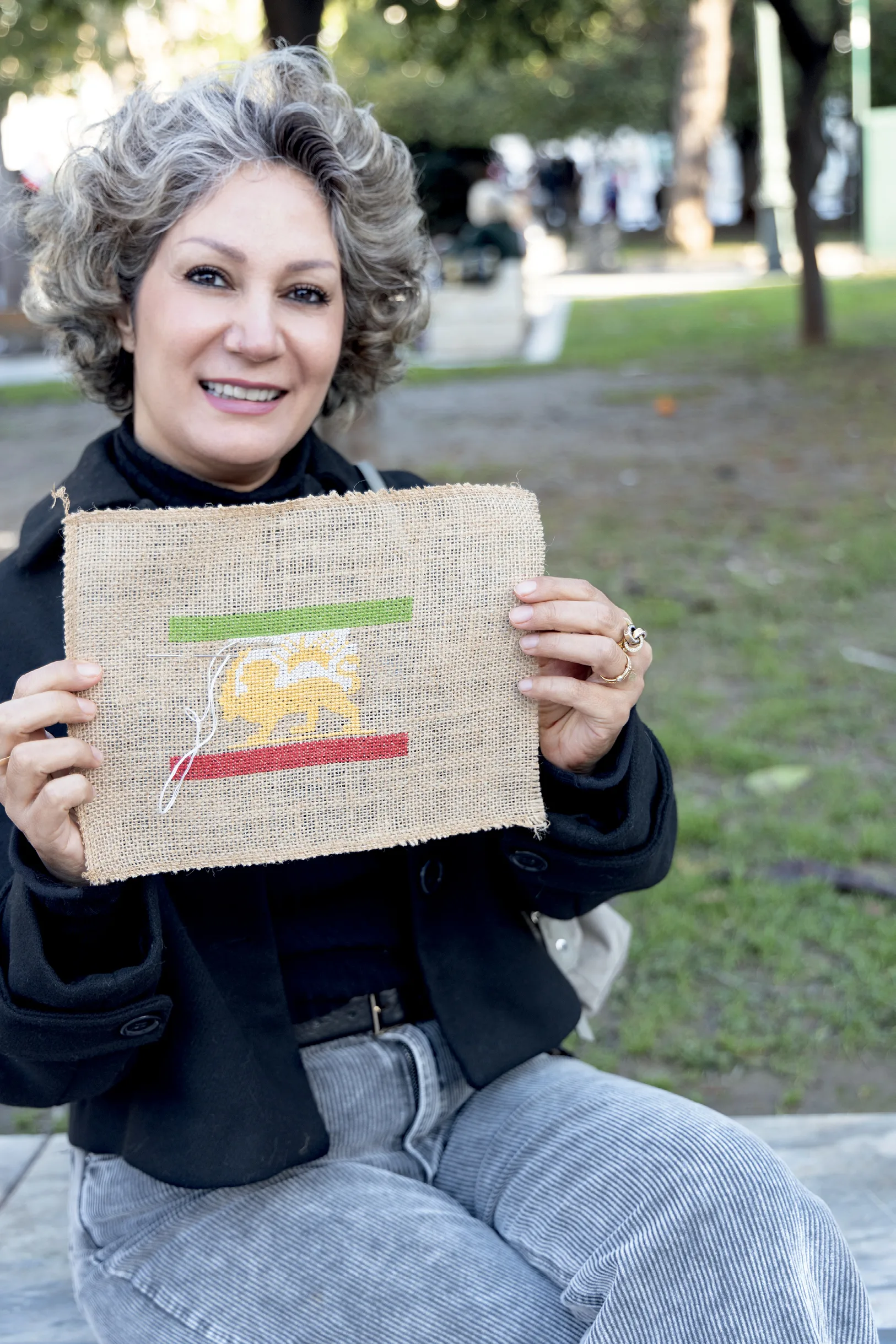
Embroidery has been part of my life since high school. We learned it at school, as a subject. For me it’s art and relaxation. When I embroider, I don’t think about anything else. At first I brought supplies from Iran; now I know where to find them here. I can’t imagine myself without embroidery. Many patterns I stitch remind me of home—motifs inspired by Iranian carpets, translated into cross-stitch. In Iran I could embroider whatever I wanted, but sharing it on social media? No. They would find me.
Right now I’m embroidering the old flag of Iran. When the mullahs came, they changed it and placed an Arabic phrase in the centre—‘God is great’—something that has nothing to do with our language or our beliefs. The lion and the sun that I stitch are ancient Iranian symbols, long before the regime.
When I embroider this flag, it isn’t just a design. It’s a way to keep memory, identity, and our history alive. What existed before. What belongs to us.
If I had to embroider a symbol of freedom, it would be a woman with long hair—free, blowing in the wind. And if I embroidered a wish for the future, I would stitch the map of Iran: so it won’t fall apart, so it will remain as it is—like a cat. We believe in that. We want it, desperately, to be saved.”
Originally published on marie claire Greece. Words: Rita Tsiolachristou

Related stories

Native ad body.
Native ad body.

Native ad body.