What lengths are we willing to go to attain physical perfection? Lengthy skin-care routines, hair maintenance, and dieting culture are hardly revolutionary for anyone raised on the steady gospel of women’s media.
Yet for a growing cohort of young boys on TikTok, these basics are being repackaged as revelation, acting as a gateway to more extreme and, in many cases, dangerous practices.
What was once dismissed as vanity, or deemed feminine, is now being reframed as strategy.

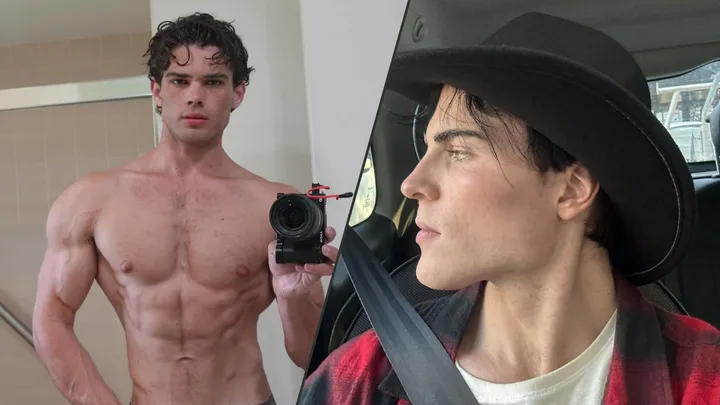
On Sunday night, 60 Minutes Australia aired a segment on “looksmaxxing”, featuring Braden Peters, better known by his online alias, Clavicular. Named after the clavicle, or collarbone, he has become one of the most recognisable faces of the movement: a sprawling online subculture of young men devoted to optimising physical appearance, often with the belief that it will improve their romantic prospects.
So what exactly is behind this movement, and why is it commanding so much airtime? Ahead, everything you need to know about a troubling corner of the internet now taking root and circulating at speed.
At its core, looksmaxxing is the pursuit of becoming as attractive as possible according to a rigid, highly codified set of criteria, with particular emphasis placed on jawlines, eyes and physique. Some influencers promote “softmaxxing”, low-lift tweaks like a better haircut or a consistent skincare routine, while others push “hardmaxxes”, far more extreme interventions that veer into surgical territory.
Terms like “hunter eyes”, describing eyes angled slightly upward toward the temples, or a “positive canthal tilt”, are framed not simply as aesthetic preferences but as measurable advantages, believed to offer a competitive edge in life. A frequently cited technique known as “bonesmashing” involves repeatedly striking the facial bones with blunt objects in an attempt to achieve a more “chiselled” appearance.
While the concept of looksmaxxing has circulated online for more than a decade, it has recently been repackaged and accelerated by TikTok, where it is reaching an expanding audience of teenage boys.
Many are algorithmically funnelled toward the broader “manosphere”, a loose network of online communities that position themselves in opposition to feminism and promote a highly prescriptive, often misogynistic vision of masculinity.
Clavicular is a 20-year-old streamer from Hoboken, New Jersey, and a self-described looksmaxxer, a figurehead for an online subculture that treats male attractiveness as the ultimate currency of success.
Like others in that world, he regards any effort to enhance his appearance as inherently worthwhile. But the ideal he is chasing is narrow, prescriptive, almost clinical in its specificity.
Since the age of 14, Clavicular, whose real name is Braden Peters, has injected and ingested a range of substances in pursuit of what the community calls “ascending”, its shorthand for becoming more conventionally attractive.
By his own account, that pursuit began with mail-order testosterone, discovered and discarded by his parents, before escalating to a rotating cast of chemicals ordered via a post-office box. He has claimed to have used substances including crystal meth to stay lean, chasing anything that might accelerate the process.
The goal is singular, and the timeline accelerated. Where self-improvement is often framed as gradual, even pleasurable, his approach is closer to a high-stakes sprint, with efficiency prized above all else.
It is this intensity, paired with the subculture’s dense vocabulary and a worldview that frames social life as a kind of Darwinian contest, that has propelled him into the spotlight. In recent months, Clavicular has become a social media phenomenon, equal parts fascination and cautionary tale.
The ideology has murkier origins, emerging from incel communities, short for “involuntary celibates”, and the broader manosphere that took shape in the darker corners of the internet in the 2010s. Within these forums, users constructed a framework to rationalise their romantic frustrations.
At its core was the belief that physical appearance operates as a rigid hierarchy, largely dictated by genetics. Those who fell short, they argued, were effectively locked out of romantic and sexual success.
For some, the conclusion was total resignation. To “take the black pill”, a reference to The Matrix, was to accept this worldview in its bleakest form: that attraction is fixed, the system is rigged, and opting out of love altogether is the only rational response.
Looksmaxxing diverges at this final step. It accepts the premise that appearance is destiny, but rejects incel fatalism. Instead of opting out, its adherents double down, treating the body as a project to be optimised at all costs, through routines, regimens and, at its most extreme, surgical intervention.
Looksmaxxing Slang Breakdown:
What was once a niche, largely overlooked corner of the internet has produced a dense and rapidly expanding lexicon, now edging into the mainstream. These terms do more than describe; they signal belonging, creating a coded language that separates insiders from outsiders while reinforcing a shared worldview shaped by competition, hierarchy and exclusion.
“Stacy” is slang for a highly attractive, unattainable, socially dominant woman, often portrayed as shallow and exclusively interested in similarly high-status men, known as “Chads.”
The male counterpart to “Stacey” is “Chad”, slang for a stereotypical alpha male, typically young, conventionally attractive, confident and successful.
The PSL scale is an elaborate attractiveness rating system popular within looksmaxxing circles, claiming to offer a quasi-scientific assessment of facial appeal. The acronym itself traces back to a lineage of now-defunct forums, ‘PUAHate’, ‘SlutHate’ and ‘Lookism’, with sites like Looksmax.org often considered their successor.
It breaks beauty down into four categories: “harmony”, or how well features work together; “dimorphism”, the degree to which someone appears distinct from the opposite sex; “angularity”, associated with sharpness and low body fat; and “miscellaneous features”, which evaluates individual traits in isolation, from skin clarity to nose shape and teeth.
Popularised in recent years, the scale reflects a broader attempt to quantify attractiveness as something measurable, optimisable and, ultimately, rankable.
To “mog” someone is to “visually outcompete them”, asserting dominance through appearance in a way that positions the other person as inferior. The term is widely understood to derive from “AMOG”, or “Alpha Male of the Group”, a concept rooted in pick-up artist and manosphere forums.
“Foid” and “femoid” are derogatory, dehumanising terms used primarily within incel communities to refer to women. Short for “female humanoid”, they reduce women to something less than fully human, reflecting the subculture’s underlying hostility and objectification.

Related stories

Native ad body.

Native ad body.

Native ad body.