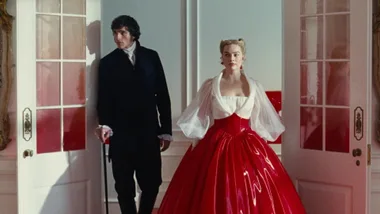
On April 17, Olivia Rodrigo released “Drop Dead,” the first single from her forthcoming album You Seem Pretty Sad For A Girl So In Love.
A visceral evocation of dreamy romance, the track arrives with an accompanying video directed by Petra Collins, whose work has long been synonymous with hazy, feminine whimsy, girlhood rendered as something surreal and self-authored.


In the video, Rodrigo treats the ornate vastness of the Palace of Versailles like a private bedroom, drifting through gilded halls in a dusty blue off-the-shoulder Chloé pre-fall 2026 top, silky ecru bloomers, and white pointelle knee socks.
Wired retro headphones complete the look as she lip-syncs in a kind of dreamy introspection. The setting, paired with its defiantly girlish aesthetic, nods to Sofia Coppola’s Marie Antoinette, while the song’s starry synths and breathless lyricism feel steeped in stylised nostalgia.
Naturally, the internet had thoughts. The babydoll silhouette she wore was quickly deemed infantilising, with some critics arguing that Rodrigo was sexualising herself by dressing in “baby” clothes. It is a curious interpretation.
The babydoll dress has a storied history. First worn as a practical nightgown in the 1940s, then reimagined in the 1960s by figures like Twiggy, it has long hovered between innocence and intent, softness and subversion. It is not a new silhouette, nor a particularly ambiguous one. And yet, it remains persistently misunderstood.
That tension is reflected clearly in the reaction it has provoked. Despite the internet’s insistence, nothing in the video’s visual language strains toward hypersexual. What unfolds is, in fact, remarkably simple: a young woman singing about romance, astrological incompatibility, and emotional intensity—all familiar terrain for Rodrigo.
What feels especially different now is the cultural lens through which it is read. In recent years, there has been a growing awareness of the ways girlhood is fetishised and misread, whether through the romanticisation of “daddy issues,” the circulation of media that trades on adolescent aesthetics, or an entertainment industry long preoccupied with imbalanced relationships between adult men and young women. The question of how fiction shapes perception no longer feels abstract.
Set against the cultural reckoning that followed the Jeffrey Epstein case, that awareness has sharpened into vigilance. It then, makes sense, that anything resembling girlhood invites scrutiny. But in practice, that scrutiny is often misdirected.
Instead of confronting the structures that enable harm, the focus narrows. A dress becomes suspect. A styling choice is sinister. Fashion experimentation is recast as something to decode, rather than something to experience.
Which leaves us here: parsing bows and ruffles for meaning they were never designed to carry.
The question, then, is not whether Rodrigo’s babydoll dress invites sexualisation. It is why we are so quick to impose it.
Clothes do not inherently solicit projection. If anything, the babydoll dress argues the opposite. Playfulness is not provocation, and reclaiming girlhood is not regression. It is a form of authorship. There is no need to distort what Petra Collins and Olivia Rodrigo have made into something uneasy. Let it stand as it is: deliberate, expressive, and entirely their own.

Related stories

Native ad body.

Native ad body.




Native ad body.